

This post is part of our complete guide to Auto Accident Injury Treatment in Spokane, WA. Browse the guide for more in-depth information on treatments, exercises, and recovery strategies.
What to Do After a Car Accident Injury
The moments immediately following a car crash are often chaotic and confusing. With adrenaline surging, it can be difficult to think clearly. However, the actions you take in these initial minutes are crucial for your health and any subsequent insurance claim. Having a clear plan can help you navigate the situation effectively.
Don’t wait — relief is closer than you think.
Your Immediate Actions at the Accident Scene
Your first and foremost priority is safety.
If possible, move your vehicle to the shoulder or a safe location away from traffic. Turn on your hazard lights immediately. This simple step can prevent a secondary collision, which is a common occurrence at accident scenes.
Prioritize Safety and Emergency Services
Once you are out of immediate danger, assess yourself and your passengers for injuries. If you are able, check on the occupants of the other vehicle. It is critical not to move anyone who appears seriously injured, as this could worsen their condition.
Next, make the most important call: dial 911.
This step is non-negotiable, even if the accident seems minor. Calling 911 serves two vital purposes: it dispatches law enforcement to create an official police report and summons medical help to evaluate injuries. The police report will become an invaluable document for your insurance claim.
This infographic outlines the immediate priorities after a collision, emphasizing that seeking medical attention is a primary concern.
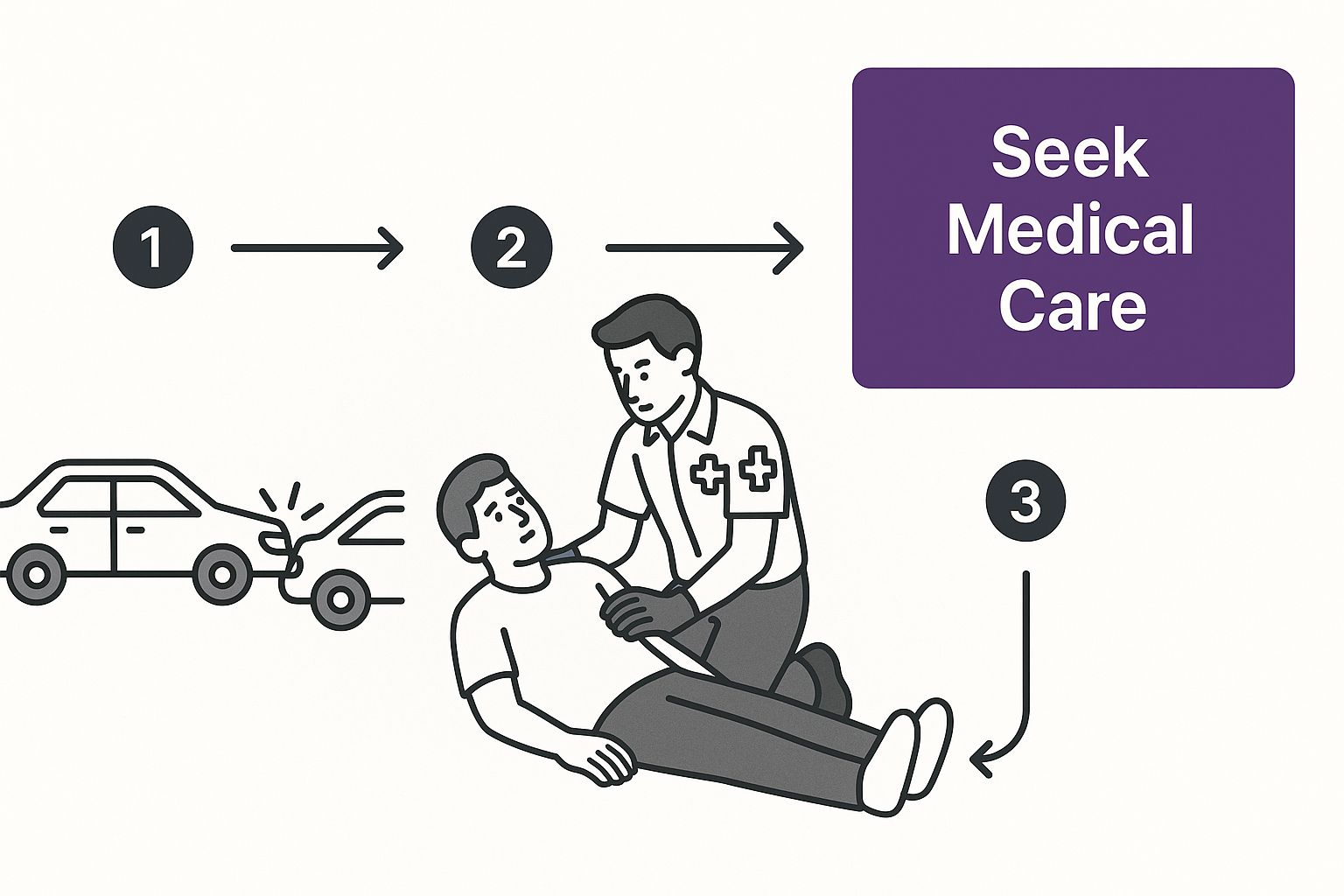
A thorough medical evaluation is the foundation for your recovery and validates any injury claim.
Document Everything at the Scene
While waiting for emergency services, use your smartphone to document the scene. The more detailed your documentation, the smoother the claims process will be.
- Photograph the Vehicles: Take pictures of all involved cars from multiple angles. Capture wide shots showing their positions relative to each other and the road, then take close-ups of all damage, including dents, scratches, and broken parts.
- Capture the Scene: Photograph the broader environment, including traffic signs, skid marks, road conditions, and any debris from the crash.
- Document Your Injuries: If you have any visible cuts, bruises, or scrapes, take clear photos of them immediately.
This collection of images creates a visual record of the event that is difficult to dispute later.
In the confusion after a collision, critical details can be forgotten. Your smartphone is an essential tool for capturing objective evidence. It’s better to take more photos and videos than you think you need; you can always delete extras, but you can’t go back in time to capture a missed shot.
For a quick reference, use this simple checklist at the scene.
Post-Accident Scene Checklist
This table provides a concise guide to the essential actions to take immediately after a car accident. Following these steps helps ensure your safety and protects your rights for insurance and potential legal matters.
| Action | Why It’s Important |
|---|---|
| Move to Safety | Prevents further collisions and keeps you out of harm’s way. |
| Call 911 | Dispatches police for an official report and medical personnel for injuries. |
| Check on Others | Assesses the need for immediate medical aid for all involved. |
| Take Photos & Videos | Creates indisputable visual evidence of damage, injuries, and the scene. |
| Exchange Information | Gathers essential contact and insurance details from the other driver. |
| Don’t Admit Fault | Avoids making statements that could be used against you by insurers. |
| Get Medical Attention | Identifies hidden injuries and officially documents them for your claim. |
This checklist is designed to help you gather facts and protect yourself, both physically and financially.
Exchange Information Carefully
When speaking with the other driver, remain calm and stick to the facts. You will need to exchange the following information:
- Full Name and Contact Information
- Insurance Company and Policy Number
- Driver’s License and License Plate Number
A crucial piece of advice: avoid discussing fault. Do not apologize or make statements like, “I’m so sorry,” as even a polite apology can be misinterpreted by an insurance company and used against you. Let law enforcement and insurance providers determine liability based on the evidence.
Your role at the scene is to gather information, not to assign blame.
Globally, road traffic injuries are the leading cause of death for individuals aged 5 to 29. For your own well-being, seeking prompt medical care is vital. The first 60 minutes after a traumatic injury are often called the ‘golden hour,’ a critical period for improving survival outcomes and preventing long-term disability. You can find more insights about global road safety on the CDC’s website.
Don’t Wait: Get a Medical Evaluation After a Crash
In the immediate aftermath of a car accident, you might feel fine. This is often due to adrenaline. Your body releases this powerful hormone during a traumatic event, which can effectively mask pain and hide the true extent of an injury.
This is why seeing a medical professional right after a collision is so important. Do not be misled by an initial lack of pain. The steps you take for your health in the first few hours can set the stage for your entire recovery.
The Danger of “Walking It Off”
Many common car accident injuries are known for their delayed onset. Conditions like whiplash, concussions, and other soft tissue damage may not present symptoms for hours, days, or even weeks.
Consider this common scenario: You are in a minor fender-bender and walk away feeling a little stiff, but assume it’s nothing serious. You go home, skip seeing a doctor, and try to move on. The next morning, you can’t turn your head, a severe headache is throbbing behind your eyes, and sharp pains are radiating down your arm.
Waiting to see a doctor because you “feel fine” is one of the biggest mistakes you can make. It not only risks your long-term health but can also complicate your insurance claim by creating a gap in your treatment history.
When there is a delay in seeking treatment, the other driver’s insurance adjuster may argue that if you were genuinely hurt in the crash, you would have seen a doctor immediately. Don’t provide them with this opportunity.
Choosing the Right Place for Care
The appropriate place for an evaluation depends on your symptoms and the severity of the accident.
- Emergency Room (ER): For obvious, severe trauma such as broken bones, significant bleeding, or loss of consciousness, go directly to the ER. They are equipped to handle life-threatening issues and provide stabilization.
- Urgent Care Clinic: For injuries that are less severe but still require prompt attention—like deep cuts or a suspected sprain—an urgent care clinic is a good alternative to a crowded ER.
- Primary Care Physician (PCP): If your injuries are not an emergency, scheduling a visit with your family doctor is a wise step. They have your complete medical history and can coordinate your overall care.
- Chiropractor: For musculoskeletal issues like neck pain, back pain, and general stiffness, a chiropractor is a suitable specialist. Chiropractors are trained to diagnose and treat injuries to the spine and soft tissues—the very types of damage that often occur in a car crash.
Often, a combination of care is most effective. The ER may rule out a fracture, but a follow-up visit with a chiropractor can address the underlying spinal misalignments that are causing your pain. If you’re experiencing common neck pain after a collision, learn more about neck pain after an accident in our detailed guide.
Creating Your Medical Paper Trail
When you speak with any healthcare provider, be as detailed as possible. This is not the time to downplay your symptoms.
Describe every ache, pain, or unusual sensation you are feeling. Explain the specifics of the crash—the direction of impact, how your body moved, and whether you hit your head. This information is not just for your treatment plan; it creates a vital medical record that directly links your injuries to the accident. This documentation serves as solid proof for your insurance claim.
The reality is that road traffic injuries are a significant global issue. Each year, approximately 1.19 million people die in crashes, and another 20 to 50 million sustain injuries that can lead to long-term disabilities. These statistics underscore the importance of taking immediate, proactive steps to protect your health.
Your health is your most valuable asset. Protecting it with a prompt medical evaluation is the most important action you can take after a car accident.
Navigating Insurance Claims and Documentation
Managing the volume of insurance paperwork after an injury can feel overwhelming. It is often confusing and stressful, especially when you are in pain. However, by breaking the process down into manageable steps, it becomes much more straightforward.
A methodical approach is your best strategy. It helps prevent you from feeling overwhelmed and assists in building a strong case for the compensation you are entitled to.
Your first action should be to report the accident to your own insurance company. Do not delay this step; aim to do it within 24 hours. Prompt reporting establishes a clear timeline and demonstrates that you are proactive from the beginning.

Your First Call to Your Insurer
When you make the initial call, have your key information ready. Being prepared will make the conversation more efficient and ensure you don’t forget any important details.
Here is a quick checklist of what they will likely ask for:
- Your policy number.
- The date, time, and location of the accident.
- A concise, factual description of what happened.
- The names and insurance details of the other drivers.
- The police report number, if available.
Stick to the facts. This call is for the purpose of opening a claim and initiating the process.
Interacting with the Other Driver’s Insurance
Eventually, you will likely receive a call from an adjuster from the other driver’s insurance company. It is important to remember their role: they work for their company, and their objective is to protect that company’s financial interests by minimizing claim payouts.
This means you must be cautious about what you say. The adjuster may sound friendly and helpful, but the conversation is almost always being recorded.
A common tactic is to request a recorded statement immediately. It is generally in your best interest to politely decline until you have seen a doctor, understand the full extent of your injuries, and are aware of your rights. An innocent comment made while you are still shaken or on pain medication can be easily misinterpreted and used against you later.
When you do speak with them, provide only basic, factual information. Do not speculate on who was at fault, do not go into detail about your injuries, and do not agree to any settlement offers on the spot. Your health condition could change, and a quick settlement offer rarely covers the true cost of long-term care.
The Power of Meticulous Record-Keeping
Organization is a key asset throughout this entire process. From day one, create a dedicated file—either a physical folder or a digital one—and store every single document related to the accident in it. This collection of evidence will support your claim.
You are essentially building the case for your own recovery. Every receipt, note, and bill adds another layer of proof.
- Police Report: Obtain a copy as soon as it is available. It provides an official, third-party account of the incident.
- Medical Records: Keep everything. This includes ER reports, your doctor’s notes, bills from every visit, and notes from any specialists.
- Repair Estimates: Always get more than one estimate for the damage to your vehicle.
- Communication Log: This is very important. Maintain a running log of every call and email with insurance representatives. Note the date, time, the person you spoke with, and a brief summary of the conversation.
This system creates a powerful, undeniable record of what you have experienced.
The economic impact of traffic injuries is substantial, with global costs projected to reach USD 1.8 trillion between 2015 and 2030. This figure includes medical bills, lost wages, and the cost of emergency services. Following the correct procedures for reporting, documentation, and medical care is not just about paperwork—it’s about protecting your health, your legal rights, and your financial future. You can find more details on motor vehicle safety trends at the National Safety Council.
Understanding Chiropractic Care After an Accident
After a car accident, your first stop is often the emergency room, which is the correct course of action for any life-threatening injuries. But what about the persistent pain, stiffness, and headaches that may appear hours or days later?
This is where chiropractic care can be beneficial. ER doctors are skilled at handling emergencies, but they do not typically specialize in the biomechanical spinal injuries that are common in car accidents. The lingering pain you feel often originates from issues that chiropractors treat daily.
The violent force of a crash can push your spine out of its natural alignment. This condition, known as a subluxation, can be a significant source of problems. It can irritate nerves, strain muscles, and initiate a cascade of painful symptoms. The focus of chiropractic care is on correcting these underlying structural issues to address the source of your pain.
How a Collision Impacts Your Spine
Think of your spine as a finely tuned instrument. A car accident can be like a sudden impact, disrupting its delicate balance. The most well-known injury is whiplash, which occurs when your head is violently thrown forward and backward, damaging the ligaments and muscles in your neck.
However, the trauma is not limited to your neck. It can lead to a variety of other issues:
- Misaligned Vertebrae: The individual bones of your spine can be forced out of place, putting direct pressure on sensitive spinal nerves.
- Herniated or Bulging Discs: The soft, gel-like cushions between your vertebrae can be damaged and protrude, causing sharp, radiating pain.
- Soft Tissue Damage: The muscles, tendons, and ligaments that support your spine can be stretched or torn, leading to inflammation and persistent pain.
These are the types of injuries that often have a delayed onset. If left untreated, they can lead to long-term problems such as chronic pain, limited mobility, and persistent headaches.
What to Expect from Chiropractic Treatment
Your first visit will focus on determining the exact nature of your injuries. We will have a detailed conversation about the accident, your symptoms, and how they are affecting your daily life. Following this, a physical examination will be conducted to assess your range of motion, muscle strength, and spinal alignment.
Based on this information, a personalized treatment plan will be developed. The goal is not just to alleviate pain but to restore your body’s proper function so it can heal correctly.
Many people associate chiropractic care solely with “cracking your back,” but it is much more than that. It is a precise approach that uses carefully targeted adjustments to restore proper alignment and relieve pressure on nerves. This is a critical step after an accident to prevent nagging issues from becoming chronic problems.
Your personalized plan may include several different techniques:
- Spinal Adjustments: A gentle, controlled force is applied to misaligned vertebrae to help restore their correct position and movement.
- Therapeutic Exercises: You will be shown specific stretches and strengthening exercises designed to rehabilitate injured tissues and improve stability.
- Advanced Therapies: Sometimes, additional support is needed for healing. We often use treatments like Cold Laser Therapy, which employs specific light wavelengths to reduce inflammation and promote tissue repair at a cellular level. You can read more about the benefits of Cold Laser Therapy in our detailed guide.
By addressing the root structural damage caused by the accident, chiropractic care helps you achieve real, lasting relief. It is about taking an active role in your recovery so you can return to feeling your best.
Your Long-Term Recovery and Final Steps
The immediate chaos of the accident scene and the initial doctor’s visits are behind you. However, recovering from a car accident injury is a process. The next steps are equally important for your long-term health and financial well-being. This phase is about committing to your healing and ensuring you are fully compensated before closing your claim.

True recovery requires patience and consistency. Following the entire treatment plan—whether from a physician, physical therapist, or chiropractor—is essential. If you start missing appointments, an insurance company may interpret this as a sign that your injuries are not serious, which could negatively impact your claim. More importantly, you would be hindering your body’s ability to heal properly.
Stick to Your Treatment Plan
Your healthcare providers have designed a specific recovery plan for your injuries. Adhering to it is the most important thing you can do for yourself right now.
- Attend Every Appointment: Each visit builds upon the previous one. Consistent care, such as regular chiropractic adjustments, is crucial for restoring your body’s proper alignment and function.
- Do Your At-Home Exercises: If you are given exercises or advised to modify certain activities, follow these instructions. They are prescribed to support your in-office treatments and accelerate your recovery.
- Communicate with Your Provider: Be open about how you are feeling. If a particular therapy is not helping or your pain is changing, let them know. Your plan can be adjusted to better meet your needs.
Consistent adherence to your plan helps you reach what is known as Maximum Medical Improvement (MMI). This is the point at which your condition has stabilized and is not expected to improve significantly further. It is a major milestone for both your recovery and your insurance claim.
Keep a Detailed Expense Log
As you undergo treatment, costs can accumulate quickly. It is vital to track every single expense related to the accident. This documentation serves as proof when seeking full reimbursement.
Use a spreadsheet or a dedicated notebook to log everything. Do not rely on memory.
Think beyond the major medical bills. Your claim should cover every dollar you have had to spend because of this accident. This includes smaller items like mileage to and from appointments, prescription co-pays, and the cost of a heating pad or neck brace. These details provide a complete picture of the financial impact you have experienced.
Your log should include items such as:
- Medical Co-pays and Bills: Note the date, provider, and amount paid.
- Prescription Costs: Keep all receipts.
- Mileage: Track the round-trip distance for every appointment.
- Lost Wages: Document any time you had to miss from work.
Understanding the Settlement Process
Here is a critical piece of advice: do not accept a final settlement offer until you have completed all of your medical treatments.
Insurance adjusters often push for a quick settlement. Their initial offers are typically low and do not account for the true long-term costs of your injuries. Once you accept an offer, you waive your right to seek further compensation, even if your condition worsens or you discover you need additional care later.
Your health must come first. By waiting until you have reached MMI, you and your doctors will have a clear understanding of your future medical needs. This ensures that any settlement you accept is fair and covers all your losses. As you focus on wellness, it is also beneficial to start rebuilding your strength. You can learn more by exploring some of the best back strengthening exercises to support your recovery.
Common Questions After a Car Accident Injury
After a crash, it is normal to have many questions and feel stressed. Getting clear answers is key to making informed decisions for your health and any potential claim.
Let’s address some of the most common concerns.
How Long Do I Have to File an Insurance Claim?
It is always advisable to report the accident to your own insurance company as soon as possible, ideally within 24 hours.
State laws, known as statutes of limitations, provide a longer period, often one to three years, to file a formal personal injury lawsuit. However, this should not be confused with the initial insurance report. Delaying notification to the insurance company can create complications. They may question the reason for the delay, making it more difficult to prove that your injuries are a direct result of the crash.
What if My Symptoms Show Up Days Later?
This is a common occurrence. The shock and adrenaline after an accident can effectively mask pain. It is not unusual to feel relatively fine immediately after, only to wake up the next day with a stiff neck, a severe headache, or dizziness.
If you begin to experience symptoms, even minor ones, seek a medical evaluation immediately. Make it clear to the doctor that you were recently in a car accident. This creates an official medical record linking your pain to the crash, which is crucial for your insurance claim.
Should I Accept the First Settlement Offer From Insurance?
Accepting the first offer is generally not recommended. Insurance adjusters are trained negotiators whose goal is to resolve your claim for the lowest possible amount. Their initial offer should be considered a starting point.
An early offer cannot account for the full scope of your situation, including future medical treatments, potential lost wages, and the impact of your pain and suffering. It is best to wait until you have completed your medical care or have a clear prognosis from your doctor before considering a settlement.
Do I Need a Chiropractor if I Already Went to the ER?
Yes, even if the emergency room cleared you of major injuries, a visit to a chiropractor is a valuable next step. The ER’s primary function is triage—to identify and treat life-threatening conditions like broken bones or internal bleeding.
Chiropractors, on the other hand, specialize in the musculoskeletal injuries of the spine and soft tissues that are common in car accidents. These include:
- Whiplash
- Spinal misalignments (subluxations)
- Soft tissue damage to the muscles and ligaments supporting your spine
These are the types of injuries that an ER may not focus on but can lead to chronic pain, stiffness, and headaches if left unaddressed. Chiropractic care focuses on correcting the underlying structural problem to promote proper healing and prevent long-term issues.
Don’t let pain from a car accident disrupt your life. The dedicated team at Audubon Park Chiropractic in Spokane is here to provide the care and guidance you need to recover. To start your journey to healing, call us today at (509) 327-4049 or simply walk in for a comprehensive evaluation. We are ready to help you get back on your feet.
Ready to Feel Better?
Our Spokane chiropractors are ready to help. Walk-ins welcome — no appointment needed.

Dr. Michelle Snyder is a Spokane chiropractor with advanced training in women’s health, hormone balancing, pregnancy, and care for infants and children. She uses gentle low-force spinal adjustments alongside specialized therapies including Webster’s breech technique, allergy desensitization, cold laser therapy, EB cellular cleanse, and Methylation/genetic nutrition — offering patients a comprehensive, whole-body approach to wellness.
A Spokane resident for over 31 years, Dr. Michelle is deeply committed to her community, contributing time and resources to organizations including Meals-on-Wheels, Second Harvest, Ronald McDonald House, and the Union Gospel Mission.
📍 2909 W. Northwest Blvd, Spokane, WA 99205 | ☎ (509) 327-4049 audubonparkchiropractic.com
Further Reading: Accidents
- How to Treat Whiplash at Home: A Practical Guide
- Understanding Whiplash: A Comprehensive Guide to Symptoms and Treatment
- Why You Need a Chiropractor After a Car Accident
- Your Guide to Auto Accident Injury Treatment
- Neck Pain After an Accident: A Guide to Causes, Symptoms, and Effective Relief
→ Complete Guide: Auto Accident Injury Treatment in Spokane, WA