

This post is part of our complete guide to Back Pain Treatment in Spokane, WA. Browse the guide for more in-depth information on treatments, exercises, and recovery strategies.
What is a spinal subluxation? It's a key concept in chiropractic care that describes a misalignment or dysfunction in the vertebrae of your spine.
Imagine your nervous system as your body’s communication superhighway. When a vertebra shifts slightly out of its proper position, it can put pressure on a nerve, creating interference—much like static on a phone line. This disruption doesn't just stay in your back; it can interfere with the critical signals traveling between your brain and the rest of your body, potentially leading to pain, stiffness, and other health issues.
Understanding Spinal Subluxation and Its Impact
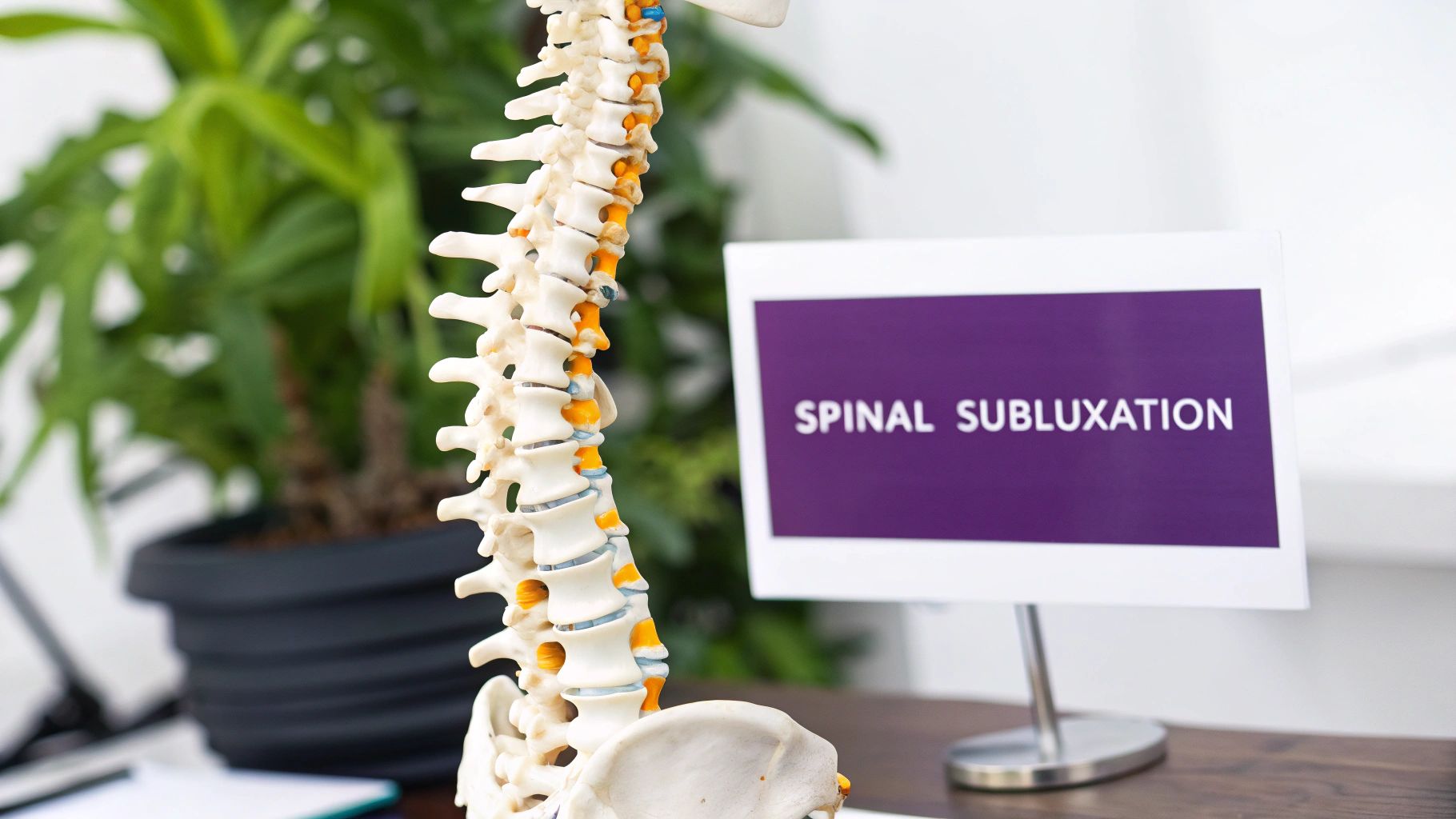
Let's expand on the highway analogy. Picture your spine as a perfectly organized highway, with each vertebra acting as a section of the road. The traffic flowing along this highway is your nervous system, carrying vital messages from your brain to every part of your body. When everything is aligned, the communication flows smoothly.
A subluxation acts like a roadblock or a sudden traffic jam. A vertebra shifts out of its proper position, creating pressure or irritation on the surrounding nerves. This doesn't just cause a local problem; it interferes with the entire communication network, slowing everything down.
This nerve interference is the core of the issue. When those signals can't get through clearly, the body's natural ability to function, regulate itself, and heal can be compromised. This can manifest in ways you might not immediately connect to a spinal problem.
More Than Just a Bone Out of Place
A common misconception is that a subluxation is simply a "bone out of place." It is actually a more complex condition that affects the entire system, including nerves, muscles, and the soft tissues that hold everything together.
When we identify a subluxation, we are observing several key things happening at once. To make it clearer, here’s a breakdown of what a subluxation involves.
Key Components of Spinal Subluxation
| Component | Simple Explanation |
|---|---|
| Misaligned Vertebra | A bone in the spine has lost its normal position or isn't moving correctly. |
| Nerve Interference | The out-of-place bone is pressing on or irritating the nearby spinal nerves. |
| Muscle Imbalance | To compensate, muscles might tighten up, spasm, or even become weak. |
| Inflammation | The tissues around the area can get swollen, tender, and painful. |
As you can see, these components work together to create a state of dysfunction.
The concept of spinal subluxation is central to chiropractic. The focus is on how these vertebral issues affect the nervous system and, in turn, overall health. It is also more common than many people think. A secondary analysis of clinical data from 1,851 people across the U.S. found that 78.55% had a vertebral subluxation. You can review the details of these findings to see just how widespread this can be.
A spinal subluxation isn't just a structural problem; it's a functional one. It represents a breakdown in communication between the brain and the body, preventing you from functioning at your best.
Correcting these misalignments is about more than just alleviating back pain. It’s about restoring your body's natural ability to heal and maintain wellness by clearing the pathways of the nervous system.
If you suspect you might be dealing with symptoms of a spinal subluxation, it's advisable not to wait for it to get worse. For a complete assessment and personalized care, contact Audubon Park Chiropractic.
Don’t wait — relief is closer than you think.
The Hidden Causes of Spinal Misalignment
A spinal subluxation rarely appears out of nowhere. More often, it is the cumulative result of various stressors your body endures daily. Your spine's proper alignment is a delicate balance. When life’s stressors become too much for your body to handle, that balance can be thrown off, leading to misalignment.
These triggers typically fall into three main categories. Understanding them makes it easier to connect your daily habits to your spinal health, shedding light on why you might be feeling pain or discomfort. By identifying these root causes, you can begin to take more control over your health.
The Impact of Physical Stress
When most people think about the causes of spinal problems, they immediately picture significant, traumatic accidents. These are indeed major culprits.
A sudden jolt from a car accident, a slip and fall on an icy sidewalk, or a hard hit during a sports game can easily knock vertebrae out of place. These are known as macrotraumas—single, major events that can overwhelm the body's structure.
However, physical stress is not always so dramatic. It is far more common for the damage to result from small, repetitive strains that accumulate over time. These are known as microtraumas, and they can be just as damaging in the long run.
- Poor Posture: Hours spent hunched over a computer, craning your neck down to look at your phone, or slumping on the couch can slowly pull your spine out of its natural curve. You can learn more about how posture can cause significant problems in our detailed guide.
- Repetitive Motions: Activities you might not think about, like lifting heavy boxes with poor form, always carrying a heavy bag on the same shoulder, or even sleeping in an awkward position night after night, all contribute to chronic misalignment.
- Birth Process: The process of being born can be a significant physical stressor, placing a surprising amount of strain on a baby's delicate neck and spine.
These subtle but constant stressors gradually weaken the muscles and ligaments that support your spine, leaving it more vulnerable to subluxation.
The Role of Emotional Stress
Your mental and emotional state has a very real and powerful effect on your physical body. When you are dealing with stress, anxiety, or anger, your body's natural reaction is to enter "fight or flight" mode. This triggers a chain reaction of physical changes, and one of the first is muscle tightening.
Consider how your body feels after a highly stressful day. Your shoulders might be raised toward your ears, your jaw clenched, and the muscles in your neck and back feel tense. This is not just a feeling; it’s a physical response.
When emotional stress becomes a chronic, everyday experience, the muscles around your spine can remain in a constant state of tension. This relentless tightness can literally pull vertebrae out of their proper alignment, causing a spinal subluxation.
This can initiate a frustrating cycle. Emotional stress causes physical tension and misalignment. Then, the pain and discomfort from that subluxation add more fuel to your emotional stress. It's a feedback loop that can be difficult to break without addressing both the physical and emotional aspects of the problem.
How Chemical Stress Affects Your Spine
The third piece of the puzzle is chemical stress. This relates to what you put into your body, from the food you eat to the environment you live in. When your body's chemistry is out of balance, it can create an internal environment conducive to inflammation and muscle problems.
Some of the main sources of chemical stress include:
- Poor Nutrition: A diet high in processed foods, sugar, and unhealthy fats can lead to system-wide inflammation. This inflammation can affect all your joints and muscles, including those that support your spine.
- Dehydration: The discs in your spine are mostly composed of water. If you are not drinking enough, they can lose height and become less flexible, which puts more stress on the vertebrae.
- Environmental Toxins: Exposure to everyday pollutants, chemicals, and even some medications can disrupt your body's natural systems, leading to inflammation and weaker muscles.
These chemical stressors make it harder for your body to maintain healthy tissues, leaving your spine less stable and more likely to develop a subluxation. Paying attention to what goes into your body is a critical part of maintaining a healthy spine for the long term.
Recognizing The Warning Signs And Symptoms
How can you tell if you have a spinal subluxation? Sometimes your body sends a clear signal, like a sudden, sharp pain. Other times, the signs are more subtle and easy to dismiss. Learning to listen to your body is the first step toward understanding what is really going on.
The symptoms of a spinal subluxation depend on its location. A misalignment in your neck will feel completely different from one in your lower back. Sometimes the pain is at the source, but often, it can appear in unexpected places.
This is because your nervous system is an incredibly complex network, connecting your brain to every muscle, organ, and cell in your body. When there's a disruption in one spot, it can create a ripple effect, causing a host of problems you might not immediately connect to your spine.
Direct And Obvious Symptoms
The most common signs—the ones that usually prompt people to seek help—are localized pain and stiffness. They are hard to ignore because they interfere with daily life.
- Persistent Neck Pain: This could be a dull, constant ache or a sharp, stabbing feeling. You might find it difficult to turn your head, and your shoulders may feel perpetually tight.
- Chronic Lower Back Ache: A nagging pain in your lower back that worsens after sitting or standing for a while is a classic sign. It can range from a dull throb to pain so intense it’s hard to move.
- Tension Headaches or Migraines: A surprising number of headaches originate in the neck. When a cervical subluxation irritates the nerves, it can send pain signals radiating up the back of your skull, into your temples, and even behind your eyes.
- Limited Range of Motion: You might notice you can’t bend over, twist, or reach for things as easily as you used to. This stiffness can make simple tasks, like tying your shoes, feel like a real chore.
Indirect Symptoms And Nerve Interference
Beyond the more obvious aches and pains, nerve interference can cause symptoms that are less direct but just as important. These are often the "mystery" symptoms people live with for years without getting to the bottom of them.
When a nerve is pinched or irritated, it cannot send its messages properly. This can lead to all sorts of strange sensations and functional issues.
Think of it like a garden hose with a kink in it. The water can't flow freely to the flowers at the end. In the same way, when a subluxation pinches a nerve, the vital communication from the brain can't properly reach the parts of the body that nerve is trying to talk to.
This infographic breaks down how different stressors—physical, emotional, and chemical—can all contribute to creating a subluxation.
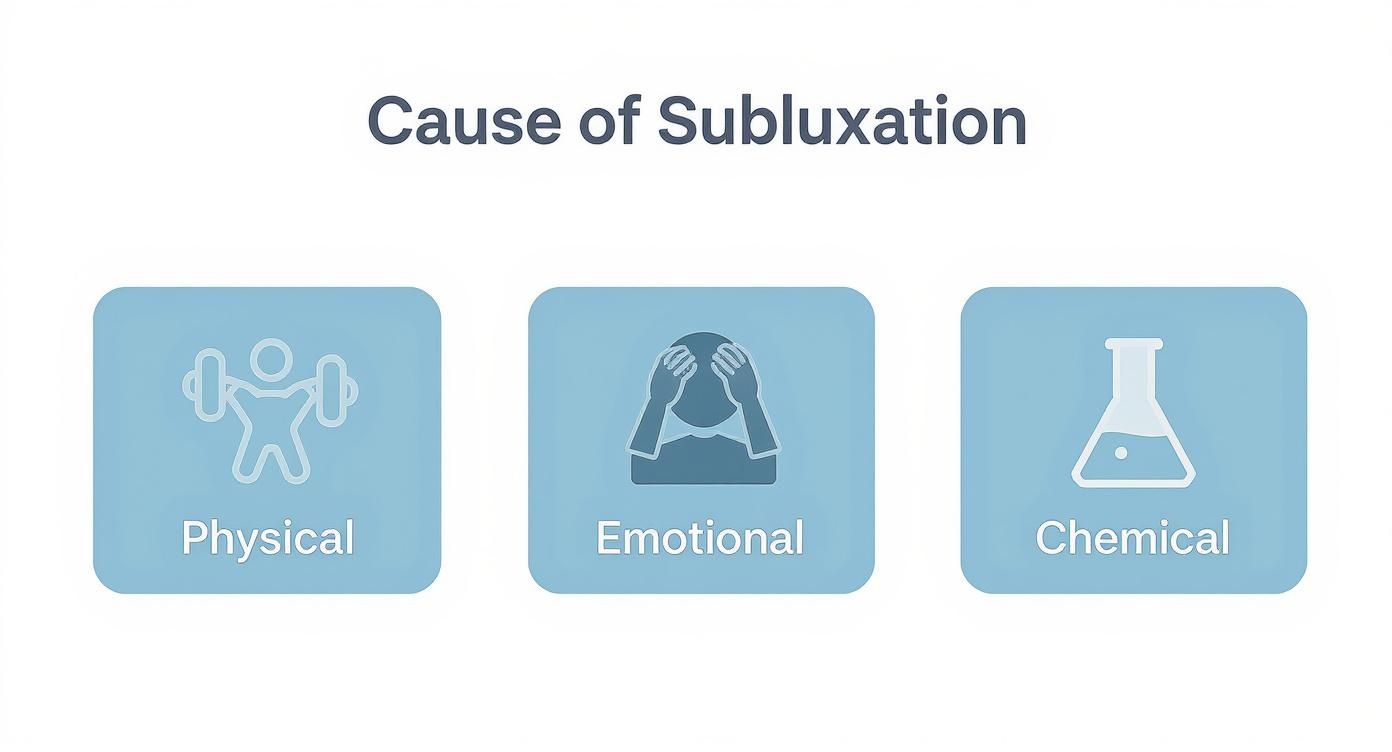
When you understand these root causes, it's a lot easier to see how everyday life can throw your spine out of alignment and impact your overall health.
This nerve interference can show up in several ways:
- Radiating Pain: The classic example is sciatica, where pain shoots from the lower back down the leg. A subluxation in the neck can cause a similar kind of radiating pain or tingling down an arm.
- Numbness or Tingling: A "pins and needles" feeling in your hands, feet, or limbs is a tell-tale sign that nerve signals are being disrupted.
- Unexplained Fatigue: When your body is constantly fighting nerve interference and muscle imbalances, it burns a ton of extra energy. This can leave you feeling completely drained and chronically tired.
- Digestive Issues: The nerves in your mid-to-lower back play a big role in how your digestive system functions. Interference in this area can sometimes contribute to things like indigestion or constipation.
To help you connect the dots, here’s a quick checklist of common symptoms and where they might originate.
Symptom Checklist Is It Spinal Subluxation
| Symptom | Commonly Associated Spinal Region | What It Might Feel Like |
|---|---|---|
| Headaches/Migraines | Cervical Spine (Neck) | A dull ache at the base of the skull, pressure behind the eyes, or throbbing pain. |
| Neck & Shoulder Pain | Cervical Spine (Neck) | Stiffness, sharp pain when turning your head, or a deep ache across the shoulders. |
| Tingling in Arms/Hands | Cervical/Upper Thoracic Spine | "Pins and needles" sensation, numbness, or a feeling of your arm "falling asleep." |
| Mid-Back Pain | Thoracic Spine (Mid-Back) | A dull, burning, or sharp pain between the shoulder blades, often worse with long periods of sitting. |
| Lower Back Pain | Lumbar Spine (Lower Back) | A constant ache or sharp pain that can worsen with bending, lifting, or standing. |
| Sciatica | Lumbar/Sacral Spine | Sharp, shooting pain that travels from your lower back, through your buttock, and down your leg. |
| Hip or Groin Pain | Lumbar/Sacral Spine | A deep ache in the hip joint or pain in the groin area that's hard to pinpoint. |
| Numbness in Legs/Feet | Lumbar Spine (Lower Back) | A tingling or numb sensation, similar to the feeling in the hands/arms. |
This checklist is not a substitute for a professional diagnosis, but it can give you a better idea of what your body might be trying to tell you.
While a subluxation is very different from a major spinal cord injury (SCI), it underscores the importance of overall spine health. The global impact of spinal injuries is significant and growing. In 2019, there were an estimated 9 million cases of spinal cord injuries worldwide—a 52.7% jump since 1990. These numbers highlight why it's crucial to pay attention to all aspects of our spinal health.
Something as simple as your sleep posture can make a huge difference. Persistent neck pain is often linked to spinal misalignment, and finding the best memory foam pillows for side sleepers can sometimes provide relief. If these symptoms are hitting close to home, a professional evaluation is the best way to get real clarity.
Don't ignore these warning signs. If any of this sounds familiar, contact us for an assessment.
How Spinal Subluxation Is Professionally Diagnosed
Determining if you have a spinal subluxation isn’t a guessing game. A proper diagnosis is a careful, methodical process that combines your personal health story with skilled, hands-on evaluations. This approach ensures that the care you receive is precisely what your body needs.
The objective is to understand not just where you hurt, but why. By looking at the complete picture, a chiropractor can identify the exact location of any nerve interference, which is the first step toward effective treatment. Let's walk through what you can expect during a thorough chiropractic evaluation.
The Initial Consultation and Health History
The first and most important step is a good conversation. Your chiropractor will want to know about your health history, current symptoms, and lifestyle. This isn't just small talk; it's a critical part of the diagnostic puzzle that helps connect your daily habits to how you're feeling right now.
We will discuss things like old injuries, ongoing stress, and any specific pain or discomfort you're experiencing. This background information provides valuable context, often revealing patterns that point directly to a spinal subluxation. The more specific you can be, the better—every detail helps build a clearer picture.
Orthopedic and Neurological Testing
After we’ve talked, the next phase involves a series of physical tests designed to assess how well your body is functioning, especially your nervous system and musculoskeletal structure. These tests are non-invasive and help us find objective evidence of a subluxation.
These evaluations typically include:
- Range of Motion Tests: We will guide you through specific movements to see how far you can comfortably turn, bend, and flex. Limited movement is a significant clue that a joint is restricted.
- Neurological Checks: These are simple tests to check your reflexes, muscle strength, and sensation in different parts of your body. They help us determine if nerve signals are getting through properly.
- Postural Analysis: Your posture provides a visual map of your spinal alignment. A chiropractor can spot subtle imbalances, like an uneven shoulder or forward head posture, that suggest underlying issues.
These tests give us real, measurable data on your spinal health, taking us beyond symptoms to find the root of the problem.
The Power of Palpation
Palpation is a cornerstone of chiropractic diagnosis. This is where a chiropractor uses their highly trained sense of touch to physically examine your spine. By skillfully feeling each vertebra, they can detect subtle misalignments, swelling, muscle tightness, and tender spots you might not even know you have.
Palpation is much more than just pressing on your back. It's a refined skill that allows a practitioner to "read" the spine, identifying specific vertebrae that aren't moving the way they should be.
This hands-on approach provides immediate feedback about the condition of your spinal joints and the surrounding tissues. It helps confirm findings from the other tests and pinpoints the exact areas that need attention.
Using Imaging for a Clearer View
While not always necessary, imaging studies like X-rays can offer an invaluable look inside your body. An X-ray shows the exact position of your vertebrae, the health of your spinal discs, and any signs of degeneration or long-term structural changes. This visual evidence helps confirm a subluxation diagnosis with a high degree of certainty.
In more complex cases, advanced techniques like MRI 3D image creation and AI-powered analysis can provide incredibly detailed insights into the spine's soft tissues and neural structures. These tools give us a comprehensive view that helps guide the most effective treatment plan.
By combining your health history, physical tests, hands-on palpation, and targeted imaging, a chiropractor can accurately diagnose a spinal subluxation. This complete and careful approach ensures your care is safe, effective, and addresses the true source of your discomfort.
If you are experiencing symptoms that suggest a spinal issue, a professional diagnosis is the first step toward relief.
Chiropractic Adjustments and Treatment Methods

Once a spinal subluxation has been identified, the next step is to restore proper movement. Our primary method for this is the chiropractic adjustment, a specific procedure designed to restore healthy function to your spine and, by extension, your nervous system.
An adjustment can be thought of as a highly skilled and controlled force applied to a vertebra that is not moving as it should. The goal is to gently guide that bone back toward its proper motion and position, taking pressure off the nearby nerves. This helps to clear up the "static" in your body's internal communication network.
The Goals of a Chiropractic Adjustment
The purpose of an adjustment is much more than just moving a bone. It is about rebooting your body's natural ability to heal and function at its peak.
Here’s what we aim to achieve:
- Relieve Nerve Pressure: By correcting the misalignment, we can remove the physical irritation on crucial spinal nerves.
- Reduce Pain and Inflammation: When joints move properly, it helps calm inflamed tissues and reduces pain signals.
- Improve Range of Motion: A well-aligned spine means more flexibility and less stiffness during your daily activities.
- Optimize Body Function: With clear nerve pathways, your brain can communicate more effectively with every organ and tissue, supporting your overall health.
This concept is at the heart of chiropractic. In the United States, it is a foundational part of chiropractic education. A review of 46 chiropractic programs found that 88% of U.S. colleges featured the term "subluxation" in their course catalogs, with mentions actually increasing between 2011 and 2017.
A chiropractic adjustment is a precise technique focused on restoring motion and alignment. It's not about forcing anything, but rather working with the body to correct the underlying cause of the problem.
What Is That Popping Sound?
One of the first questions people ask is about the "pop" or "crack" they sometimes hear during an adjustment. This is a completely normal and harmless process called cavitation.
Your spinal joints are lubricated by a special fluid that contains dissolved gases, similar to a can of soda. When we gently stretch the joint during an adjustment, the pressure inside changes, causing those gas bubbles to be released. That is the popping sound you hear.
It is simply a sign that the joint has moved and pressure has been released. Whether you hear a pop or not has no bearing on the effectiveness of the adjustment. If you want to dive deeper into the mechanics, you can discover more about what a chiropractic adjustment involves right here on our blog.
A Complete Picture of Care
While adjustments are the cornerstone of care for subluxations, an effective plan often includes more. Supportive therapies are also used to help stabilize your spine and prevent the problem from recurring.
A well-rounded treatment plan might look something like this:
- Targeted Exercises and Stretches: We will provide specific movements to strengthen weak muscles and improve flexibility where you're tight.
- Lifestyle Recommendations: Simple guidance on your posture, desk setup, sleep positions, and other daily habits can make a significant difference.
- Nutritional Advice: We might offer suggestions to help reduce inflammation naturally and support the health of your muscles, joints, and nerves.
By combining precise adjustments with these supportive strategies, we address the spinal subluxation from all angles. This approach not only helps you get out of pain now but also empowers you with the tools to maintain a healthy spine for years to come.
If you think a spinal subluxation might be the root of your discomfort, a professional adjustment could be the solution.
Got Questions About Spinal Subluxation? We've Got Answers.
When you start digging into spinal health, it's natural for a lot of questions to pop up. If you're wondering what a spinal subluxation really is and what it takes to get better, you're definitely not alone. Getting straight answers is the first step toward feeling confident and making smart choices for your health.
Let's tackle some of the most common questions people have when they first hear about chiropractic care and subluxations.
Can a Subluxation Fix Itself?
Many of us hope a nagging ache will just disappear on its own. While our bodies are amazing at adapting, a true spinal subluxation involves a structural shift that almost never fully corrects itself without help.
Think of it like a car with a misaligned wheel. You can still drive it, but you'll notice the tire wearing down unevenly, and you'll constantly be fighting the wheel to stay straight. Your body does something similar—it might tighten muscles around a misaligned vertebra to maintain stability, but that's just a temporary patch. Over time, this can lead to chronic stiffness, pain, and other problems.
A professional adjustment does more than just soothe the symptoms; it gets to the root of the structural problem. A chiropractor is trained to find the exact source of the misalignment and use a specific force to bring back proper motion. This allows your nervous system to get back to work without any interference.
Are Chiropractic Adjustments Safe?
This is a significant question, and it's a great one to ask. When performed by a licensed Doctor of Chiropractic, adjustments have an incredible safety record. Chiropractors undergo years of intense training, focusing heavily on anatomy, neurology, and diagnostics to ensure the care they provide is both safe and effective.
The education is incredibly demanding, on par with medical school in terms of classroom hours, but with a deep focus on the body's musculoskeletal system. This ensures every adjustment is delivered with precision. The techniques are always adapted to the person on the table—from the gentle touch used for an infant to the specific methods needed for an adult.
How Long Will It Take to See Results?
This is a personal question. There's no single timeline for healing, because your recovery journey is as unique as you are.
How quickly you feel better depends on a few factors:
- How long has it been there? A recent, minor misalignment usually responds much faster than a chronic issue that's been around for years.
- What's your overall health like? Factors like your diet, stress levels, and how active you are play a huge part in how fast your body can heal.
- Are you sticking with the plan? Following your recommended care plan is key to building momentum and getting results that last.
Some people feel relief right after their first adjustment. For others, it’s a more gradual process as we retrain the spine and nervous system. Our goal isn't just to get you out of pain—it's to stabilize your spine so you can enjoy better health for the long haul.
If you have more questions or you’re ready to find out what’s going on, our team is here to help.
Take the Next Step Toward Spinal Health
Living with discomfort and feeling like you can't move the way you used to doesn't have to be your new normal. Just by reading this far, you've taken a powerful first step: understanding what a spinal subluxation is and how it might be affecting your body. Now, it’s time to take action.
If you’ve been nodding along, recognizing the symptoms we’ve talked about, a professional evaluation is the best way to get some real clarity and, more importantly, relief. Don't just wait for that nagging ache to become a constant presence in your life. Addressing the root cause now means you're not just covering up symptoms—you're getting on the path to genuine, long-term wellness.
Your Path to a Healthier Spine
Finding the right person to guide you on this journey is crucial. You need a professional who really listens and develops a care plan that’s built just for you. If you need some help with that, our article on how to choose a chiropractor offers some great, practical tips to help you feel confident in your decision. Taking a proactive approach isn't just a good idea; it can truly change your quality of life.
Your body has an incredible capacity to heal and function at its best—but only when your nervous system is free from interference. Addressing a spinal subluxation is all about unlocking that potential.
Every day you put it off is another day you might be living with unnecessary pain and limitations. The journey to better spinal health, improved mobility, and a greater sense of well-being starts with a simple first step. You can start feeling your best right now.
If you are experiencing symptoms or are ready to take control of your spinal health, don't wait. Contact Audubon Park Chiropractic today to schedule your comprehensive evaluation. Call us at (509) 327-4049 or feel free to walk in for treatment. Your path to relief and better health starts now.
Ready to Feel Better?
Our Spokane chiropractors are ready to help. Walk-ins welcome — no appointment needed.

Dr. Michelle Snyder is a Spokane chiropractor with advanced training in women’s health, hormone balancing, pregnancy, and care for infants and children. She uses gentle low-force spinal adjustments alongside specialized therapies including Webster’s breech technique, allergy desensitization, cold laser therapy, EB cellular cleanse, and Methylation/genetic nutrition — offering patients a comprehensive, whole-body approach to wellness.
A Spokane resident for over 31 years, Dr. Michelle is deeply committed to her community, contributing time and resources to organizations including Meals-on-Wheels, Second Harvest, Ronald McDonald House, and the Union Gospel Mission.
📍 2909 W. Northwest Blvd, Spokane, WA 99205 | ☎ (509) 327-4049 audubonparkchiropractic.com
Further Reading: Back
- Back Pain, Sciatica, and Headaches: When Chiropractic Helps — And When It Doesn’t
- Chiropractic Without the Commitment: What No Long-Term Contracts Actually Means for Your Care
- What causes sciatic nerve pain: Symptoms and relief
- NW Spokane’s Neighborhood Chiropractor: Why Location, Parking, and Knowing Your Doctor Actually Matter
- Why Some People Are Afraid of the Chiropractor & And What We Do Differently