

This post is part of our complete guide to Back Pain Treatment in Spokane, WA. Browse the guide for more in-depth information on treatments, exercises, and recovery strategies.
It's a common misconception, but sciatica isn't a condition on its own. Instead, think of it as a smoke signal—it’s a symptom pointing to a bigger issue that’s irritating your sciatic nerve. The most frequent culprit, by a long shot, is a lumbar herniated disc. This is when a disc in your lower back bulges out and puts direct pressure on the nerve roots, kicking off that all-too-familiar pain that travels down your leg.
Understanding the Source of Sciatic Nerve Pain
To really get what’s happening with sciatic nerve pain, it helps to picture the sciatic nerve itself. It's the longest and widest nerve in your entire body, sort of like a major electrical highway. It starts from a bundle of nerve roots in your lower back (the lumbar spine), then runs down through your buttocks and along the back of each leg.
Pain flares up when this nerve "highway" gets pinched, squeezed, or inflamed anywhere along its route. That sensation—whether it's a sharp jolt, a burning feeling, a pins-and-needles tingle, or a deep, dull ache—is simply the nerve sending distress signals up to your brain. It's the symptom, not the source of the problem.
The real issue is whatever is putting that pressure on the nerve. And while a few different things can be to blame, the problem usually starts right where the nerve begins: in your lower spine.

The Most Common Cause: A Herniated Disc
A herniated disc—sometimes called a slipped or ruptured disc—is the number one reason people experience sciatica. Your spinal discs are the cushiony shock absorbers sitting between your vertebrae. When the tough outer shell of a disc gets weak or tears, the soft, gel-like stuff inside can bulge out, pressing directly on the sciatic nerve root right next to it.
This one issue is incredibly common. In fact, lumbar disc herniation is the culprit in approximately 90% of all sciatica cases worldwide. It’s most often seen in adults between 30 and 50 years old, and some studies suggest that up to 40% of people may deal with it at some point in their lives. You can learn more about the prevalence and causes of sciatica from this detailed study.
To give you a clearer picture, here’s a quick breakdown of the most common sciatica triggers.
Quick Overview of Common Sciatica Causes
| Cause | What It Is | How It Causes Pain |
|---|---|---|
| Herniated Disc | The soft center of a spinal disc pushes through a tear in the outer layer. | The bulging disc material directly presses on or inflames the sciatic nerve root. |
| Spinal Stenosis | A narrowing of the spinal canal, where the spinal cord and nerves live. | The reduced space squeezes the nerve roots, leading to irritation and pain. |
| Spondylolisthesis | A condition where one vertebra slips forward over the one beneath it. | The slipped vertebra can pinch or compress the nerve root as it exits the spine. |
| Piriformis Syndrome | Spasms or tightness in the piriformis muscle, located deep in the buttock. | The tight muscle can irritate or squeeze the sciatic nerve, which runs right under it. |
While a herniated disc is the usual suspect, it’s not the only story.
Other Potential Triggers
Other conditions can also create sciatic nerve pain by putting pressure on the nerve in different ways. Some of these include:
- Spinal Stenosis: This is essentially a narrowing of the channel your spinal cord runs through, leaving less room for the nerves.
- Spondylolisthesis: This happens when one of your vertebrae slips out of place and slides over the one below it, which can easily pinch the nerve roots.
- Piriformis Syndrome: Sometimes the problem isn't in your spine at all. The piriformis is a small muscle deep in your glutes, and if it gets tight or spasms, it can clamp down on the sciatic nerve that runs right underneath it.
Realizing that sciatica is a symptom of one of these underlying mechanical issues is the first and most important step toward finding relief that actually lasts.
Don’t wait — relief is closer than you think.
What’s Actually Causing My Sciatic Nerve Pain?
To really get to the bottom of sciatica, we need to look at what’s happening in your lower back. Most of the time, it’s a simple case of mechanics—something is physically pressing on or irritating the sciatic nerve roots right where they leave the spine. While a few different things can cause this, a handful of culprits are responsible for that all-too-familiar, radiating pain.
The #1 Cause: A Herniated Disc
By far, the most common reason people get sciatica is a lumbar herniated disc. This is behind the vast majority of cases, and it’s helpful to know how it works.
Picture the discs between your vertebrae as little jelly donuts. They have a tough, fibrous outside and a soft, gel-like center that acts as a shock absorber. This setup gives your spine the cushioning it needs to bend and twist without any trouble.
A herniation happens when a weak spot or tear develops in that tough outer layer, letting some of the inner “jelly” squeeze out. The problem is, the sciatic nerve roots are positioned directly behind these discs. When that disc material bulges out, it can press right up against those sensitive nerves. That direct compression is what sets off the pain, inflammation, and other symptoms we call sciatica. It’s a physical traffic jam between the displaced disc and the nerve.
To dig deeper into this, you can learn more about what causes disc herniation and how it can impact your overall spinal health.
When the Spinal Canal Gets Too Narrow: Spinal Stenosis
Another major cause is something called spinal stenosis. Imagine your sciatic nerve roots traveling through a tunnel made of bone inside your spine. Stenosis is what happens when that tunnel, called the spinal canal, starts to narrow over time. This leaves less and less space for the nerves, putting them in a tight squeeze.
So what makes this tunnel shrink? It’s usually a combination of things that happen as we age:
- Bone Spurs: Age-related changes can cause little overgrowths of bone that push into the canal.
- Thickened Ligaments: The tough ligaments that hold your spine together can get thicker and start to bulge inward.
- Degenerative Disc Disease: As discs wear down and lose height, they can bulge out into the space meant for your nerves.
This gradual narrowing slowly cranks up the pressure on the nerve roots, which is why sciatica from stenosis often comes on slowly. Unlike the sudden jolt of pain you might feel from a herniated disc, stenosis-related sciatica can build up over months or even years.
When a Vertebra Slips Out of Place: Spondylolisthesis
A less frequent but still important cause of sciatic pain is spondylolisthesis. This happens when one of your lower back vertebrae slips forward over the one just below it. That shift throws off the spine's alignment and can directly pinch the nerves nearby.
When a vertebra slides forward, it can narrow the opening where the nerve root exits the spine. That pinching action is what triggers those classic sciatica symptoms. This slip can happen for different reasons, from a stress fracture in the bone (which we sometimes see in young athletes) to the degenerative changes that come with getting older.
The big picture here is that these main causes—herniated discs, stenosis, and spondylolisthesis—are all structural problems. They cause sciatica by physically squishing or aggravating the sciatic nerve roots in your low back. That’s why a real solution has to fix the underlying mechanical issue, not just mask the pain.
Once you can visualize how each of these conditions puts pressure on the nerve, it all starts to make sense. A herniated disc is like a bulge blocking the nerve's path. Stenosis is like the walls of a tunnel slowly closing in. And spondylolisthesis is like a gate slamming shut on the nerve as it tries to pass through.
Each one is a different mechanism, but they all lead to the same result: an angry, irritated nerve sending pain signals all the way down your leg. Understanding how this works is the first step toward finding a solution that brings lasting relief.
Less Common But Significant Sciatica Triggers
While problems with spinal discs and bones are the usual suspects behind sciatic nerve pain, they aren't the only culprits. Sometimes, the issue comes from the muscles around the nerve or from unique life events that put new kinds of stress on your body. Getting to the bottom of these less common triggers is key to finding the right treatment.
One of the most well-known non-spinal causes is something called piriformis syndrome. Deep in your buttocks, you have a small muscle called the piriformis. For most people, the sciatic nerve runs right underneath it, but for some, it actually passes straight through the muscle.
If that piriformis muscle gets tight, swollen, or starts to spasm, it can squeeze or rub against the sciatic nerve. Think of it like a clamp pinching a delicate wire. This pressure can create the exact same shooting pain, tingling, or numbness down the leg as a herniated disc. It's often tied to overuse from things like long-distance running, sitting for too long, or even a direct blow to the area.
How Pregnancy Can Lead to Sciatica
Pregnancy is a time of amazing changes, but for many, it also brings the misery of sciatic nerve pain. In fact, between 50% and 80% of pregnant people experience back pain, and a big chunk of that is actually sciatica.
A few things are going on here:
- Weight Gain and Shifting Gravity: As the baby grows, the extra weight pulls your center of gravity forward. This can strain your lower back and pelvic muscles, changing your posture and putting pressure right where the sciatic nerve lives.
- Hormonal Loosening: Your body produces a hormone called relaxin, which does the important job of loosening ligaments for childbirth. The downside is that it can also make your spine less stable, leaving it more vulnerable to nerve compression.
- The Baby's Position: Toward the end of pregnancy, the baby's head can sometimes settle directly on the sciatic nerve as it travels through the pelvis, causing a very direct and literal pain in the butt!
This infographic helps show the difference between these muscular or situational triggers and the more common structural causes of sciatica.
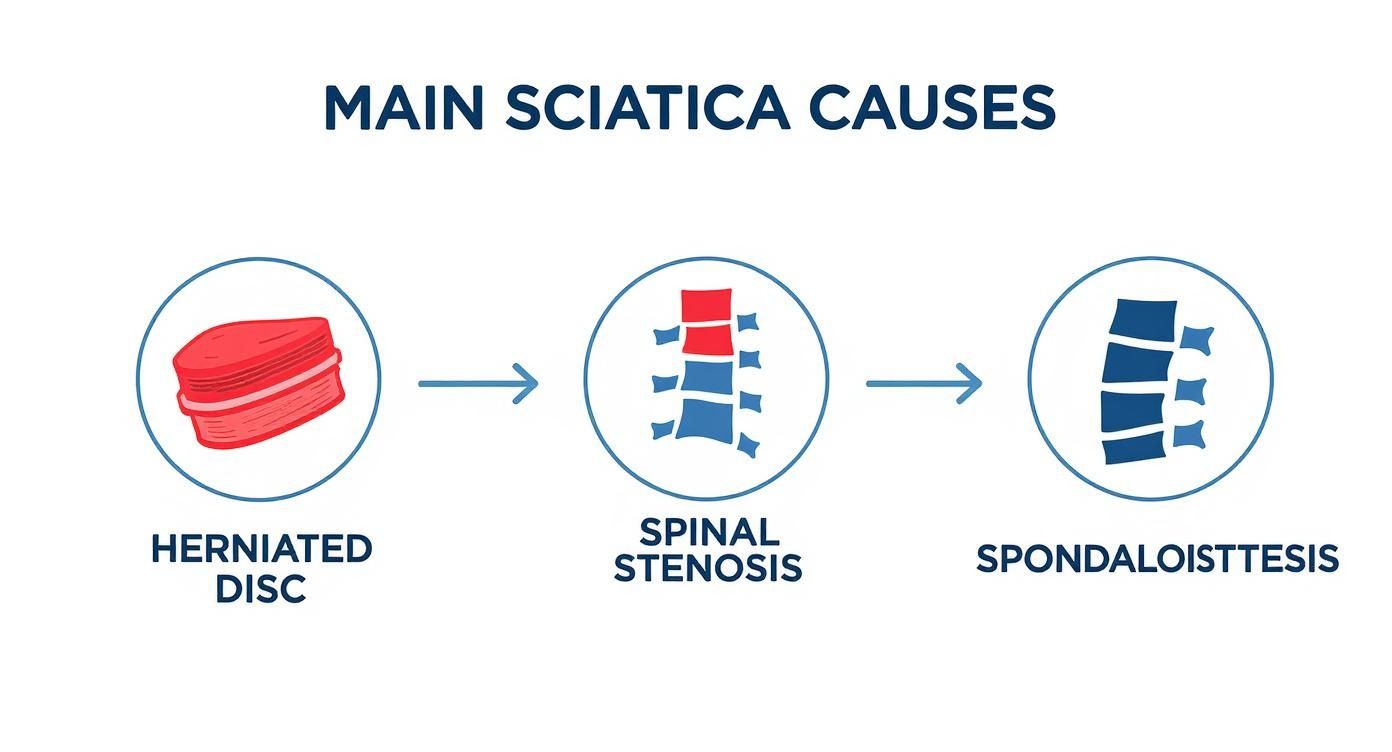
You can see how herniated discs, spinal stenosis, and spondylolisthesis all involve parts of the spine physically pressing on the nerve roots.
The Impact of Direct Trauma or Injury
It’s also important to remember that sciatica doesn't always creep up on you. A sudden, jarring injury can absolutely be the trigger.
A car accident, a bad fall, or a hard hit during sports can damage the sciatic nerve or the tissues around it. We're talking about things like a pelvic fracture, deep muscle bruising in the buttocks, or a dislocated hip. Any of these can cause immediate swelling and pressure on the nerve, kicking off a severe case of sciatica.
Unlike the slow onset you might see with spinal stenosis, sciatica from an injury is often immediate and intense. The initial trauma causes inflammation that puts instant pressure on the nerve, making it crucial to get checked out right away to make sure there's no serious structural damage.
Rare But Serious Causes of Nerve Compression
Finally, it's very rare, but sometimes sciatic nerve pain can be a red flag for a more serious health problem. This is exactly why you should never try to self-diagnose and always see a professional.
A few of these rare causes include:
- Spinal Tumors: A growth near the spinal cord can press on the nerve roots leading to the sciatic nerve.
- Infections: An infection in the lower spine, like an abscess, can cause swelling that compresses the nerves.
- Cauda Equina Syndrome: This is a true medical emergency where the bundle of nerves at the very end of the spinal cord gets squeezed. It often causes loss of bowel or bladder control along with sciatica.
While these situations are not common, they highlight why it’s so important to seek professional care if your pain is severe, won't go away, or comes with other "red flag" symptoms. A proper examination makes sure we find the real cause so you can get safe and effective treatment.
How to Recognize Sciatica Symptoms and Red Flags
Lower back pain is incredibly common, so how do you know if what you're feeling is sciatica? It's a fair question. The truth is, sciatica has a very distinct personality. It’s not just a dull ache that hangs out in one spot.
The classic, tell-tale sign of sciatica is pain that travels. It usually starts in your lower back or buttock and then shoots down the back of one leg, sometimes going all the way to your foot. It follows the path of that sciatic nerve like a roadmap.
People describe this sensation in all sorts of ways. For some, it’s a sharp, electric jolt. For others, it's more of a deep, burning ache that just won't quit. No matter the feeling, the key is its journey down the leg.

Beyond Just Pain
But it's not always just about pain. When a nerve is this irritated, it can cause other bizarre sensations along with the discomfort.
You might also notice:
- Numbness: Parts of your leg or foot might feel like they’ve “fallen asleep.”
- Tingling: That classic “pins-and-needles” feeling is a very common clue.
- Muscle Weakness: You might suddenly find it hard to lift your foot, stand on your toes, or move your leg with normal strength.
These symptoms almost always show up on just one side of the body. While it's technically possible to have sciatica in both legs at once, it's much, much less common. The intensity can be all over the map, too—from a minor annoyance to pain so severe that sitting or even standing feels impossible.
Critical Red Flags You Should Never Ignore
Most of the time, sciatica can be managed with conservative care. However, there are a few symptoms we consider "red flags." These aren’t something to wait on; they are warning signs of a serious problem that needs immediate medical attention.
These particular symptoms can point to a rare but serious condition called cauda equina syndrome. This happens when the whole bundle of nerves at the very end of your spinal cord gets compressed, and it’s a true medical emergency. Quick action is needed to prevent permanent damage.
Please pay close attention to these warning signs:
- Loss of Bladder or Bowel Control: This is the big one. If you suddenly can't control your urination or bowel movements, or if you feel numbness in your groin or "saddle" area, you need to go to an emergency room.
- Sudden, Severe Weakness: If your leg or foot abruptly becomes so weak or numb that you can't lift your foot (a condition called "foot drop") or you start stumbling, get seen right away.
- Pain After a Major Injury: If your symptoms kicked off after a bad fall, a car accident, or other serious trauma, a professional evaluation is necessary to check for a fracture or other severe injury.
- Pain With Fever or Unexplained Weight Loss: When severe back pain comes with a fever, chills, or you're losing weight without trying, it could signal an underlying infection or even a tumor.
Knowing the difference between typical sciatica and these red flags is absolutely vital. It helps you understand when it’s time to see a chiropractor and when you need to head straight to the hospital.
Your Path to Diagnosis and Lasting Relief
Getting to the bottom of your sciatic nerve pain is the first—and most important—step toward finding relief that actually sticks around. Think of the diagnostic process as a partnership. It all starts with a simple conversation, where we map out your symptoms and your medical history. This initial chat gives us crucial clues about what’s really going on.
From there, we move on to a thorough physical exam to pinpoint the problem. This is more than just poking and prodding. We’ll run through specific tests to check your muscle strength, reflexes, and how well you can move. You've probably heard of the straight leg raise—where you lie down and we gently lift your leg. It’s a classic for a reason, as it helps us see if a herniated disc is irritating the nerve. These hands-on checks often give us a very clear picture of the situation.
Starting with Conservative, Hands-On Care
Once we know the cause, the focus shifts to treatment. We always start with safe, non-invasive methods. This is where skilled, hands-on care truly shines and becomes the foundation of your recovery. The goal isn't just to silence the symptoms with pills, but to address the mechanical issue that’s causing the nerve compression in the first place.
Chiropractic care is a cornerstone of this approach. We use gentle, precise adjustments to restore proper alignment to the vertebrae in your lower back. You can think of it like carefully nudging a crooked puzzle piece back into its correct spot. This simple act can relieve the physical pressure on the nerve root, giving it the space it needs to heal and calming the painful inflammation.
The whole idea is simple but powerful: by correcting the underlying structural problem—whether that’s a misaligned vertebra or a compressed disc—we can take the pressure off the sciatic nerve. This lets your body kickstart its own natural healing process and tackles the root of what causes sciatic nerve pain for long-term results.
By focusing on the mechanics of your spine, we can often bring about significant relief without needing to jump to more invasive procedures.
A Balanced Approach to Treatment
A solid treatment plan usually involves more than just one thing. Real, lasting relief comes from a strategy that combines professional care with things you can do for yourself at home.
Alongside spinal adjustments, your recovery plan might include:
- Therapeutic Exercises: We'll give you specific stretches and strengthening exercises to improve flexibility in your hamstrings and lower back. We also focus on core-strengthening moves to help stabilize and support your spine.
- Cold Laser Therapy: This is a modern, non-invasive therapy that uses specific wavelengths of light. It penetrates deep into your tissues to help reduce inflammation and speed up cell repair right where the nerve is irritated.
- Lifestyle and Posture Guidance: Sometimes, the smallest changes can make the biggest difference. We’ll show you how simple tweaks to how you sit, stand, and lift can help prevent future flare-ups.
This balanced approach makes sure we're addressing every angle of your condition, from the initial cause to long-term prevention. In some situations, a deeper diagnostic look might be useful. As part of a complete evaluation, a doctor might order different tests to check your overall health. A great resource for this is understanding your comprehensive metabolic panel, which can help rule out other things contributing to the problem.
If you’re curious and want to take a deeper dive into how our targeted adjustments work, our guide on chiropractic treatment for sciatica explains these effective techniques in more detail.
Ultimately, finding the right path forward starts with a precise diagnosis and a plan built on conservative, effective care. If you're ready to find the source of your pain and get on the road to recovery, our team is here to help.
Simple Steps for Sciatica Prevention and Self-Care
Once your sciatic nerve pain starts to settle down, the game plan shifts from immediate relief to long-term prevention. Let’s face it, nobody wants a repeat performance of that kind of pain. The good news is that building a few simple, mindful habits into your day is one of the most powerful things you can do to protect your spine and keep flare-ups from coming back.
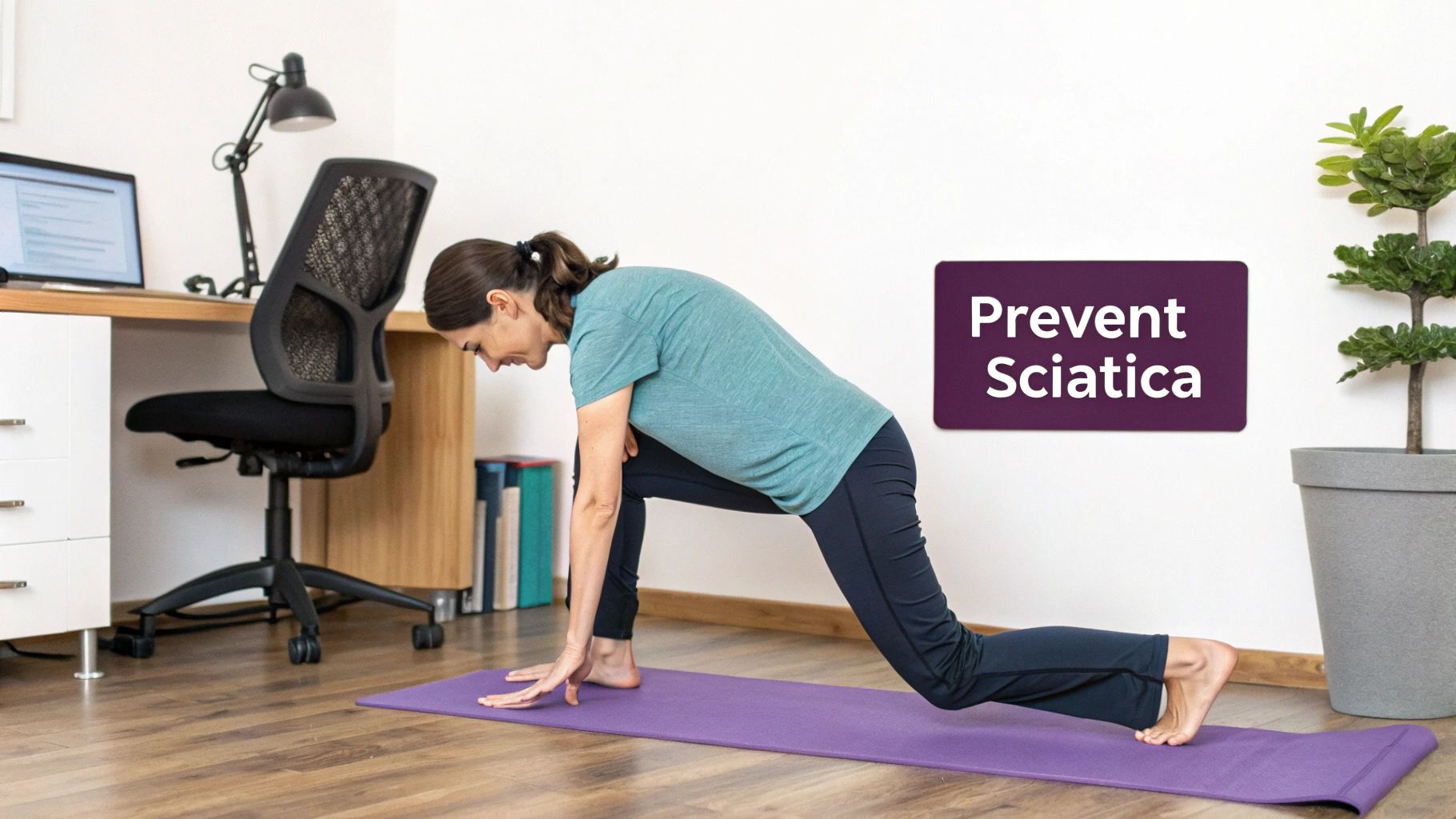
It really all starts with being more aware of how you move. The way you sit at your desk, how you stand while waiting for coffee, and especially how you lift things can either be a friend or a foe to your lower back. Small tweaks—like tucking a rolled towel behind your lower back for support or always bending with your knees instead of your waist—can make a massive difference over time.
Building a Strong Foundation
Think of the muscles around your midsection—your core—as a natural back brace. When these muscles are strong, they provide incredible support for your spine, taking a huge amount of pressure off your discs and nerves. This is ground zero for preventing future sciatica problems.
Here are a few key things to focus on every day:
- Mindful Posture: Whether you’re at your desk or in the grocery line, try to keep your spine in a nice, neutral alignment. This means no slouching! Keep your shoulders back, head held high, and gently engage those core muscles.
- Ergonomic Workspace: If you have a desk job, make your workspace work for you. Your chair should support the natural curve of your low back, your screen should be at eye level, and your feet should be flat on the floor. This setup prevents you from slowly straining your spine all day long.
- Safe Lifting Techniques: This one is huge. Always lift with your powerful leg muscles, not your back. Hug the object close to your body and never, ever twist while lifting. That’s a recipe for disaster for the delicate parts of your lower spine.
The goal of self-care is to create an environment where your spine feels supported, not strained. These daily habits are powerful tools for managing symptoms and preventing the return of sciatic nerve pain, but they work best when combined with professional care that addresses the root cause.
For a deeper dive into managing discomfort, check out our guide on how to manage sciatica pain. It’s packed with more tips you can use right away.
Staying Active and Flexible
Gentle, consistent movement is like medicine for your spine. Regular activity gets your blood flowing, delivering all the good stuff (like nutrients) to your spinal discs and helping to clear out inflammatory junk. If you're an active person, especially a runner, understanding how to prevent running injuries in general is a huge part of taking care of your back.
Stretching is just as crucial. When the muscles in your hips, glutes, and hamstrings get tight, they can tug on your lower back, throwing things out of alignment and irritating that sciatic nerve. A few simple stretches each day can keep you flexible and ease that tension. Try these out:
- Knee-to-Chest Stretch: Lying on your back, gently pull one knee up toward your chest and hold for 30 seconds. This is a great way to lengthen the lower back and glute muscles.
- Seated Piriformis Stretch: While sitting in a chair, cross one ankle over the opposite knee. Gently lean forward until you feel a good stretch deep in your glute.
- Cat-Cow Stretch: Get on your hands and knees, then slowly alternate between arching and rounding your back. This is fantastic for encouraging spinal mobility.
We've put together a simple checklist to help you incorporate these habits into your daily life.
Sciatica Self-Care and Prevention Checklist
This table offers a quick look at actionable daily habits you can adopt to help manage sciatic pain and reduce your risk of future flare-ups.
| Habit | Why It Helps | Simple Tip |
|---|---|---|
| Mindful Posture | Reduces constant strain on your spinal discs and nerves. | Set a reminder on your phone to "check your posture" every hour. |
| Core Strengthening | Builds a natural corset of support around your spine. | Add a 30-second plank to your morning routine. |
| Proper Lifting | Protects your back from sudden, damaging forces. | Before you lift, think: "Bend my knees, not my back." |
| Daily Stretching | Keeps muscles flexible, preventing them from pulling on your spine. | Do a gentle hamstring stretch while watching TV. |
| Stay Hydrated | Helps keep your spinal discs cushioned and healthy. | Keep a water bottle on your desk and sip throughout the day. |
| Regular Movement | Improves circulation and nutrient delivery to the spine. | Get up and walk around for 5 minutes every hour. |
Following these tips can make a world of difference. Remember, while these self-care strategies are vital for your long-term health, true and lasting relief often comes from addressing the underlying structural issue that started the pain in the first place.
Got Questions About Sciatica? We've Got Answers.
When you're dealing with the unique pain of sciatica, it's natural to have a lot of questions. We hear them every day in our Spokane office. Here are some of the most common ones, with straightforward answers to help you understand what's going on and how to get better.
Can a Chiropractic Adjustment Make Sciatica Worse?
This is a concern we hear a lot, and it’s a fair question! The short answer is no—when performed by a licensed and experienced Doctor of Chiropractic, an adjustment is one of the safest and most effective ways to address the root mechanical cause of your sciatic pain. Our goal is to gently correct the problem to take pressure off the nerve, not add to it.
You might feel a little sore after your first adjustment, much like you would after trying a new workout at the gym. That’s perfectly normal and temporary. It's just your body responding as it begins to heal and realign.
How Long Until the Sciatica Goes Away?
This really depends on what's causing the problem in the first place. Every person's journey is a bit different. If it's a minor irritation, you could start feeling significantly better within a few weeks of consistent care. For something more serious, like a major disc herniation, it might take a few months of dedicated treatment.
The most important thing is consistency and getting to the source of the problem. Just covering up the pain with medication can actually drag out the healing process. When we correct the underlying issue, your body can finally do its job and heal properly.
Is It Okay to Walk with Sciatic Nerve Pain?
For most people, yes! Gentle walking is one of the best things you can do. It gets the blood flowing, which helps reduce inflammation, and it can even trigger the release of endorphins—your body’s own natural painkillers.
The key is to listen to your body. Start slow with short walks on a flat surface. If the pain gets worse, stop and rest. The old advice of complete bed rest has been shown to make things worse by increasing stiffness, so gentle movement is definitely your friend.
Should I Be Using Ice or Heat?
Great question! They both have their place, but they do different jobs.
- Ice is for the first 48-72 hours. During that initial, acute phase when the pain is sharpest, use an ice pack for about 15 minutes at a time. This will help numb the pain and bring down the inflammation.
- Heat is for after the initial flare-up. Once that intense, initial phase has passed, switching to a heating pad can work wonders. It helps relax those tight, spasming muscles and improves circulation to the area, promoting healing.
Don’t let questions and uncertainty keep you in pain. If you're struggling with that tell-tale sciatic nerve pain, our team at Audubon Park Chiropractic is here to give you the clear answers and hands-on care you're looking for. Take the first step towards lasting relief today. Contact Audubon Park Chiropractic by calling (509) 327-4049 or feel free to walk in for an assessment and treatment. We're ready to help you get started on your journey back to a pain-free life.
Ready to Feel Better?
Our Spokane chiropractors are ready to help. Walk-ins welcome — no appointment needed.

Dr. Michelle Snyder is a Spokane chiropractor with advanced training in women’s health, hormone balancing, pregnancy, and care for infants and children. She uses gentle low-force spinal adjustments alongside specialized therapies including Webster’s breech technique, allergy desensitization, cold laser therapy, EB cellular cleanse, and Methylation/genetic nutrition — offering patients a comprehensive, whole-body approach to wellness.
A Spokane resident for over 31 years, Dr. Michelle is deeply committed to her community, contributing time and resources to organizations including Meals-on-Wheels, Second Harvest, Ronald McDonald House, and the Union Gospel Mission.
📍 2909 W. Northwest Blvd, Spokane, WA 99205 | ☎ (509) 327-4049 audubonparkchiropractic.com
Further Reading: Back
- Back Pain, Sciatica, and Headaches: When Chiropractic Helps — And When It Doesn’t
- Chiropractic Without the Commitment: What No Long-Term Contracts Actually Means for Your Care
- NW Spokane’s Neighborhood Chiropractor: Why Location, Parking, and Knowing Your Doctor Actually Matter
- Why Some People Are Afraid of the Chiropractor & And What We Do Differently
- What Is Spinal Subluxation? A Guide to Understanding Spinal Misalignment