

This post is part of our complete guide to Back Pain Treatment in Spokane, WA. Browse the guide for more in-depth information on treatments, exercises, and recovery strategies.
Avoid Lower Back Stiffness
That stiff, locked-up feeling in your lower back is more than just an annoyance—it’s your body’s way of sending up a flare. It’s a signal that something, somewhere, is under a bit too much stress. For some, it’s a minor hiccup when they first get out of bed, but for others, it can be a constant, nagging tightness that gets in the way of everyday life.
Don’t wait — relief is closer than you think.
Your Quick Guide to Lower Back Stiffness
Getting to the bottom of why your back feels this way is the first real step toward finding relief that actually lasts. The culprits usually fall into one of three buckets: the way your body is built, your daily habits, or an underlying medical condition.
While your lifestyle plays a massive role, it’s also true that your spine’s unique structure can make you more prone to stiffness.
To give you a clearer picture, the main drivers of lower back stiffness are:
- Anatomical Causes: These are issues related to the actual structure of your spine, like a problematic disc or inflamed joints.
- Lifestyle Factors: Think about your daily routine—things like sitting at a desk all day, slouching, or not getting enough movement. For a deeper dive, check out our guide on how to strengthen your lower back.
- Medical Conditions: Sometimes, stiffness is a symptom of a bigger issue like arthritis or spinal stenosis that needs professional attention.
Primary Causes of Lower Back Stiffness at a Glance
To make it even simpler, here’s a quick breakdown of what we’re talking about. This table sums up the main categories of causes so you can see where your own stiffness might be coming from.
| Cause Category | What It Means | Common Example |
|---|---|---|
| Anatomical | Issues with the physical parts of your spine—the bones, discs, and joints. | Herniated Disc or Sacroiliac (SI) Joint Dysfunction |
| Lifestyle | Habits and daily activities that put stress on your back muscles and spine. | Sitting for 8+ hours a day or Improper Lifting Technique |
| Medical | Underlying health conditions that directly affect the spine and cause stiffness. | Osteoarthritis or Ankylosing Spondylitis |
Looking at these categories helps pinpoint the source of the problem. Once you have an idea of the “why,” finding the right solution becomes a whole lot easier.
Why Your Lower Back Feels Stiff, Not Just Sore
First things first, let’s clear up a common mix-up: stiffness is not the same as soreness. Soreness is that familiar, dull ache you feel after hitting the gym a little too hard—that’s just your muscles repairing and getting stronger.
Stiffness is a whole different beast. It’s that frustrating, locked-up feeling that stops you from bending over to tie your shoes or twisting to grab something. It’s a physical restriction to your movement.
Think of your spine like a well-oiled bicycle chain. When every link is clean and moving freely, you can pedal effortlessly. But if even one link gets rusty and seizes up, the whole chain grinds to a halt. That’s exactly what happens with lower back stiffness; a single problem area—a tight muscle, an angry joint—can bring your whole system to a standstill.
This feeling is actually your body’s emergency brake. When it senses a problem in your lower back, the surrounding muscles lock down to form a natural brace, trying to protect the area from any further damage.
The Trio Behind the Tightness
This protective tightening isn’t a random event. It’s usually kicked off by a combination of three factors that create a cycle that’s tough to escape on your own:
- Muscle Tension: When muscles are overworked (or even just underused), they can become tight and lose their natural flexibility.
- Joint Inflammation: The small facet joints that connect your vertebrae can get irritated and swell up, which physically blocks your range of motion.
- Reduced Blood Flow: That tightness and swelling can squeeze off circulation, starving the tissues of the oxygen and nutrients they need to heal.
This vicious cycle is almost always at the heart of what causes lower back stiffness. It’s a massive problem, too. In 2020 alone, an estimated 619 million people around the world were dealing with lower back pain. That number is expected to balloon to 843 million by 2050 as the global population grows and ages. You can read more about these global trends00098-X/fulltext) and what they mean for our health.
Think of stiffness as your body’s check-engine light. It’s more than just an inconvenience; it’s a blaring signal that the underlying mechanics of your spine are under serious stress and need a good look. Ignoring it is like keeping your foot on the gas when that light is flashing—you’re only making the eventual breakdown worse.
Understanding this dynamic is the first step toward real relief. When you realize that stiffness is a symptom of deeper issues like muscle imbalances and joint irritation, you can finally start tackling the root cause instead of just trying to quiet the alarm.
How Your Spine’s Structure Can Cause Stiffness
To really get to the bottom of lower back stiffness, we have to look at the incredible architecture of your spine. Think of it like a sophisticated, living tower built from bones, discs, and joints that all have to work in perfect harmony to keep you upright and moving. When any of these core parts runs into trouble, stiffness is usually the first red flag.
Your spine is much more than just a stack of bones. It’s a dynamic, flexible system. Tucked between each vertebra is an intervertebral disc, which you can picture as a tiny, gel-filled shock absorber. These discs are essential for cushioning your spine as you walk, bend, or lift anything.
But when a problem like a bulging or herniated disc occurs, the whole system gets thrown off. A disc that pushes out of its normal space can press on nearby nerves, triggering an instant protective reaction from your body. The muscles around it will immediately spasm and tighten up to shield the sensitive area, creating that all-too-familiar locked-up sensation.
The Role of Spinal Joints
Guiding every twist and turn of your spine are small but vital connections called facet joints. These paired joints sit on the back of each vertebra, allowing your back to bend and rotate smoothly. But if they become inflamed from arthritis, an old injury, or just simple wear and tear, their ability to move freely is compromised.
This inflammation shoots pain signals that tell the deep muscles in your back to contract and defend the area. It’s a chain reaction: the joint gets irritated, the muscles lock down to stop you from making painful movements, and you’re left dealing with significant stiffness.
This concept map breaks down how these structural issues—from tight muscles to inflamed joints—are directly linked to that stiff, immobile feeling.
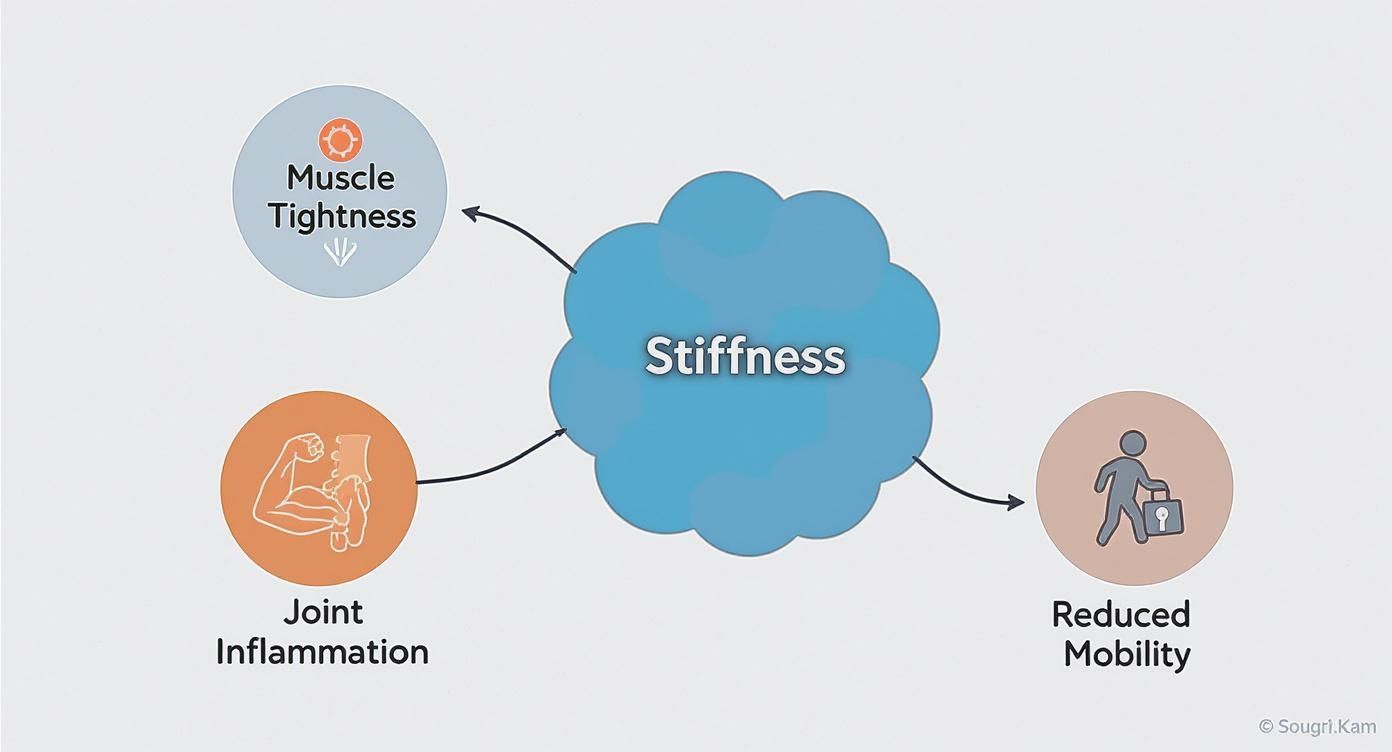
As you can see, stiffness rarely comes from just one thing. It’s almost always the result of several interconnected problems within your spinal anatomy.
When Muscles and Ligaments Contribute
Wrapped around this entire bony structure is a complex network of muscles and ligaments that provide stability. If these supporting tissues are weak or imbalanced—often a result of poor posture or not getting enough exercise—they can’t do their job properly. This forces the smaller muscles closer to the spine to work overtime, leading to chronic tension and, you guessed it, stiffness.
This kind of structural stress isn’t a small problem; it’s a massive global health issue. Back in 2020, the worldwide prevalence of low back pain was around 7,460 cases per 100,000 people. Even though the rates have slightly decreased since 1990, the total number of people affected keeps rising as the population grows and ages. It just goes to show how important it is to understand what’s happening inside our backs.
A stiff back is often a sign of structural imbalance. It’s your body’s way of telling you that the internal support system—your discs, joints, and muscles—is under strain and needs attention before a minor issue becomes a major problem.
Taking steps to support your spinal structure, such as looking into beneficial supplements for bones and joints, can make a real difference. If you’re dealing with persistent stiffness and think a structural issue might be the cause, don’t wait for it to get worse.
How Your Daily Habits Impact Back Stiffness
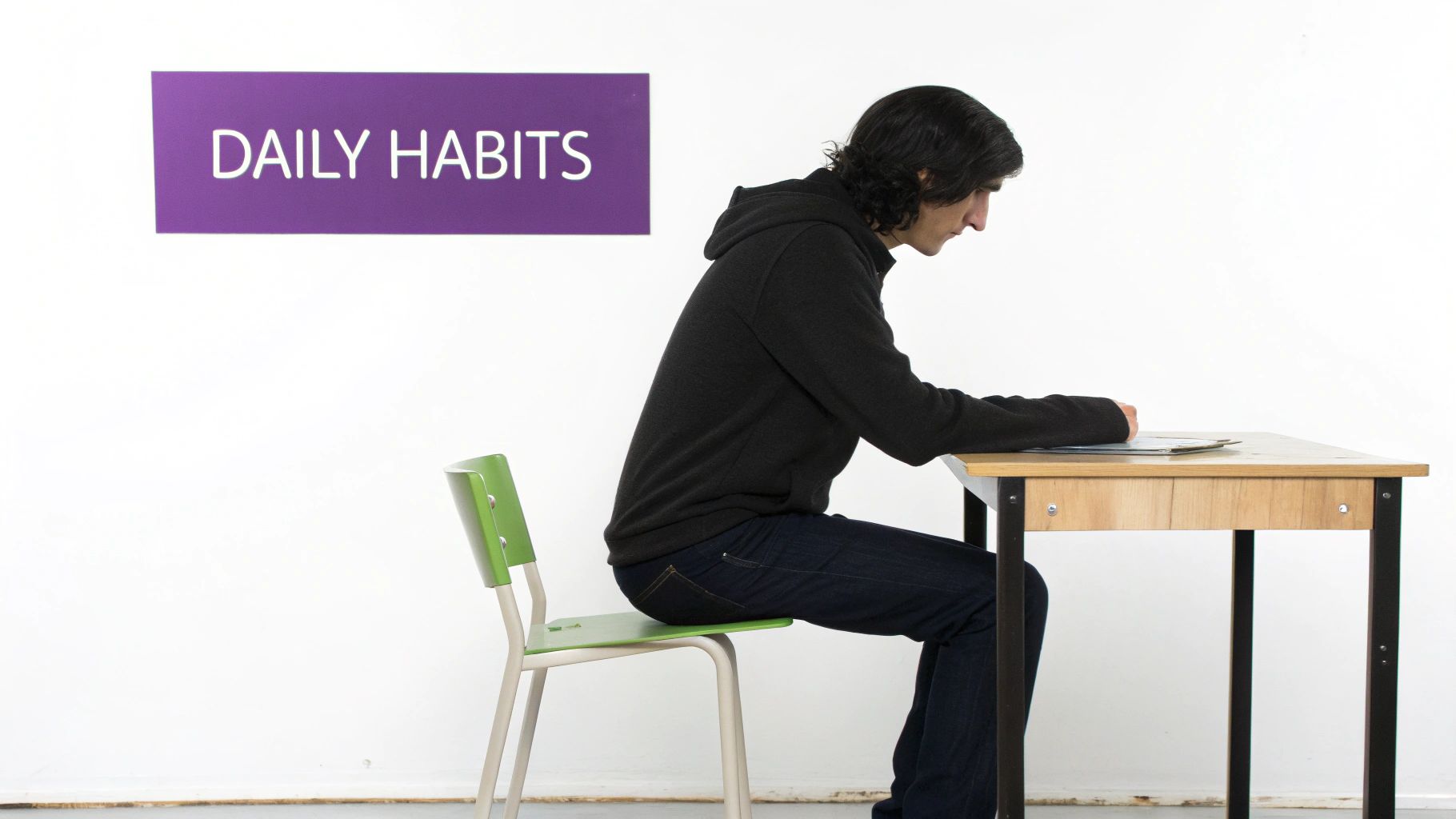
While the structure of your spine is a big piece of the puzzle, what often causes lower back stiffness really boils down to the small things we do every single day. These little habits might seem harmless, but over time, they add up. Think of it like a slow leak in a tire—eventually, all that accumulated stress leaves your back feeling flat and stiff.
One of the biggest culprits we see is a sedentary lifestyle. Spending hours sitting, whether it’s at a desk, in a car, or on the couch, puts constant pressure on the discs between your vertebrae. It also weakens the core muscles that are meant to hold your spine steady.
When those support muscles get out of shape, they can’t do their job properly. This forces the smaller, deeper muscles in your back to pick up the slack, and they aren’t built for that kind of heavy lifting. The result is chronic tension, fatigue, and that all-too-familiar locked-up feeling.
The Big Problem with Sitting Still
Plain and simple, inactivity is a major driver of back problems. In places like the United Kingdom, about one-third of adults say they deal with low back pain each year, and roughly 20% of them end up seeing a doctor for it. A sit-down lifestyle is often a key factor behind these numbers. You can discover more insights about inactivity and back pain to see just how widespread this issue is.
Imagine your back muscles are like elastic bands. When you use and stretch them regularly, they stay flexible and strong. But if you leave them in one position for too long, they start to lose that elasticity, becoming tight and brittle. This is exactly what happens to your lower back when you’re stuck in a chair for hours.
The good news is that breaking up long periods of sitting can make a huge difference.
- Set a reminder to move: Use your phone or watch to buzz you every hour. Just stand up, stretch, and walk around for a couple of minutes.
- Take active breaks: Instead of emailing a colleague in your building, take a quick walk over to their desk to chat.
- Consider a standing desk: Switching between sitting and standing is a fantastic way to reduce the constant strain on your lower back.
Poor Lifting and Awkward Moves
Another all-too-common cause of a stiff lower back is simply using bad body mechanics, especially when lifting. Every time you bend at the waist to pick something up—even if it’s just a bag of groceries—you’re putting a ton of strain on the small muscles and ligaments in your lower back.
The right way to lift is to bend with your knees and hips, keeping your back straight. Let your powerful leg muscles do the work! Forgetting this simple rule, even just once, can lead to a muscle strain that leaves you stiff and uncomfortable for days.
Your daily routine is either building a foundation for a healthy, flexible spine or slowly chipping away at its strength. The choice is often found in the small habits you practice consistently.
Getting a handle on your daily habits is a powerful first step. By moving more, paying attention to your posture, and lifting safely, you can protect your spine from a lot of unnecessary stress. You can also check out our guide on active range of motion exercises for some simple ways to improve your flexibility.
Underlying Conditions That Contribute to Stiffness
While daily habits and spinal mechanics play a huge part, sometimes that stubborn lower back stiffness is your body’s check engine light. It’s a signal that something deeper might be going on—an issue that a few stretches or a new office chair won’t fix.
When stiffness just won’t quit, it’s often a clue that a more systemic condition is at play, affecting how your spine moves and feels. These issues often involve inflammation or structural changes that go way beyond simple muscle tightness.
Arthritis and Inflammatory Conditions
One of the most common culprits we see is osteoarthritis. Think of it as the “wear and tear” arthritis. Over time, the protective cartilage cushioning your spinal joints starts to break down. Without that smooth buffer, bone can rub against bone, sparking inflammation, pain, and a serious loss of flexibility.
Another one is ankylosing spondylitis, an inflammatory disease that can actually cause the small bones of your spine (the vertebrae) to fuse together. This fusion process makes the spine rigid and can lead to a hunched posture. For many, deep stiffness—especially right after waking up—is one of the very first signs.
Structural and Degenerative Issues
Beyond arthritis, other conditions can change the very architecture of your spine, leading to that locked-up feeling.
- Spinal Stenosis: This is when the spaces within your spinal canal begin to narrow, putting the squeeze on the nerves running through it. This pressure doesn’t just cause pain; it often creates stiffness, cramping, and numbness in the lower back that can travel down into the legs.
- Osteoporosis: When bones become weak and brittle, they’re much more likely to fracture. Tiny compression fractures can develop in the vertebrae, throwing off the spine’s alignment. Your muscles then tighten up to protect the area, and you feel that as persistent stiffness.
- Scoliosis: A sideways curve in the spine means the discs and joints wear down unevenly. This imbalance forces muscles on one side to work overtime, leading to chronic tension, knots, and a constant feeling of stiffness.
It’s important to remember that persistent stiffness, especially when paired with other symptoms like radiating pain or weakness, is more than just a minor inconvenience. It’s a clear signal that your body needs a thorough evaluation to identify the root cause.
Some of these conditions can also bring on symptoms of sciatica, where pain shoots down the leg. If that sounds familiar, you can learn more about how to manage sciatica pain in our detailed guide.
When to Consider Chiropractic Care for Stiffness
While stretching and improving your daily habits are fantastic first steps, there comes a point where they just aren’t enough to get rid of that stubborn lower back stiffness. If you’ve been dealing with that locked-up feeling for weeks with no real improvement, that’s a pretty clear signal from your body that it needs a different kind of help. This is where chiropractic care often comes in.
Think of it like this: if a door hinge is a little squeaky, a bit of oil usually does the trick. But what if the hinge itself is bent or knocked out of alignment? No amount of oil will fix the core problem—you need a professional to get it lined up correctly. It’s much the same with your spine. When joints are restricted or misaligned, a chiropractor can help restore proper motion where your own efforts fall short.
Key Signs It’s Time for a Visit
Knowing when to get help can stop a small nuisance from turning into a long-term problem. If any of the following sound familiar, a chiropractic evaluation is a really good next step:
- Stiffness That Lingers: Your back has felt tight and restricted for more than a couple of weeks, even after trying to rest and stretch it out.
- It Interrupts Your Life: The stiffness is making it hard to do simple things like bending down to tie your shoes, getting out of the car, or enjoying your hobbies.
- Morning Stiffness is a Real Problem: It takes you more than 30 minutes just to “warm up” and move around comfortably after getting out of bed.
- You’re Feeling Radiating Symptoms: You’ve started to feel tingling, numbness, or pain that travels from your back down into your glutes or legs.
These symptoms often point to something more than just simple muscle tightness. It could be an issue with joint dysfunction or nerve irritation that needs a specific, hands-on approach to fix.
What to Expect from Chiropractic Care
When you visit a chiropractor, the first goal is to figure out exactly what’s causing your discomfort. Your first appointment usually involves a thorough chat about your health history and the specifics of your stiffness. This lets us create a care plan that’s actually designed for you and your body.
Chiropractic care isn’t just about “cracking” your back. It’s about using precise, gentle adjustments to restore mobility to stuck or misaligned spinal joints. This, in turn, takes pressure off the nerves and finally allows those tight muscles to relax.
The whole point is to get your spine functioning better so your body can do what it does best—heal itself. As you consider chiropractic, it’s also smart to look into other supportive methods for ongoing discomfort. For example, learning about natural chronic pain management strategies can give you more tools for your overall wellness.
Common Questions We Hear About Lower Back Stiffness
When you’re dealing with a stiff lower back, you’ve probably got a lot of questions running through your mind. Getting clear, straightforward answers is the first step toward understanding your body and figuring out what to do next. Let’s tackle some of the most common concerns we hear from patients.
How Can I Get Rid of Morning Stiffness?
Waking up feeling like the Tin Man is a complaint we hear all the time. After a night of being still, your back muscles are cold and tight. The best thing you can do is get some gentle movement going to increase blood flow and warm everything up.
A couple of simple stretches before you even get out of bed can make a huge difference:
- Knee-to-Chest Stretch: While lying on your back, gently pull one knee up toward your chest and hold it for 20-30 seconds. You’ll feel a nice, easy stretch in your lower back. Then, switch legs.
- Cat-Cow Stretch: Get on your hands and knees. Slowly arch your back up toward the ceiling (like an angry cat), then let it sink down toward the floor (like a relaxed cow). This is fantastic for improving the mobility of your spine.
Can Being Dehydrated Make My Back Stiff?
You bet it can. It’s a factor people often overlook. Think of the discs between your vertebrae as little jelly-filled cushions that need water to stay plump and spongy. When you don’t drink enough, these discs can actually lose some of their height and flexibility.
This can lead to more friction between the bones of your spine, which you’ll feel as stiffness.
Staying hydrated is one of the easiest and most effective things you can do for your spine. You’re essentially lubricating your back from the inside out.
Is This a Muscle Problem or a Joint Problem?
It can be tough to tell the difference on your own, but there are usually some clues. If it’s a muscle issue, you might feel a general tightness or a nagging ache across a wider area of your back. Often, a little gentle movement or a warm compress helps it feel better.
Joint stiffness, on the other hand, tends to feel deeper and more localized—sometimes you can point to the exact spot on your spine. You might even notice some clicking or grinding sounds. It often feels worse right after you’ve been resting for a while. The only way to know for sure is to have a professional take a look.
What’s the Best Way to Sleep?
If you’re struggling with a stiff lower back, sleeping on your back with a small pillow tucked under your knees is usually your best bet. This little trick helps your spine maintain its natural, healthy curve and takes a lot of pressure off your lower back.
Are you a side sleeper? No problem. Just slide a pillow between your knees. This keeps your hips, pelvis, and spine all lined up, preventing that twisting that can lead to morning pain.
If your stiffness is preventing you from living your life to the fullest, it’s time to take action. The caring team at Audubon Park Chiropractic is ready to help you understand the root cause of your discomfort and create a personalized plan to restore your mobility. Don’t wait for the problem to get worse. Contact us today by calling (509) 327-4049 or feel free to walk in for treatment. We are here to help you get back to moving freely and feeling your best.
Ready to Feel Better?
Our Spokane chiropractors are ready to help. Walk-ins welcome — no appointment needed.

Dr. Michelle Snyder is a Spokane chiropractor with advanced training in women’s health, hormone balancing, pregnancy, and care for infants and children. She uses gentle low-force spinal adjustments alongside specialized therapies including Webster’s breech technique, allergy desensitization, cold laser therapy, EB cellular cleanse, and Methylation/genetic nutrition — offering patients a comprehensive, whole-body approach to wellness.
A Spokane resident for over 31 years, Dr. Michelle is deeply committed to her community, contributing time and resources to organizations including Meals-on-Wheels, Second Harvest, Ronald McDonald House, and the Union Gospel Mission.
📍 2909 W. Northwest Blvd, Spokane, WA 99205 | ☎ (509) 327-4049 audubonparkchiropractic.com
Further Reading: Back
- Back Pain, Sciatica, and Headaches: When Chiropractic Helps — And When It Doesn’t
- Chiropractic Without the Commitment: What No Long-Term Contracts Actually Means for Your Care
- What causes sciatic nerve pain: Symptoms and relief
- NW Spokane’s Neighborhood Chiropractor: Why Location, Parking, and Knowing Your Doctor Actually Matter
- Why Some People Are Afraid of the Chiropractor & And What We Do Differently