

This post is part of our complete guide to Back Pain Treatment in Spokane, WA. Browse the guide for more in-depth information on treatments, exercises, and recovery strategies.
What causes disc herniation in Spokane?
A herniated disc is rarely the result of a single, isolated event. More often, it represents the culmination of gradual wear and tear over time, where a final trigger causes the disc to rupture.
Imagine your spinal discs as small, jelly-filled shock absorbers situated between each vertebra. Throughout the years, these discs naturally lose some of their water content and flexibility, much like a rubber tire becomes less pliable with age. One day, a seemingly routine movement—such as lifting a box incorrectly or a sudden, sharp twist—can be sufficient to tear the disc’s tough outer layer. This breach allows the soft, gel-like center to protrude and press on nearby nerves, causing pain and other symptoms.
Don’t wait — relief is closer than you think.
Understanding the Primary Causes of Disc Herniation
A herniated disc, often referred to as a “slipped disc,” almost always has an underlying history. It is typically the result of long-term disc degeneration combined with an acute stressor. Although the term ‘slipped disc’ is widely used, understanding what a ‘slipped disc’ really means provides clarity on the actual mechanism—the disc does not slip out of position but rather ruptures.
The infographic below effectively illustrates how these two factors—degeneration and a trigger—converge to cause a herniation.
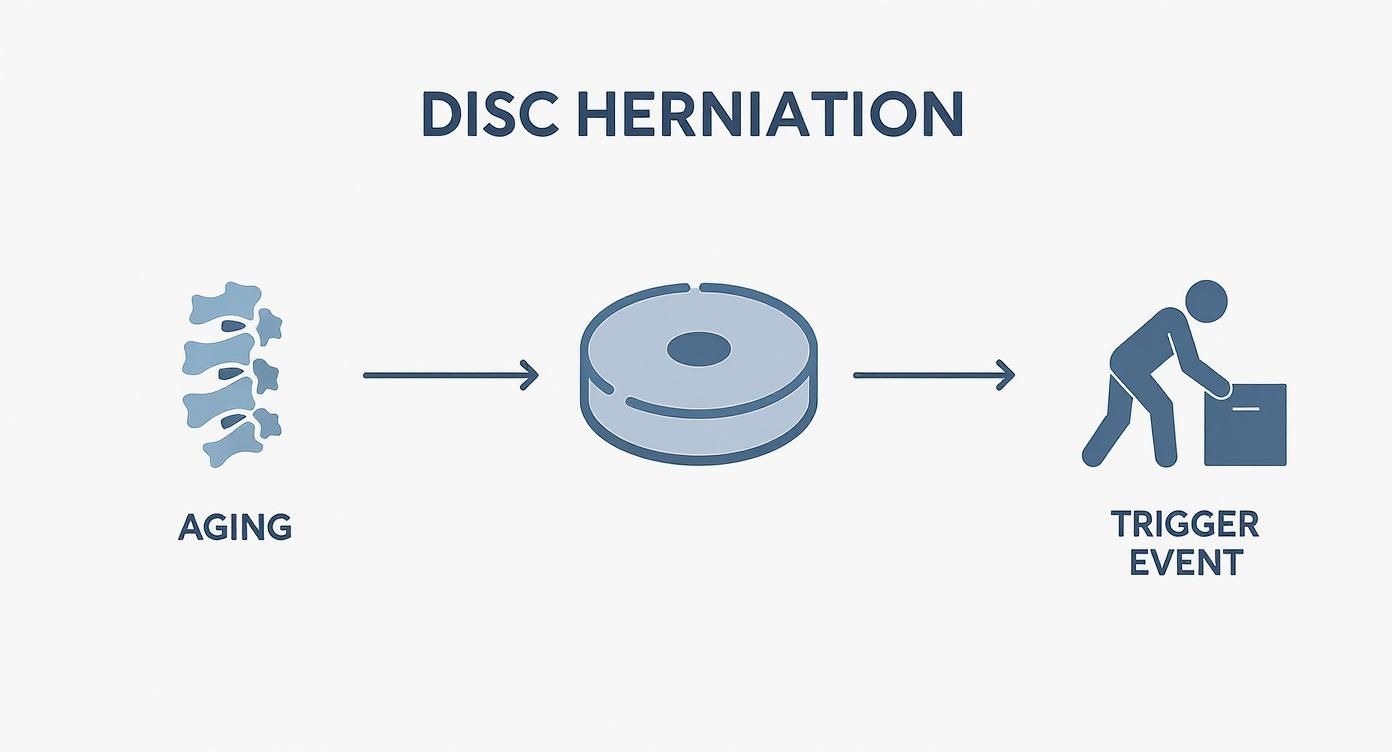
As shown, the gradual weakening of the disc is what establishes its vulnerability to an injury from an activity that might be part of a daily routine.
To provide a clearer understanding, let’s examine the principal factors that contribute to disc failure.
Primary Causes of Disc Herniation at a Glance
This table offers a quick summary of the different forces at play.
| Cause Category | Primary Mechanism | Common Examples |
|---|---|---|
| Degenerative Changes | Natural, age-related wear and tear weakens the disc structure. | Disc dehydration, loss of elasticity, development of tiny tears in the outer wall. |
| Acute Trauma/Injury | A sudden, forceful event puts more stress on the disc than it can handle. | Car accidents, falls, sports injuries, improper lifting of heavy objects. |
| Repetitive Strain | Repeated small stresses over time accumulate and break down the disc. | Jobs requiring frequent bending/twisting, prolonged sitting with poor posture. |
| Genetic Predisposition | Inherited traits can make discs inherently weaker or more prone to degeneration. | Family history of disc issues, specific genetic markers affecting collagen. |
Each of these categories plays a role in the comprehensive picture of why a disc may herniate.
The Role of Aging and Gradual Wear
One of the most significant factors behind disc herniation is the natural aging process, a condition known as intervertebral disc degeneration. As time progresses, our discs begin to dehydrate. They lose water content, which makes them less spongy and more brittle.
A healthy, well-hydrated disc is an excellent shock absorber. However, a dehydrated disc becomes less effective at managing the daily pressures exerted on the spine. This increased mechanical strain on the disc’s tough outer wall (the annulus fibrosus) leads to the formation of small tears and fissures. Eventually, these weakened areas can fail, allowing the soft inner material to extrude.
This gradual breakdown creates an ideal environment for an injury. The key factors include:
- Disc Dehydration: A natural loss of fluid that reduces the resilience of the discs.
- Loss of Elasticity: Discs become stiffer and more susceptible to cracking under load.
- Weakened Outer Wall: The fibrous outer layer develops minor tears over time.
A useful analogy is to compare a spinal disc to a car tire. A new tire is pliable and easily absorbs bumps in the road. After years and thousands of miles, the rubber becomes harder, develops cracks, and is much more vulnerable to a blowout from hitting a pothole. The same principle applies to our spinal discs.
How Aging and Degeneration Weaken Your Spine
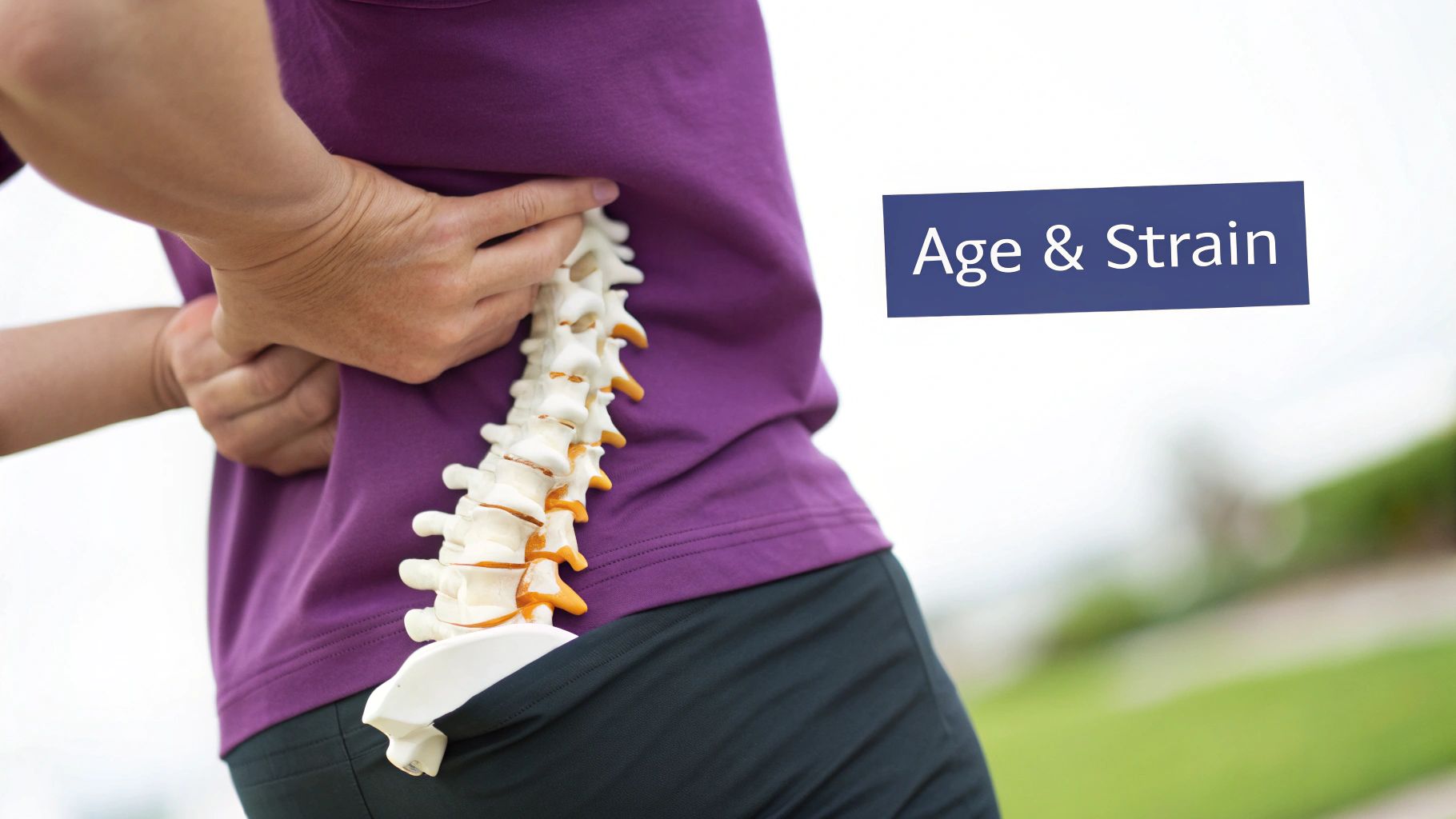
By far, the single largest contributor to disc herniation is the natural process of aging. Day after day, your spinal discs endure significant wear and tear, a process referred to as degenerative disc disease. This slow deterioration weakens the disc from the inside out, making it much more susceptible to injury from even simple daily activities.
I often compare spinal discs to car tires. A brand-new tire is flexible, durable, and readily absorbs road imperfections. But after tens of thousands of miles, that same rubber becomes harder, drier, and begins to develop tiny cracks. It becomes a prime candidate for a blowout. Your spinal discs follow a very similar trajectory over the years.
The Anatomy of Disc Breakdown
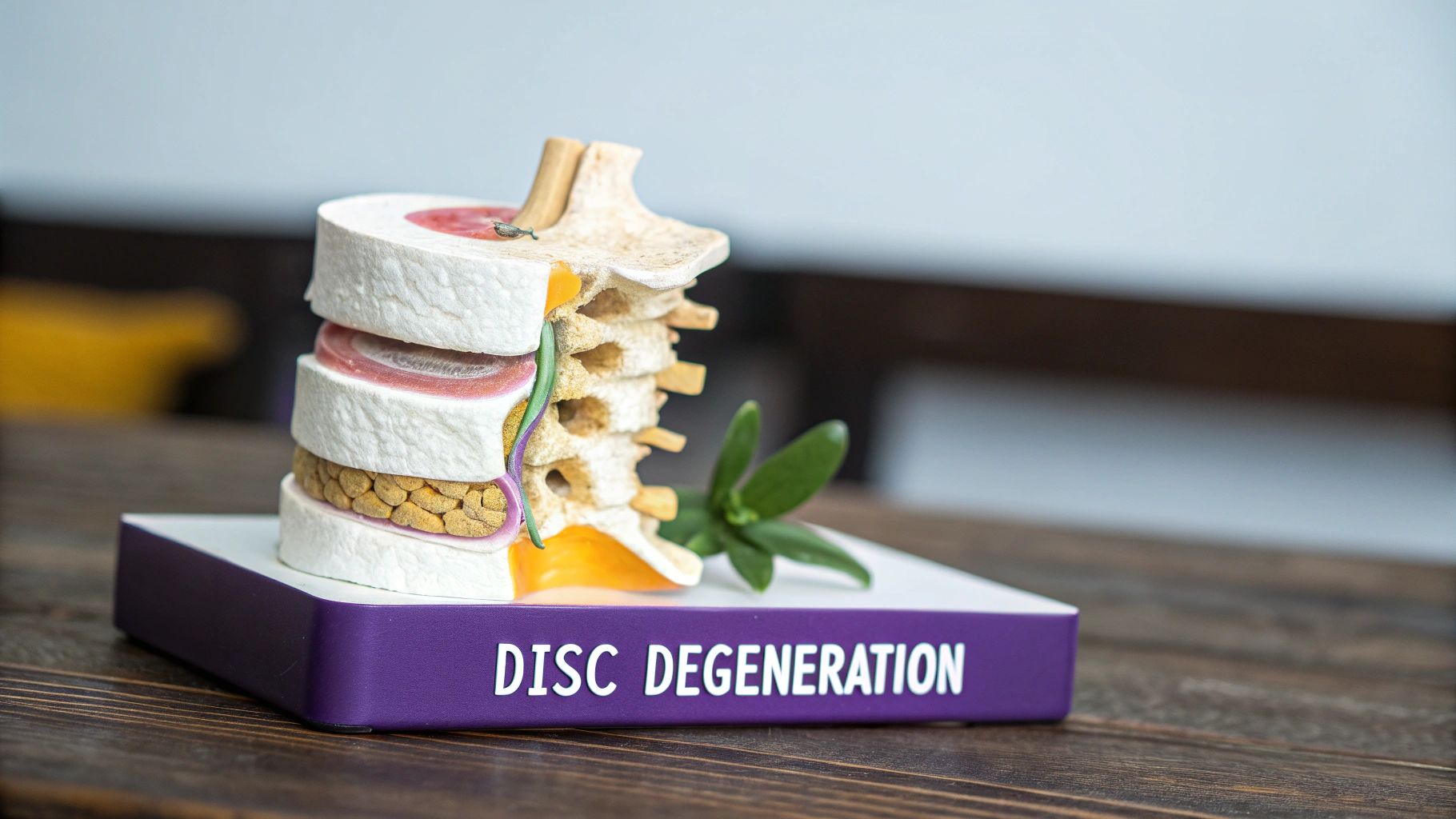
To fully grasp this, it’s essential to understand the disc itself. Each one consists of two primary parts: a tough, fibrous outer wall called the annulus fibrosus and a soft, gel-like center known as the nucleus pulposus. The nucleus is crucial for the disc’s cushioning and shock-absorbing capabilities.
As we age, this gel-like nucleus begins to lose its water content—it literally dries out. This dehydration causes the entire disc to become:
- Less flexible and significantly more brittle.
- Thinner, which reduces the space between your vertebrae.
- Less effective at absorbing shock, placing increasing stress on the outer wall.
When the nucleus loses its hydration and resilience, the outer wall (the annulus fibrosus) starts to weaken, developing tiny tears and fissures. It is through these weak points that the jelly-like nucleus can push out—or herniate—when subjected to pressure.
The Peak Age for Herniation
Interestingly, the risk of herniation is highest for individuals in their 30s and 40s. This period represents a convergence of factors. The nucleus is still soft and gelatinous enough to be extruded through a tear, while the outer wall has already begun to weaken from years of use.
Later in life, such as after age 50 or 60, the nucleus often becomes so dry and fibrous that a classic herniation, where the soft center squeezes out, is less probable. For those interested in detailed statistics, you can explore more information about disc herniation epidemiology to see how the data breaks down.
A weakened, degenerated disc does not require a major accident to rupture. Sometimes, a simple action like twisting to get out of a car or lifting a bag of groceries can be the final event that triggers a painful herniation.
This entire degenerative process is precisely why so many herniated discs seem to occur unexpectedly, without any significant injury. The foundation for the problem was laid years in advance, simply through the natural course of living.
The Sudden Triggers That Can Cause a Disc to Herniate
While wear and tear can weaken your spinal discs over the years, a full-blown herniation often occurs in a single, specific moment. It is typically a single, forceful event that acts as the final straw, pushing an already vulnerable disc beyond its limit. This is the “why now?” aspect of the issue, where a simple action suddenly leads to debilitating pain.
These triggers are almost always sudden injuries or unexpected mechanical stresses that the disc’s structure cannot withstand. Examples include lifting a heavy box incorrectly, a sudden awkward twist, or the impact from a fall or even a minor car accident. Each of these situations places immense, immediate pressure on your spine, which a weakened disc is simply not equipped to handle.
The Physics of a Sudden Injury
By far, the most common trigger we observe is improperly lifting a heavy object. When you bend at the waist and attempt to lift something using your back muscles, you essentially turn your spine into a lever. This common mistake multiplies the force on your lower back discs, creating a massive spike in pressure that can easily cause a rupture.
This type of axial overloading—where excessive force is applied down the length of the spine—is a classic cause of acute herniations. The mechanical stress from lifting, twisting, or other trauma can cause the soft, gel-like center of the disc (the nucleus pulposus) to burst through its tough outer wall. Unlike slow degeneration, these injuries are immediate and often result in much more severe symptoms right away. You can explore more insights on herniated disc causes from Mayo Clinic to gain a deeper understanding of the mechanics.
A healthy disc can withstand considerable pressure. But a degenerated disc is more like a worn-out tire—hitting one more pothole (the sudden trigger) is all it takes for a complete blowout.
Some of the most common sudden triggers include:
- Lifting and Twisting: Picking up a heavy object while turning your torso is one of the most dangerous movements for your discs.
- Falls: Landing hard on your buttocks can send a powerful shockwave directly up your spine.
- Car Accidents: Even a low-speed collision can generate enough abrupt force to herniate a disc.
In these instances, there is a clear cause-and-effect relationship. You can often identify the exact moment an action occurred and when your symptoms began.
Lifestyle Choices and Genetic Factors That Increase Your Risk
While aging and sudden injuries are major contributors to disc herniation, it is often our daily habits and even our genetic makeup that set the stage. Consider this: years of wear and tear may slowly thin the tire tread on your disc, but certain lifestyle choices are like driving on a rough road daily—they accelerate the process and make a failure far more likely.

Repetitive physical strain is one of the most significant contributors. If your job involves constant lifting, pulling, bending, or twisting, you are placing a cumulative load on your spine day after day. However, this is not limited to manual labor. Even something as seemingly benign as sitting at a desk for hours can put chronic, focused pressure on your lower back discs, especially with poor posture.
How Daily Life Impacts Disc Health
Your lifestyle choices can either support your spine’s health or work against it. The constant, subtle pressures from these habits can dramatically accelerate the wear and tear on your discs, weakening their structure over time.
Here are some of the key lifestyle risk factors we frequently see:
- Excess Body Weight: Carrying extra pounds, particularly around the abdomen, adds a significant and constant load to the discs in your lower back. It’s a matter of physics—more weight means more pressure, which speeds up degeneration.
- A Sedentary Life: A lack of physical activity leads to weak core muscles. Your abdominal and back muscles act as a natural support system for your spine; when they are not strong, your discs are forced to absorb far more stress than they were designed to handle.
- Poor Diet and Smoking: A diet high in processed foods can promote systemic inflammation, which is detrimental to disc health. If you are interested in how to counteract this, you can learn about the best anti-inflammatory foods list in our guide. Additionally, smoking is harmful to your discs because it impairs circulation, restricting the flow of vital nutrients that your discs need for repair.
It is also important to note that for some individuals, genetics play a role. Research indicates that you can inherit traits that affect the composition and strength of your disc cartilage, making you more susceptible to a herniation even with a healthy lifestyle.
Recognizing these risk factors is the first crucial step you can take toward protecting your spine for the long term.
Taking That First Step Toward a Healthier Spine
Understanding what causes a herniated disc is the first meaningful step you can take toward preventing future issues and, more importantly, finding effective relief. We have seen that it is usually a combination of factors—long-term wear and tear, a single triggering event, and your personal risk factors all converging. But you do not have to navigate this or manage the pain alone.
A proper diagnosis is the only way to develop a treatment plan that is right for you. If you are experiencing symptoms like persistent back pain, or unusual numbness or weakness in your arms or legs, it is time to have it evaluated by a professional. Taking control of your spine’s health truly begins with that one decision. For more on what you can do at home, take a look at our guide on the best exercises for a herniated disc.
When you do seek professional help, it is always beneficial to have an understanding of how clinicians track your progress. Learning about understanding physical therapy outcome measures can empower you to be a more active and informed participant in your own recovery.
Your Questions About Herniated Discs, Answered
Can A Sneeze Really Cause A Disc Herniation?
It may seem unlikely, but yes, it is possible. A forceful sneeze or a deep cough generates a sudden, massive spike of pressure within your core. That force is transferred directly to your spinal discs.
If a disc is already weakened from years of use and general wear and tear, that abrupt jolt can be the final straw. It is often just enough force to push the soft, gel-like center through the disc’s tougher outer wall.
Is Disc Herniation A Hereditary Condition?
There is certainly a genetic component. While you do not inherit a herniated disc in the same way you inherit eye color, you can inherit certain traits that increase your predisposition to developing one.
Some of these inherited risk factors include:
- The specific chemical composition of your disc cartilage, which might make it weaker or more prone to dehydration over time.
- Minor variations in your spinal anatomy that could place additional stress on certain discs.
- A family history of degenerative disc disease, suggesting a potential predisposition to faster wear and tear.
If your parents or siblings have experienced disc issues, it is wise to be particularly mindful of your own spine health—focus on good posture, appropriate exercise, and always lifting with your legs.
How Does Being Overweight Contribute To A Herniated Disc?
Carrying excess weight is a major risk factor, particularly for the discs in your lower back (the lumbar spine). The most effective way to conceptualize this is to imagine forcing your spine to carry a heavy backpack 24 hours a day, 7 days a week.
This constant, additional load places chronic stress on your discs. It accelerates the natural aging process, causing them to lose water and weaken much more rapidly. This makes them far more vulnerable to herniating from simple, everyday movements. That relentless pressure is also a frequent cause of sciatica, which you can learn more about in our guide on how to manage sciatica pain.
Can Poor Posture Lead To A Herniated Disc?
Absolutely. Poor posture is a slow, cumulative contributor to disc herniation. When you consistently slouch or sit with your spine out of its natural alignment, you are placing uneven, sustained pressure on your discs.
Consider slouching at your desk. You are compressing the front portion of your lumbar discs while stretching the back. If this is done day after day for years, you gradually weaken the tough, fibrous outer wall, creating the ideal conditions for a herniation to occur.
Don’t let questions about your back pain go unanswered. If you’re experiencing symptoms that might point to a herniated disc, the team at Audubon Park Chiropractic is here to provide clarity and create a path toward relief. Contact us at (509) 327-4049 or walk in for an evaluation. We are ready to help you find relief.
Ready to Feel Better?
Our Spokane chiropractors are ready to help. Walk-ins welcome — no appointment needed.

Dr. Michelle Snyder is a Spokane chiropractor with advanced training in women’s health, hormone balancing, pregnancy, and care for infants and children. She uses gentle low-force spinal adjustments alongside specialized therapies including Webster’s breech technique, allergy desensitization, cold laser therapy, EB cellular cleanse, and Methylation/genetic nutrition — offering patients a comprehensive, whole-body approach to wellness.
A Spokane resident for over 31 years, Dr. Michelle is deeply committed to her community, contributing time and resources to organizations including Meals-on-Wheels, Second Harvest, Ronald McDonald House, and the Union Gospel Mission.
📍 2909 W. Northwest Blvd, Spokane, WA 99205 | ☎ (509) 327-4049 audubonparkchiropractic.com
Further Reading: Back
- Back Pain, Sciatica, and Headaches: When Chiropractic Helps — And When It Doesn’t
- Chiropractic Without the Commitment: What No Long-Term Contracts Actually Means for Your Care
- What causes sciatic nerve pain: Symptoms and relief
- NW Spokane’s Neighborhood Chiropractor: Why Location, Parking, and Knowing Your Doctor Actually Matter
- Why Some People Are Afraid of the Chiropractor & And What We Do Differently