

This post is part of our complete guide to Auto Accident Injury Treatment in Spokane, WA. Browse the guide for more in-depth information on treatments, exercises, and recovery strategies.
A sudden jolt from a car accident or sports injury can leave your neck feeling intensely sore and stiff. This is the classic signature of whiplash, a common injury that occurs when your head snaps forward and backward abruptly.
If you suspect you have whiplash, your actions in the first 48 hours are crucial for a smoother recovery. It’s helpful to start by understanding whiplash and concussion injuries, including their symptoms to know what you’re dealing with. Your body’s immediate response is inflammation, which causes swelling and pain. The initial goal isn’t to push through the discomfort but to calm the inflammation.
The Role of Cold Therapy
For the first two days, an ice pack is your most effective tool. Cold therapy, or cryotherapy, works by constricting blood vessels. This simple action helps limit the swelling and inflammation in the injured soft tissues of your neck, which is precisely the desired effect.
Here’s a step-by-step guide for effective cold therapy:
- Prepare a cold pack. A bag of frozen peas or a gel pack wrapped in a thin towel is ideal. Never apply ice directly to your skin, as this can cause an ice burn.
- Time it correctly. Apply the cold pack for about 15 minutes at a time.
- Be consistent. Repeat this process every 2-3 hours during the day for the first two days. Consistency is key to controlling inflammation effectively.
This initial phase is about finding a balance. While rest is important, controlled, gentle movement is equally vital to prevent long-term stiffness.
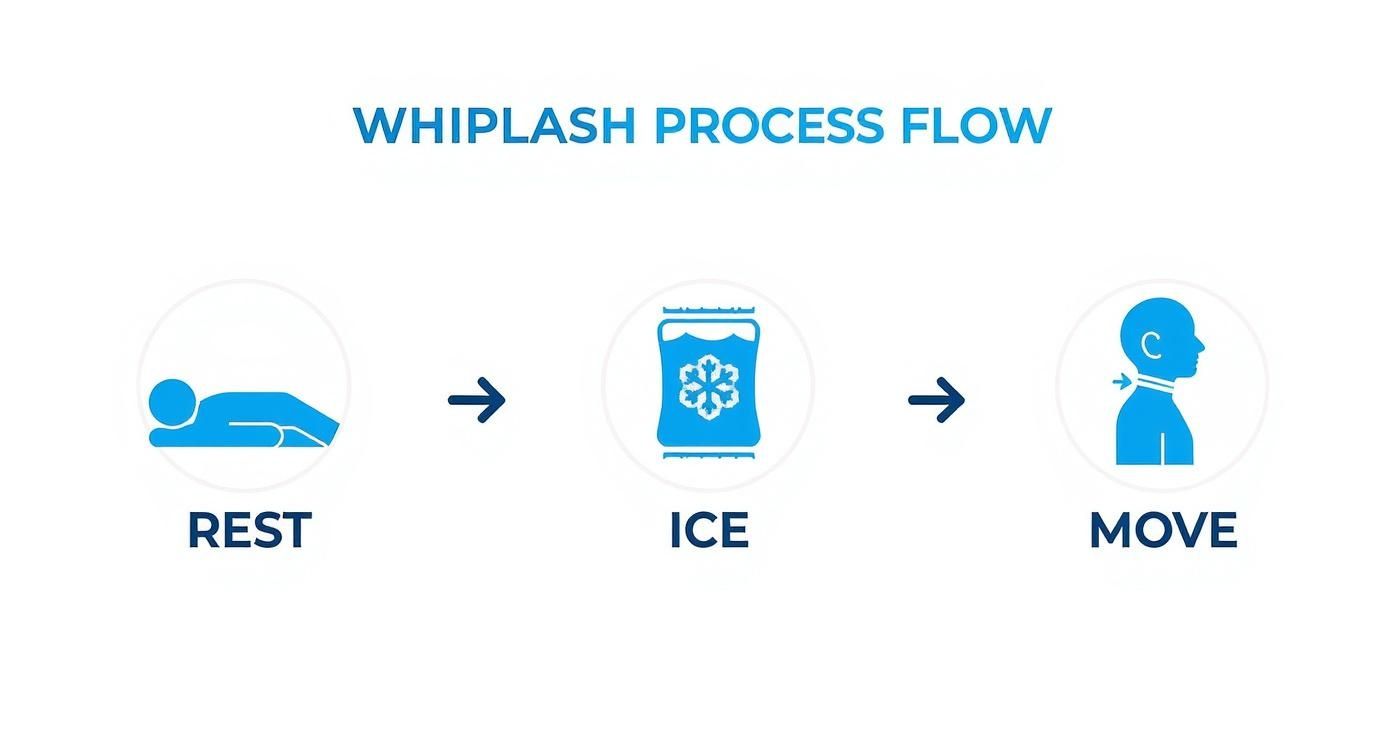
Gentle Movement Is Key
Your first instinct might be to keep your neck completely still. However, total immobilization can be counterproductive, causing your muscles and ligaments to become even stiffer. The actual goal is to encourage light, pain-free movement to maintain flexibility.
Think of it as gently reminding your neck muscles of their function. Simple, slow movements are what you should aim for.
- Slowly turn your head from side to side, as if looking over your shoulder, but only go as far as you can without pain.
- Next, try a gentle tilt, bringing your ear toward your shoulder on each side.
- These movements should always be fluid and controlled, never jerky or forced.
The outdated advice of wearing a rigid neck brace is no longer recommended for most mild to moderate whiplash cases. Current knowledge indicates that gentle motion promotes blood flow and helps prevent muscles from seizing up, which can significantly shorten your recovery time.
This checklist can help you stay on track during those crucial first two days.
Immediate Whiplash Care Checklist
| Action | Guideline | Why It Works |
|---|---|---|
| Apply Ice | 15-20 minutes every 2-3 hours for the first 48 hours. | Constricts blood vessels to reduce swelling and numb pain signals. |
| Gentle Movement | Perform slow, pain-free neck rotations and tilts several times a day. | Prevents muscles from stiffening up and promotes healing blood flow. |
| Proper Rest | Use a supportive pillow that keeps your neck neutral while sleeping. | Avoids putting extra strain on injured ligaments and muscles. |
| Watch Your Posture | Avoid slouching. Sit and stand with your head aligned over your shoulders. | Poor posture can aggravate the injury and delay healing. |
| Pain Management | Consider over-the-counter NSAIDs (like ibuprofen) as directed. | Helps manage pain and further reduce inflammation. |
Following these simple yet powerful steps gives your body the best possible start to healing right from home.
Of course, if the pain is severe, worsens, or you see no improvement, it’s a clear signal that you need a professional assessment.
Moving from Pain Management to Active Healing

After the initial 48 hours, your home care strategy for whiplash should evolve. The initial goal was to use ice to reduce acute inflammation. Now, the focus shifts to encouraging blood flow to promote healing.
This marks a transition from managing initial pain to actively supporting your body’s repair process. Good circulation is vital because it delivers oxygen and nutrients to damaged neck tissues, accelerating their repair. It also helps remove metabolic waste from the injury site. In this phase, gentle heat becomes your primary tool.
Introducing Heat Therapy
Switching from cold packs to warm compresses can significantly aid whiplash recovery. Heat is excellent for relaxing and soothing tight, achy muscles that have been guarding the injured area. It helps persuade tense muscle fibers to release.
For the best results, moist heat is preferable as it penetrates deeper than dry heat.
- Warm, Moist Towel: Soak a towel in warm—not scalding—water, wring it out, and apply it to the sore areas of your neck and shoulders for 15-20 minutes.
- Warm Shower or Bath: Let warm water run over your neck and shoulders. This can be particularly soothing in the morning when you feel stiffest.
- Heating Pad: If you use an electric heating pad, keep it on a low setting. Place a thin towel between the pad and your skin to prevent burns.
A crucial safety tip: never fall asleep with a heating pad on. Similar to ice, limit heat sessions to about 20 minutes at a time to allow your skin to rest.
Managing Lingering Pain and Inflammation
Even as you begin to feel better, some discomfort may persist. Over-the-counter (OTC) nonsteroidal anti-inflammatory drugs (NSAIDs) like ibuprofen or naproxen can be helpful. These medications can reduce pain and any remaining inflammation.
It is critical to use them correctly. Always follow the dosage instructions on the packaging and avoid long-term use without consulting a professional. If you have other health conditions or are taking other medications, a brief consultation with your doctor or pharmacist is advisable.
The purpose of pain medication is not to mask pain so you can resume normal activities. It is to make you comfortable enough to perform the gentle movements and activities necessary for a full recovery.
Simple Techniques for Releasing Tension
Pain often causes tension throughout the body, especially in the shoulders and upper back. This can create a cycle: pain leads to tension, which in turn causes more pain. You can break this cycle yourself.
Gentle Self-Massage
You don’t need professional training. Use your opposite hand to gently knead the large muscle of your shoulder and upper back (your trapezius). Use slow, circular motions to release tightness. Avoid pressing directly on the most tender spots of your neck.
Deep Breathing Exercises
When in pain, breathing tends to become shallow and rapid. Practicing slow, deep breathing for a few minutes can have a powerful calming effect on your entire body.
- Find a comfortable position, either sitting or lying down.
- Place one hand on your chest and the other on your stomach.
- Inhale slowly through your nose for about four seconds. You should feel your stomach rise more than your chest.
- Hold your breath for a moment.
- Exhale slowly through your mouth for about six seconds.
- Repeating this for 5-10 minutes a few times a day can help calm your nervous system and release muscle tension.
By combining heat, appropriate use of OTC medications, and these simple relaxation techniques, you are providing your body with the active support it needs to heal.
Don’t wait — relief is closer than you think.
Gentle Exercises to Reclaim Your Neck Mobility
When your neck is painful from a whiplash injury, the idea of moving it can be daunting. While initial rest is important, keeping your neck completely still for too long can lead to chronic stiffness.
The objective is not to push through sharp pain but to gently reintroduce motion to prevent muscles from seizing up completely.
Taking an active role in your recovery is crucial. Modern research consistently shows that active approaches, such as gentle exercises and maintaining normal activity levels, are more effective for long-term recovery than passive treatments. High-quality studies suggest that starting physiotherapy early can reduce pain intensity by approximately 30% at the six-month mark. You can find more information in this detailed study on whiplash treatment. This highlights the importance of starting to move as soon as your body allows.
The Golden Rule of Movement: Listen to Your Body
Before attempting any stretches, it’s essential to distinguish between productive discomfort and harmful pain. A mild pulling or stretching sensation is normal as your muscles re-engage.
Be cautious of any sharp, shooting, or stabbing pain. This is your body’s signal to stop. If you feel it, back off immediately. The goal is to gently test the boundaries of your comfort zone, not to exceed them.
Foundational Neck Exercises for Whiplash
These movements should be slow, deliberate, and controlled. They are designed to restore basic function without aggravating injured tissues. Perform them a few times throughout the day with only a few repetitions each time. Quality is more important than quantity.
1. Slow and Controlled Head Turns
This is often the first movement lost after whiplash, so it should be reintroduced gently.
- Sit or stand tall, with your shoulders relaxed.
- Slowly turn your head to the right as if looking over your shoulder.
- Stop immediately if you feel any sharp pain.
- Hold for a breath, then gently return to the center.
- Repeat on the left. Aim for 3-5 turns on each side.
2. Gentle Ear-to-Shoulder Tilts
The muscles on the sides of your neck become very tight after an accident. This stretch can provide relief.
- Start in the same upright, relaxed posture.
- Gently tilt your head to the right, allowing your right ear to move toward your right shoulder.
- Do not lift your shoulder to your ear; keep it down.
- Hold for 15-20 seconds, feeling a gentle stretch along the left side of your neck.
- Slowly return to the starting position and repeat on the other side.
The objective is not to touch your ear to your shoulder but to feel a gentle, sustained stretch. Forcing it will only worsen the injury.
The Importance of Chin Tucks
The chin tuck is a highly recommended exercise for whiplash recovery. It strengthens the deep stabilizing muscles at the front of your neck, which often become weak after an injury.
Imagine you are trying to create a double chin.
- This can be done lying on your back with your knees bent or sitting upright in a chair.
- Without lifting your head, gently draw your chin down and back. Think about pressing the back of your neck toward the floor or the headrest.
- You should feel a stretch at the base of your skull and a subtle tightening of the muscles at the front of your neck.
- Hold for 5 seconds, then relax.
- Start with 5 repetitions and gradually increase to 10.
This small movement is very effective for restoring proper neck posture and stability. For a more detailed guide on movements like this, you can review information on active range of motion exercises.
Integrating Movement into Your Day
Beyond these specific exercises, incorporating gentle motion into your daily routine is key. Avoid staying in one position for too long, whether at a computer or on a couch.
Set a reminder to get up every 30-45 minutes. When you do, gently turn your head, tilt it from side to side, or roll your shoulders back and down. These “micro-movements” maintain blood flow to the area and prevent stiffness from setting in.
Setting Up Your Daily Life for Better Recovery

Effective whiplash recovery extends beyond the time spent on exercises. Your daily habits and environment significantly influence how quickly and completely you heal.
Your neck is in a fragile state, and seemingly harmless activities like slouching at your desk or craning your neck to look at your phone can strain injured muscles and ligaments. Therefore, correcting your posture and ergonomics is essential.
Optimizing Your Workstation
If you work at a desk, your workspace can either support your recovery or hinder it. The primary goal is to maintain a neutral neck posture, where your head is balanced over your spine.
- Monitor Height: Adjust your screen so the top is at or slightly below eye level. You should not have to look up or down. Placing books under your monitor is a simple solution.
- Chair Support: A good chair supports the natural curve of your lower back. Sitting with your feet flat on the floor and your knees at approximately a 90-degree angle helps align your upper back and neck properly.
These adjustments can prevent the nagging strain that undermines your recovery efforts.
Mastering Your Sleep Position
We spend about a third of our lives sleeping, making it a crucial part of recovery. An improper sleep posture can lead to increased stiffness and pain upon waking.
The worst sleeping position is on your stomach, as it forces your head to be turned to one side for hours, stressing your neck. If you are a stomach sleeper, now is an ideal time to change this habit.
The best sleeping positions for a healing neck are on your back or your side. Both positions allow your head and neck to remain aligned with the rest of your spine, giving injured tissues a chance to rest and repair overnight.
The right pillow is also crucial. A pillow that is too high or too flat can create an improper angle and cause morning stiffness. For guidance on selecting an appropriate pillow, you can check out our guide on the best pillow for neck support.
Mindful Movement in Everyday Activities
Be mindful of your movements during everyday tasks to avoid further injury.
- Lifting: Bend at your knees, not your waist. Keep your back straight and hold the object close to your body.
- Turning: Instead of just twisting your neck, turn your whole body. Use your larger torso muscles.
- Phone Use: Avoid “text neck” by holding your phone closer to eye level instead of dropping your chin to your chest.
Some individuals find non-invasive tools helpful. Options like red light therapy at home may offer additional support for tissue repair and pain management. By making these small adjustments into consistent habits, you create an environment conducive to healing.
Knowing When At-Home Care Isn’t Enough

Knowing how to treat whiplash at home is an important first step. It provides you with immediate tools to manage initial pain and inflammation. For many mild cases, diligent self-care can be sufficient.
However, it is equally important to recognize when your body requires more than home remedies. Certain symptoms can be red flags, indicating a more serious underlying issue. These signs should not be ignored.
Red Flags That Need Professional Attention
If you experience any of the following symptoms, it is time to seek a professional opinion. These symptoms may suggest that the injury is not limited to the soft tissues of your neck.
- Severe or Worsening Headaches: A persistent, intense headache, especially if it is worsening or concentrated at the base of your skull, is a significant warning sign.
- Dizziness or Vertigo: Feeling constantly off-balance, lightheaded, or experiencing a spinning sensation requires a proper diagnosis.
- Numbness or Tingling: “Pins and needles” sensations, weakness, or numbness extending from your neck into your shoulders, arms, or hands are red flags for nerve involvement.
- Cognitive Difficulties: Difficulty concentrating, memory problems, or unusual irritability can accompany a whiplash injury and should be evaluated.
Another benchmark is a lack of improvement. If your pain has not started to improve after a couple of weeks of consistent home care, or if it is getting worse, your body likely needs a different approach.
Seeking professional help is not a failure of your at-home efforts. It is the next logical step in your recovery, ensuring you address the root cause of the problem for long-term healing.
When Chiropractic Care Is the Next Step
When home care is insufficient, professional intervention can be highly effective, especially for persistent symptoms.
Chiropractic care has been shown to be valuable for chronic whiplash. One study of patients with long-term whiplash pain found that 93% experienced improvement after a course of chiropractic treatment. You can learn more about these findings on chiropractic whiplash treatment.
Symptoms That Warrant a Professional Visit
This table can help you decide when to transition from self-care to a professional evaluation.
| Symptom Type | What to Look For | Your Next Step |
|---|---|---|
| Pain Level | Pain that is severe, constant, or progressively worsening despite home care. | Seek professional evaluation from a chiropractor or physician. |
| Neurological Signs | Numbness, tingling, or weakness in the arms, hands, or shoulders. | This requires immediate professional assessment to check for nerve involvement. |
| Headaches & Dizziness | Persistent, severe headaches, feelings of vertigo, or trouble with balance. | Consult a professional to rule out more serious head or neck injuries. |
| Recovery Plateau | Initial improvement that has stopped, or no improvement after 1-2 weeks. | A chiropractor can offer targeted treatments to get your recovery moving again. |
Recognizing these signs is a key part of safely managing your recovery. If your symptoms align with the “Your Next Step” column, it is time to act.
What to Expect at Your Chiropractic Assessment
Taking the step to see a professional is significant, especially when at-home efforts are not providing relief. Understanding what a chiropractic visit for whiplash entails can help you feel more prepared.
The primary goal of the first visit is to identify the source of your pain and create a clear plan for your recovery. This is a collaborative process between you and your chiropractor.
The Initial Conversation and Physical Exam
Every new appointment begins with a conversation. This is your opportunity to share the details of the incident, describe where it hurts, and explain what makes the pain better or worse. These details help your chiropractor form a complete picture of the injury.
Following the conversation, your chiropractor will conduct a thorough physical exam. This hands-on evaluation will include checking your neck’s range of motion, identifying muscle knots and tender spots, and testing for joint restrictions. This process helps pinpoint which parts of your spine and surrounding tissues were most affected.
Your Personalized Recovery Plan
Based on the information gathered, your chiropractor will develop a personalized recovery plan. This plan will be a roadmap designed to meet your specific needs and achieve your recovery goals. It will typically involve a combination of complementary treatments.
Here’s what a typical plan may include:
- Gentle Spinal Adjustments: This is a core component of chiropractic care. Using skilled, gentle techniques, the goal is to restore proper movement to spinal joints that have become restricted due to the whiplash. This can relieve pressure on nerves and reduce pain.
- Soft Tissue Therapies: Whiplash affects muscles, ligaments, and tendons. Your chiropractor may use techniques like targeted massage to ease muscle tension, break down scar tissue, and improve blood flow to injured areas.
- A Guided Exercise Program: Building on the gentle stretches you started at home, your chiropractor will provide specific strengthening and stretching exercises. The program will be progressed as you heal to safely rebuild neck stability and function.
A chiropractic assessment is about more than a diagnosis; it’s about building a partnership. The plan is designed to address the root cause of your pain, not just mask symptoms, for a more complete and lasting recovery.
This comprehensive approach ensures that all aspects of the whiplash injury are addressed, from joint mechanics to muscle health. The focus is on guiding your body’s natural healing process, which reduces the risk of chronic pain and stiffness in the future.
Don’t let persistent pain dictate your life. If your at-home whiplash treatment isn’t bringing the relief you need, the team at Audubon Park Chiropractic is ready to help with targeted, professional care. Contact us today by calling (509) 327-4049 or simply walk in for an assessment and start your journey to recovery.
Ready to Feel Better?
Our Spokane chiropractors are ready to help. Walk-ins welcome — no appointment needed.

Dr. Michelle Snyder is a Spokane chiropractor with advanced training in women’s health, hormone balancing, pregnancy, and care for infants and children. She uses gentle low-force spinal adjustments alongside specialized therapies including Webster’s breech technique, allergy desensitization, cold laser therapy, EB cellular cleanse, and Methylation/genetic nutrition — offering patients a comprehensive, whole-body approach to wellness.
A Spokane resident for over 31 years, Dr. Michelle is deeply committed to her community, contributing time and resources to organizations including Meals-on-Wheels, Second Harvest, Ronald McDonald House, and the Union Gospel Mission.
📍 2909 W. Northwest Blvd, Spokane, WA 99205 | ☎ (509) 327-4049 audubonparkchiropractic.com
Further Reading: Accidents
- Understanding Whiplash: A Comprehensive Guide to Symptoms and Treatment
- Why You Need a Chiropractor After a Car Accident
- Your Guide to Auto Accident Injury Treatment
- What to Do After a Car Accident Injury: A Step-by-Step Guide
- Neck Pain After an Accident: A Guide to Causes, Symptoms, and Effective Relief
→ Complete Guide: Auto Accident Injury Treatment in Spokane, WA