

This post is part of our complete guide to Wellness Care at Audubon Park Chiropractic. Browse the guide for more in-depth information on treatments, exercises, and recovery strategies.
Learn Why is it Important to Strengthen Core Muscles
If you want to strengthen your core, the key is to focus on exercises that stabilize your spine and pelvis, such as planks, bird-dogs, and glute bridges. This approach is superior to endless crunches because it builds a truly functional core by training the deep system of muscles that supports your posture and helps protect against back pain. It’s about creating practical, real-world strength that supports your daily life.
Don’t wait — relief is closer than you think.
Why Your Core Is More Than Just a Six-Pack
When most people hear the word “core,” they immediately picture visible six-pack abs. While the rectus abdominis is part of the system, it’s just one piece of a much larger and more important puzzle.
True core strength originates from a coordinated group of deep muscles that function like a natural corset for your entire torso. This integrated system works together to stabilize your spine, transfer force efficiently between your upper and lower body, and shield you from injury.
The Real Muscles of Your Core
To truly strengthen your core muscles, it’s essential to understand the key components that make up this system:
- Transverse Abdominis: This is your deepest abdominal muscle. It wraps around your midsection, supporting your internal organs and providing crucial spinal stability.
- Obliques: Located on the sides of your abdomen, these muscles control twisting and side-bending movements.
- Pelvic Floor: This group of muscles forms a sling at the base of your pelvis, supporting your bladder and bowel while also stabilizing your hips.
- Diaphragm: Your primary breathing muscle also plays a vital role in creating intra-abdominal pressure, which contributes significantly to core stability.
When these muscles are strong and function cohesively, the benefits extend far beyond physical appearance. A well-conditioned core enables you to lift groceries without straining your back, maintain better alignment while sitting at a desk, and improve your overall balance and stability.
Functional Strength for Everyday Life
The connection between a stable core and daily wellness is undeniable. It is a cornerstone of functional movement, especially as we age, making activities like climbing stairs or carrying a heavy box noticeably easier and safer.
With over half of U.S. adults reporting chronic back pain, it’s not surprising that research consistently shows a clear link between weak core muscles and mobility challenges. For many individuals, core training serves as a safe and accessible method for managing discomfort.
A strong core provides the foundation for nearly every movement you make. It’s not just about athletic performance; it’s about enhancing your quality of life and reducing the risk of pain during routine activities.
A strong core is also fundamental for good posture. Understanding the importance of good posture for pain relief is a game-changer for injury prevention.
We take a deeper look at posture and how it can cause problems in another one of our articles. This guide focuses on building the practical strength that supports your life, reduces pain, and establishes a solid foundation for any physical activity you enjoy.
A Foundational Core Workout You Can Start Today
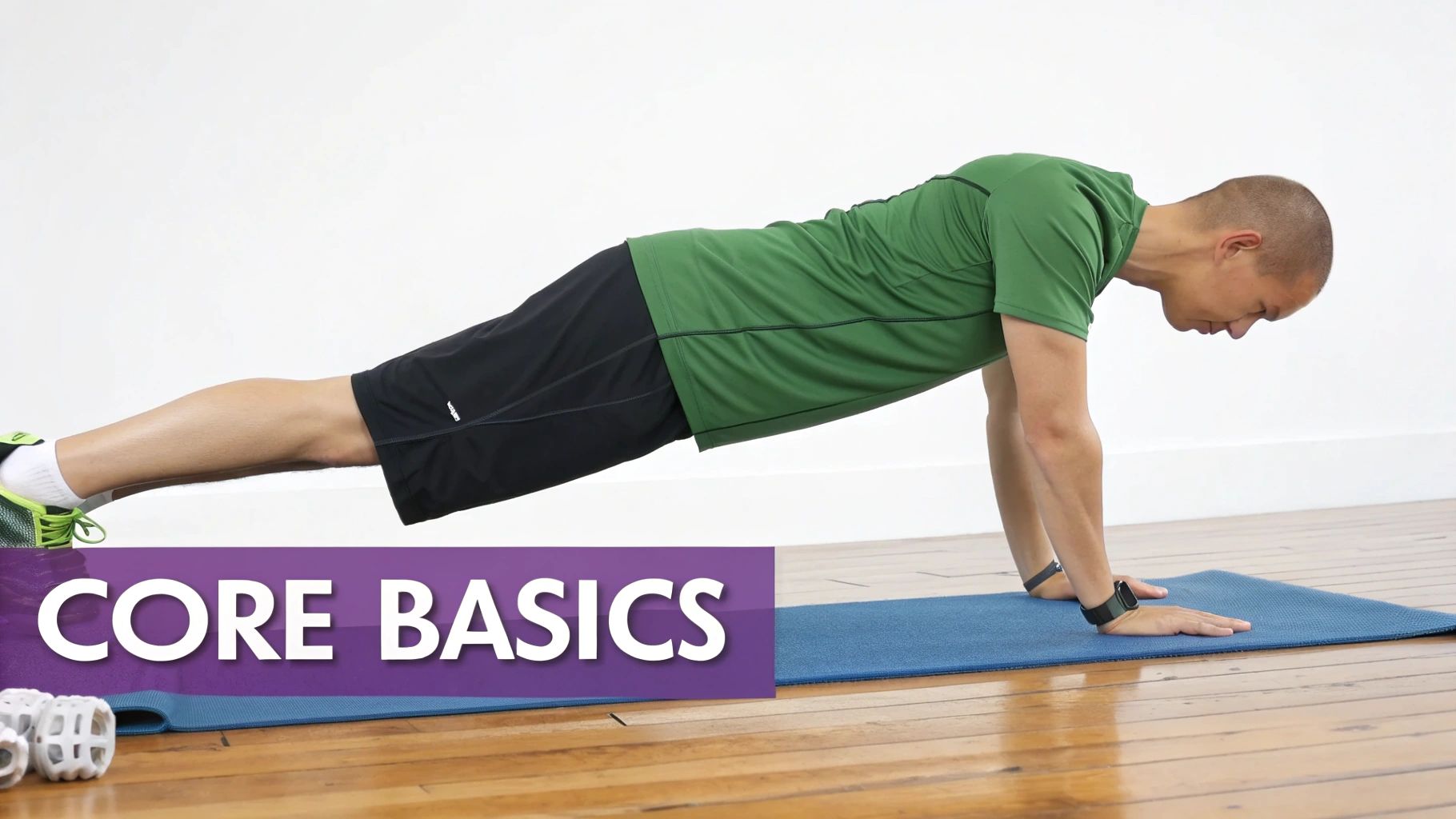
You don’t need a gym membership or a complex routine to build a truly strong core. Real, lasting strength comes from mastering a few key movements with excellent form. This workout prioritizes quality over quantity, helping you build a solid foundation for a more stable and resilient body.
The secret to success is consistency. Aim to perform this routine 2-3 times per week on non-consecutive days to allow your muscles adequate time for recovery and adaptation. As you become stronger, you can gradually increase the hold times or add more repetitions.
Here is a simple and effective routine to get you started.
| Beginner Core Strengthening Routine | |||
|---|---|---|---|
| Exercise | Primary Muscles Worked | Sets x Reps/Duration | Key Form Tip |
| The Plank | Entire core, including rectus abdominis, transverse abdominis, obliques, and back extensors | 2-3 sets of a 20-30 second hold | Maintain a straight line from your head to your heels; prevent your hips from sagging. |
| The Bird-Dog | Erector spinae, glutes, rectus abdominis, and obliques | 2-3 sets of 10-12 reps per side | Move slowly and with control to keep your torso perfectly still. |
| The Glute Bridge | Glutes, hamstrings, and lower back extensors | 2-3 sets of 12-15 reps | Squeeze your glutes to lift your hips, not your lower back. |
| The Dead Bug | Transverse abdominis (deep core) and obliques | 2-3 sets of 10-12 reps per side | Press your lower back gently into the floor throughout the entire movement. |
Let’s break down exactly how to perform each of these movements safely and effectively.
The Plank
The plank is a classic core exercise for a good reason—it engages your entire core from front to back. As an isometric exercise, it involves holding a static position, which is fantastic for building endurance in the deep stabilizing muscles that protect your spine.
- How to Do It: Start on your hands and knees, then extend your legs back one at a time. You can perform this on your forearms or hands. The goal is to create a perfectly straight line from your head to your heels.
- Common Mistake: The most frequent error is allowing the hips to drop too low or hiking them up too high. Both of these mistakes reduce the tension on your abdominal muscles. Begin by holding for 20-30 seconds.
The Bird-Dog
This movement is exceptional for improving stability and coordination. It challenges your core to work hard to prevent your torso from twisting while your arms and legs are in motion—a crucial function for almost every daily activity.
- How to Do It: Start on all fours, with your hands directly under your shoulders and your knees under your hips. Keep your back flat as you slowly extend your right arm straight forward and your left leg straight back.
- Common Mistake: Rushing the movement or arching the back. Imagine balancing a glass of water on your lower back; your torso should remain that still. Aim for 10-12 controlled reps on each side.
The real purpose of these exercises isn’t just to “feel the burn.” It’s about teaching your brain and muscles to work together. You’re building neuromuscular control and spinal stability, which are keys to long-term back health.
The Glute Bridge
While many people think of this as a glute exercise (and it is!), the bridge is a powerhouse for the entire posterior side of your core. It strengthens your lower back and glutes, which work as a team with your abs to support your pelvis. It’s one of the best back strengthening exercises you can do.
- How to Do It: Lie on your back with your knees bent and feet flat on the floor, about hip-width apart. Squeeze your glutes and lift your hips toward the ceiling until your body forms a straight line from your shoulders to your knees.
- Common Mistake: Overextending the lower back at the top of the movement. The lift should be driven by your glutes, not by arching your spine. Hold for a moment at the top, then lower slowly. Perform 12-15 reps.
Many of the most effective core movements are simple ones that use your own body weight. If you’re looking for more ways to expand your routine, you can explore various bodyweight exercises that build upon this solid foundation.
The Dead Bug
Don’t let the unusual name fool you—this exercise is a safe and incredibly effective way to coordinate your core without placing stress on your spine. It’s especially good for targeting the deep transverse abdominis, the muscle that acts like a natural corset for your midsection.
- How to Do It: Lie on your back with your arms extended toward the ceiling and your knees bent at a 90-degree angle directly over your hips. While keeping your core engaged, slowly lower your right arm and left leg toward the floor simultaneously.
- Common Mistake: The biggest mistake is allowing the lower back to arch and lift off the floor. Only lower your arm and leg as far as you can while maintaining a flat back. Complete 10-12 reps per side.
Common Core Training Mistakes to Avoid

Knowing the right exercises is only half the battle. To achieve real progress without frustration or injury, it’s crucial to sidestep common pitfalls that can sabotage your efforts. It’s surprisingly easy to fall into bad habits, but by being mindful, you can train smarter and make every movement count.
Focusing Only on Crunches
The classic crunch primarily targets the rectus abdominis—your “six-pack” muscles. The problem with over-relying on crunches is that your deeper stabilizing muscles, like the transverse abdominis and obliques, can become neglected. This can create a muscular imbalance. If you’ve ever felt a nagging strain in your neck or lower back while doing crunches, that’s often a sign that other muscles are compensating. A truly effective routine should address the core from all angles, including rotational, anti-rotational, and stability movements.
Using Momentum Instead of Muscle
Have you ever found yourself swinging your legs to finish a set of leg raises? That’s momentum doing the work, not your muscles. When you rush through exercises, you rob your core of the very tension it needs to become stronger.
True core strength is built with slow, deliberate control. The goal is to maintain tension on the target muscles throughout the entire range of motion, which is impossible when you rely on momentum.
The solution is simple: slow down. Focus on feeling the specific muscles contract and release with every repetition. This mindful approach can make even basic exercises significantly more effective.
Holding Your Breath
It’s a common reflex to hold your breath during a challenging exercise, but for core training, this is a significant mistake. Proper breathing is non-negotiable for engaging your deepest core muscle—the transverse abdominis—and maintaining spinal stability. Holding your breath can create a spike in intra-abdominal pressure that may place unnecessary strain on your back. Instead, practice diaphragmatic breathing.
- Exhale during the most challenging part of the movement (e.g., as you lift your shoulders for a crunch).
- Inhale as you return to the starting position.
This simple change can make a world of difference in keeping your core engaged and your spine protected.
Neglecting Your Hips and Back
A strong core is a 360-degree system of support. Many people forget that weak glutes and tight hip flexors can pull the pelvis out of alignment, which can lead to lower back pain and an unstable core. Incorporating exercises like glute bridges and bird-dogs is crucial for strengthening the posterior chain. If you frequently experience tightness in the front of your hips, it’s beneficial to learn how to stretch tight hip flexors to improve your mobility and allow your core to function optimally.
How to Progress Your Core Workout Safely
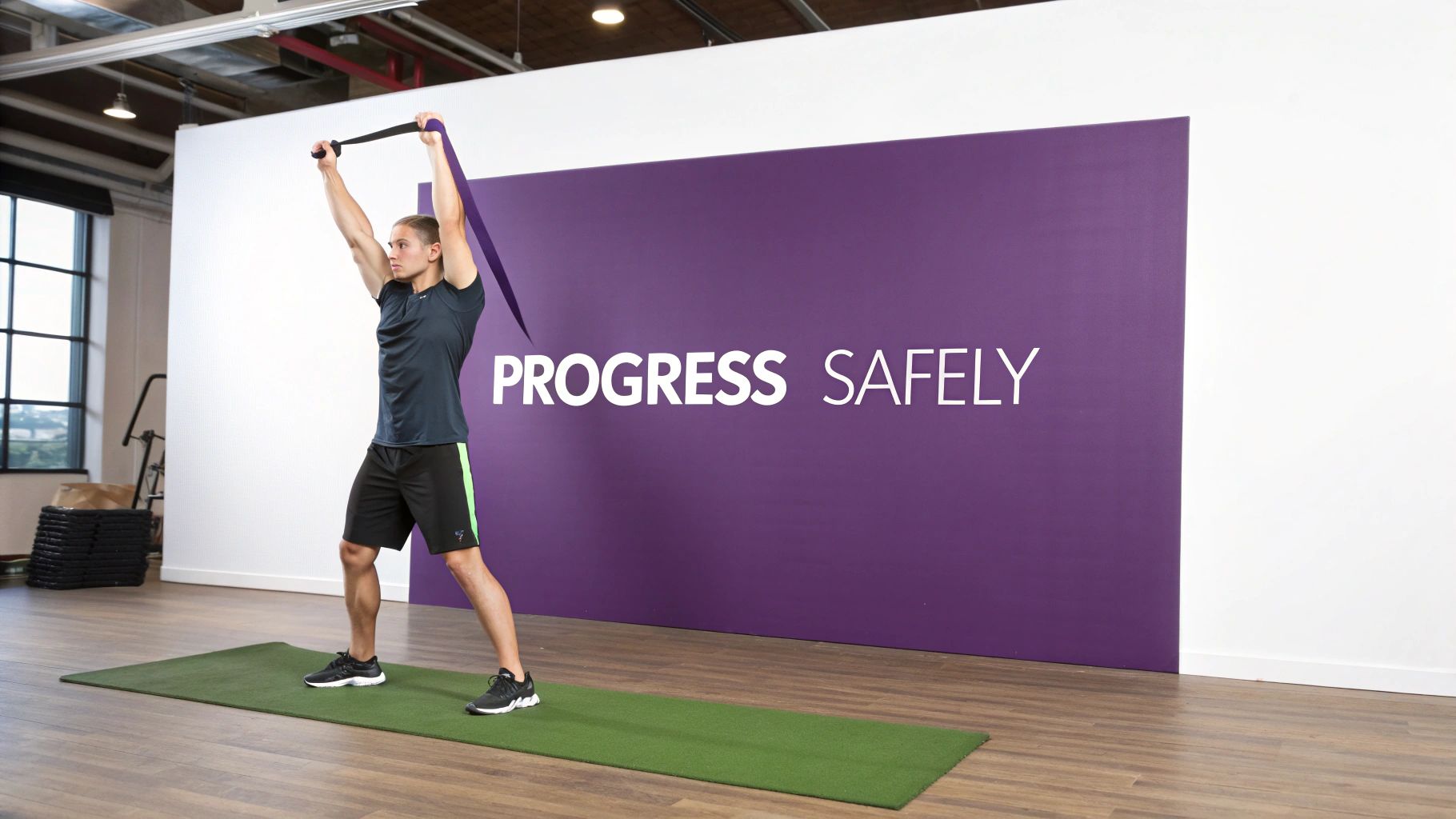
Once you’ve mastered foundational movements like the plank and bird-dog with good form, your body is ready for a new challenge. The secret to long-term strength is knowing how to progress safely—pushing your limits just enough to stimulate growth without risking injury. Smart progression isn’t about jumping to the most complex exercise you can find; it’s about making small, intentional adjustments to the routine you’ve already built.
When Are You Ready to Level Up?
Before adding weight or complexity, be honest with yourself about your readiness. If you can perform your current exercises with perfect control and feel you have more to give, that’s a great sign. You shouldn’t feel any unusual strain in your neck or lower back, only a deep engagement in your midsection.
Look for these indicators:
- You can complete all your sets and reps with impeccable form.
- The last few seconds of a plank hold feel challenging but manageable.
- You no longer wobble or lose your balance during exercises like the bird-dog.
If these criteria are met, it’s time to introduce new variables.
Smart Strategies for Progression
Increasing the challenge doesn’t always require learning a completely new workout. You can make current exercises more demanding by holding poses longer, adding more reps, or shortening rest periods between sets.
A great way to progress is by adding instability. Swapping a stable floor for an unstable surface like a stability ball or BOSU immediately forces your deep core muscles to work harder to maintain balance. For example, try performing a plank with your forearms on a stability ball; you’ll feel the difference instantly.
Progression is about making an exercise harder for the right reasons. The goal is to challenge your stability and control, not just to see how much strain you can place on your lower back.
Advanced Movements to Build On Your Foundation
Once you are comfortable with longer holds and added instability, you can begin incorporating more dynamic, multi-joint exercises. These movements teach your core to brace and stabilize against external forces, which is what real-world strength is all about.
Here are a few advanced exercises to consider:
- Pallof Press: This anti-rotation exercise is excellent for building strength in your obliques and transverse abdominis. Using a cable machine or resistance band, you press the handle straight out from your chest and resist the rotational pull.
- Renegade Row: This is an advanced variation of the plank. While holding a plank position with your hands on dumbbells, you row one weight up toward your chest while actively preventing your hips from rocking or dipping.
- Stability Ball Pike: Start in a plank position with your shins on a stability ball. Use your core to pull your hips straight up toward the ceiling, rolling the ball forward until your body is in a pike position.
It’s worth noting that balanced core training regimens have been shown to significantly boost athletic measures like jump performance and dynamic balance. Research suggests that focused workouts lasting 30 minutes or less, performed just 2 to 5 times per week, can lead to measurable gains. You can explore the research on core training and performance to see the data for yourself.
When to Seek Professional Guidance for Your Core
Building a stronger core at home is a fantastic goal, but sometimes a DIY routine isn’t enough. If you’ve hit a plateau or are dealing with nagging pain, it may be time for a more personalized approach. Learning to recognize these signals is crucial for preventing injury and building a truly resilient midsection. Feeling challenged is one thing; feeling pain is another. If you consistently experience sharp pain, a pinching sensation in your lower back, or discomfort that lingers long after your workout, it’s time to pause.
Signs You Might Need a Personalized Assessment
While normal muscle soreness is expected with a new workout, certain red flags may indicate a deeper issue. Professional guidance can be a game-changer if you’re experiencing:
- Chronic Back Pain: If your back pain doesn’t improve—or worsens—with core exercises, an imbalance is likely present. A professional can help determine if weak glutes, tight hips, or improper form is the root cause.
- Poor Posture That Won’t Budge: If you’re still slouching or feeling constant strain in your neck and shoulders despite your efforts, a trained eye can pinpoint the specific muscular imbalances holding you back.
- Post-Injury or Post-Surgery Recovery: Rebuilding your core after an injury or surgery requires a careful, methodical approach. Guidance is essential here to ensure you’re strengthening the right muscles safely and effectively.
How Professional Guidance Makes a Difference
A generic workout plan from the internet cannot see how your body moves. A personalized assessment, however, can identify your unique movement patterns, weaknesses, and muscle imbalances. This insight allows for a targeted plan designed specifically for your body’s needs.
Working with a professional isn’t a sign of failure; it’s a smart investment in your long-term health. It ensures you’re building strength on a solid, safe, and effective foundation tailored specifically to you.
Instead of guessing which exercises might be effective, you receive a clear roadmap. This often involves correcting your form on foundational movements and adding specific exercises to activate dormant muscles. The goal is to address the root cause of your discomfort, not just mask the symptoms, so you can build a core that supports you for years to come.
Frequently Asked Questions About Core Strength
Here are answers to some of the most common questions about how to strengthen core muscles.
How Often Should I Train My Core?
You don’t need to train your core every day. Like any other muscle group, your core muscles benefit from a balance of work and recovery. For most people, performing 2 to 3 dedicated core workouts per week on non-consecutive days is an effective frequency. This schedule provides enough stimulus for your muscles to adapt and grow stronger without leading to overtraining. Always listen to your body; if you feel excessively sore, an extra rest day can be beneficial.
Can I Build a Strong Core With Just Bodyweight Exercises?
Absolutely. Bodyweight exercises are highly effective for building core strength because they often focus on stability and control, teaching your midsection to function as an integrated unit. Key bodyweight exercises include:
- Planks: Build endurance throughout the entire core.
- Bird-dogs: Improve coordination and spinal stability.
- Glute Bridges: Strengthen the posterior chain, a critical component of core strength.
- Dead Bugs: Target the deep transverse abdominis without placing stress on the spine.
These foundational movements translate directly into improved functional strength for everyday activities.
How Long Until I Notice a Difference?
Consistency is more important than intensity. Most people begin to feel more stable and notice improved posture within a few weeks of consistent training. The first signs might be the ability to hold a plank for longer or bend over without hesitation. Visible changes, such as increased muscle definition, typically take longer and are also influenced by factors like nutrition and overall body composition. With a consistent routine of 2–3 core sessions per week, you can expect to notice significant functional strength gains in 4 to 8 weeks.
If you’re dealing with persistent discomfort, have hit a plateau in your progress, or want personalized guidance to ensure your form is correct, professional help can make all the difference. The team at Audubon Park Chiropractic is here to help you build a resilient core safely and effectively.
For a personalized assessment and treatment plan, contact Audubon Park Chiropractic today at (509) 327-4049 or walk in for a consultation and strengthen core muscles.
Ready to Feel Better?
Our Spokane chiropractors are ready to help. Walk-ins welcome — no appointment needed.

Dr. Michelle Snyder is a Spokane chiropractor with advanced training in women’s health, hormone balancing, pregnancy, and care for infants and children. She uses gentle low-force spinal adjustments alongside specialized therapies including Webster’s breech technique, allergy desensitization, cold laser therapy, EB cellular cleanse, and Methylation/genetic nutrition — offering patients a comprehensive, whole-body approach to wellness.
A Spokane resident for over 31 years, Dr. Michelle is deeply committed to her community, contributing time and resources to organizations including Meals-on-Wheels, Second Harvest, Ronald McDonald House, and the Union Gospel Mission.
📍 2909 W. Northwest Blvd, Spokane, WA 99205 | ☎ (509) 327-4049 audubonparkchiropractic.com
Further Reading: Healthy Living
- Natural Remedies for Muscle Spasms: What Actually Works
- The Anti-Inflammatory Foods List: Foods That Calm Pain and Foods That Fuel It
- Herniated & Bulging Disc: The Exercises That Help (and the Ones to Skip)
- What Actually Happens at Your First Chiropractic Visit & And What to Expect in the First Few Weeks
- Pricing, Insurance and What Chiropractic Actually Costs at Audubon Park
→ Complete Guide: Wellness Care at Audubon Park Chiropractic