

This post is part of our complete guide to Neck Pain Treatment in Spokane, WA. Browse the guide for more in-depth information on treatments, exercises, and recovery strategies.
Before you can find lasting relief, it’s helpful to understand what’s causing the discomfort. That nagging ache in your neck often stems from our everyday habits. Pinpointing the real cause is a critical first step to relieving the pain for good.
Understanding the Real Causes of Your Neck Pain

Most of the time, that persistent throb or sharp twinge comes down to a few key culprits that go far beyond just “tech neck.”
- Muscle Strain: This is a primary cause. We see it all the time from hours spent hunched over a computer, cradling a phone between the ear and shoulder, or even just reading in bed at an awkward angle. Holding these positions for too long exhausts your neck muscles, leaving them sore and stiff.
- Nerve Compression: The vertebrae in your neck are designed to protect the nerves running to your shoulders, arms, and hands. When poor posture or an injury causes misalignment, those vertebrae can pinch a nerve. The result? Sharp, shooting pain, numbness, or that frustrating pins-and-needles feeling.
- Joint Irritation: Just like any other joint in your body, the joints in your cervical spine can suffer from wear and tear. Repetitive stress and chronic inflammation can make even simple movements feel painful.
Identifying Your Personal Pain Triggers
The source of your discomfort is usually hiding in plain sight, tangled up in the little things you do every day without a second thought.
For instance, are you a stomach sleeper? This habit forces your head to be cranked to one side all night, twisting your cervical spine and straining everything that supports it. It’s no wonder so many people who sleep this way wake up with a stiff, aching neck.
Even how you relax on the couch matters. Slouching down to watch a movie can put a surprising amount of pressure on your neck, adding to the strain day after day.
It’s easy to dismiss neck pain as a minor annoyance, but it’s a significant global health issue. For the past 30 years, it has consistently been a leading cause of disability around the world. As populations grow and age, projections show this burden will likely increase by 2050.
The Impact of Posture on Neck Health
If we had to pick the single most common and damaging trigger for neck pain, it would be poor posture.
When your head drifts forward—a classic problem for anyone working at a desk—the strain on your cervical spine skyrockets. For every single inch your head moves forward, its effective weight on your spine increases by about 10 pounds.
This condition is often called forward head posture, and it’s a primary driver of chronic neck issues. We have a whole guide on how to fix forward head posture because it’s just that important.
Fixing it isn’t just about trying to “sit up straight.” It takes a conscious effort to rethink your workspace and daily movements. There are some fantastic tips on how to improve your posture at your desk that can help create a much healthier setup. By tackling these foundational issues, the relief strategies we’ll cover next will be far more effective.
Don’t wait — relief is closer than you think.
Immediate Relief Strategies for Quick Comfort

When that familiar twinge in your neck flares up, you want relief now. The good news is, you have a toolkit of at-home remedies that can bring quick comfort without any special equipment.
These strategies are all about calming down overworked muscles, reducing inflammation, and releasing built-up tension. Think of it as hitting the reset button on that pain cycle before it has a chance to really dig in.
Simple Stretches to Release Tension
When your neck is stiff and sore, your first instinct might be to hold it perfectly still. But gentle, controlled movement is actually one of the best things you can do. The goal is to carefully release that tightness and get things moving again. Just remember to go slow and never push into sharp pain.
Here are a few simple stretches that are often recommended for neck pain:
- Gentle Side Tilt: Sitting or standing tall, slowly bring your right ear toward your right shoulder. You’re not trying to touch them, just feel a light stretch. Hold it for 15-20 seconds, breathe, and then come back to the center before repeating on the left side.
- Forward and Backward Tilt: Gently drop your chin to your chest, feeling the stretch along the back of your neck. Hold for about 15 seconds. Then, slowly look up toward the ceiling to open up the front of your neck.
- Slow Neck Rotations: Look straight ahead, then turn your head to the right as if you’re looking over your shoulder. Go as far as is comfortable and hold for 15 seconds. Return to the start and do the same on the left.
These movements are fantastic for improving your range of motion. If you want a more detailed guide, you can learn more about the kinds of active range of motion exercises that really support long-term neck health.
Using Hot and Cold Therapy Correctly
Heat and ice are classic pain-relief tools, but using the right one at the right time is the secret to making them work. They have very different jobs.
When to Use Cold Therapy (Ice)
Reach for a cold pack within the first 24 to 48 hours of an injury, or anytime the pain feels sharp and inflamed. Cold constricts blood vessels, which is great for reducing swelling and numbing the immediate pain.
- Wrap an ice pack or a bag of frozen peas in a thin towel.
- Place it on the sore spot for 15-20 minutes max.
- Give your skin a break for at least an hour before you ice it again.
When to Use Heat Therapy
Once that initial sharp phase is over, or for that nagging, chronic muscle ache, heat is your best friend. Heat boosts blood flow, helping to relax those tight muscles and soothe the ache.
- A heating pad, a warm shower, or a warm compress all work well.
- Apply heat for 15-20 minutes.
- Using heat right before you do your gentle stretches can help warm up the muscles, making them more pliable.
A crucial step in alleviating neck discomfort involves understanding and applying effective methods to reduce muscle tension. Addressing the underlying tightness is often the key to finding lasting comfort.
The Role of Mindfulness and Breathing
Ever notice how your shoulders creep up toward your ears when you’re stressed? That’s a direct line to neck pain. Stress causes us to unconsciously clench the muscles in our neck and shoulders, leading to stubborn aches and knots.
A simple breathing exercise can make a world of difference. Try this:
- Find a comfortable seated position, back straight but not rigid.
- Close your eyes. Put one hand on your belly.
- Breathe in slowly through your nose for a count of four, feeling your hand rise.
- Hold that breath for a count of four.
- Exhale slowly through your mouth for a count of six, feeling your hand fall.
- Repeat this for 3-5 minutes.
This kind of focused breathing helps calm your entire nervous system and gives you a moment to consciously let go of the tension you didn’t even realize you were holding.
Building a Pain-Free Workspace Environment
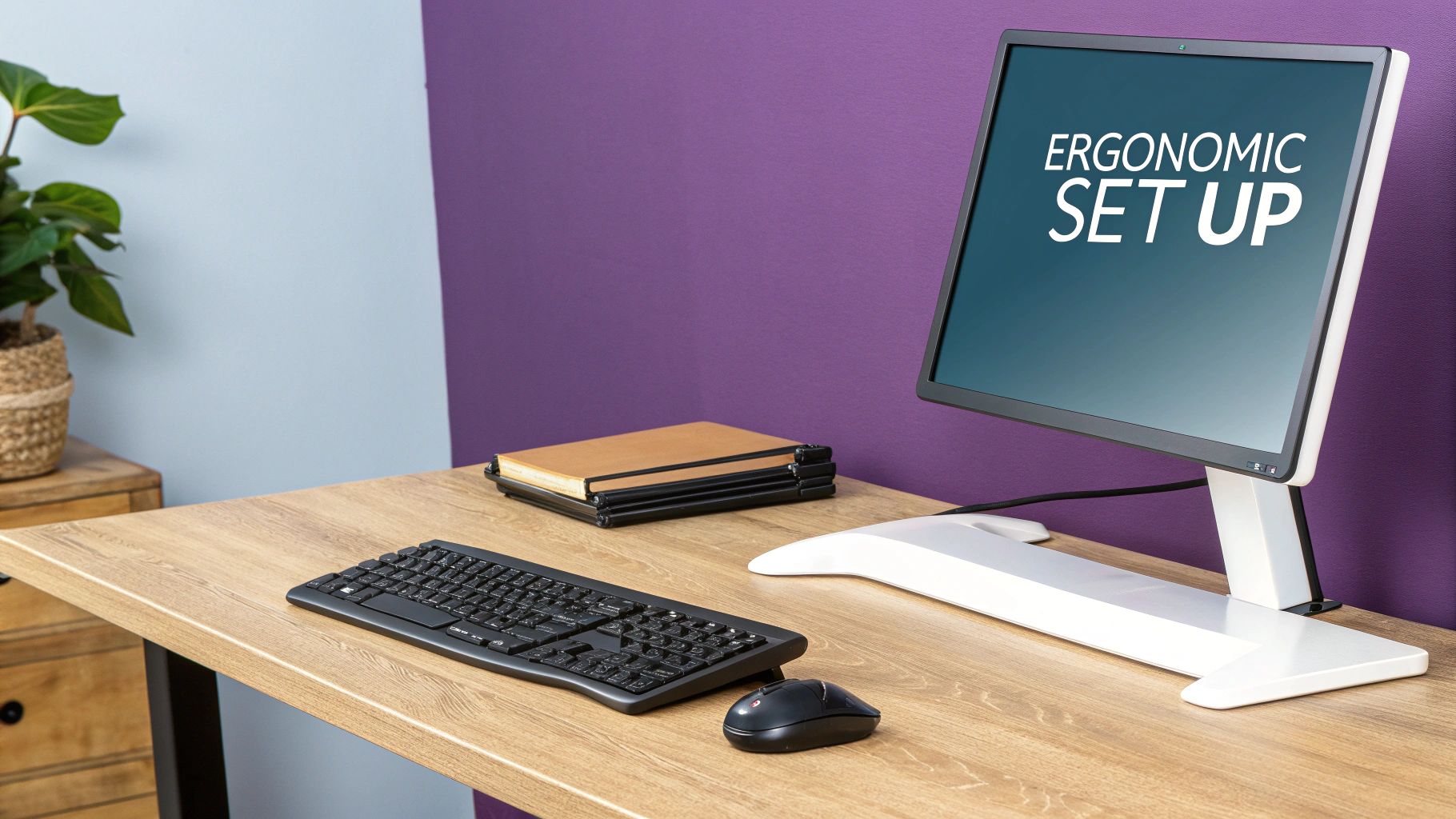
For so many of us, our nine-to-five routine is a primary contributor to chronic neck strain. You can do all the stretches in the world, but if you spend hours every day hunched over a keyboard or craning your neck at a poorly positioned screen, you’re just fighting a losing battle.
The goal isn’t just to buy a fancy chair. It’s about turning your workspace—whether it’s a corner office or your kitchen table—into a supportive environment. Let’s make good posture the easy, natural choice.
Optimizing Your Desk for Spinal Alignment
Your desk setup dictates your posture for thousands of hours every year. Even tiny misalignments add up, leading to serious muscle strain and joint irritation over time. Let’s get the key components dialed in so you can relieve neck pain just by adjusting your surroundings.
- Monitor Height is Key: The top third of your screen should be at your direct eye level. This one tweak stops you from constantly tilting your head down—a major cause of “tech neck.” If you’re on a laptop, using a stand or even a sturdy stack of books is essential to get that screen up where it belongs.
- Keyboard and Mouse Placement: You shouldn’t have to reach. Keep your keyboard and mouse close enough that your elbows stay comfortably by your sides, bent at about a 90-degree angle. Reaching forward is a one-way ticket to shoulder and neck strain.
- Chair Support and Alignment: Adjust your chair so your feet are flat on the floor with your knees at a 90-degree angle. You also need solid lumbar support to maintain the natural curve in your lower back. When your low back is supported, your neck and head naturally fall into a healthier position.
The impact of poor workplace ergonomics is significant. It’s not just you; neck pain is a global problem. Recent data shows there were 159 million existing cases and 32.6 million new cases in 2021 alone. This isn’t a minor inconvenience—it’s a widespread public health issue. You can explore the full research on neck pain trends to see just how prevalent this has become.
To make this easier, here’s a quick checklist to audit your own desk setup.
Ergonomic Checklist for a Pain-Free Desk Setup
Use this quick reference guide to assess and correct your workspace ergonomics. A few small adjustments can make a world of difference for your neck and spine alignment.
| Workspace Element | Optimal Position | Common Mistake to Avoid |
|---|---|---|
| Monitor/Screen | Top third of the screen is at eye level, roughly an arm’s length away. | Looking down at a laptop screen or up at a monitor that’s too high. |
| Chair Height | Feet flat on the floor, knees at a 90-degree angle. | Dangling feet or knees pushed up higher than your hips. |
| Lumbar Support | Chair provides firm support for the natural curve of your lower back. | Slouching forward with a rounded lower back, leaving a gap between you and the chair. |
| Keyboard/Mouse | Elbows at your sides, bent at a 90-degree angle. Wrists are straight, not bent up or down. | Reaching forward for the keyboard or having the mouse too far to the side. |
| Desk Height | Allows for the 90-degree arm angle described above without shrugging your shoulders. Use a footrest if needed. | Working at a desk that’s too high, causing you to raise your shoulders, or too low, forcing you to hunch over. |
Getting these elements right creates a strong foundation, but it’s only half the battle.
Embracing Movement Throughout the Day
Even the most perfectly ergonomic setup can’t save you from the negative effects of staying in one position for too long. Your body was made to move. Incorporating frequent, small “movement snacks” is one of the best things you can do to prevent stiffness.
The best posture is your next posture. Your body craves variety, so the goal isn’t to find one perfect position and lock into it, but to change positions frequently throughout the day.
This doesn’t mean you need to stop everything for a full workout. It’s all about micro-breaks.
Quick Desk Stretches and Activities
Set a timer on your phone for every 30-45 minutes as a simple reminder to get up or just shift your position. Here are a few simple things you can do right at your desk:
- Shoulder Rolls: Gently roll your shoulders up toward your ears, then back and down. Do this 5-10 times to release that tension building in your upper back and neck.
- Overhead Reach: Clasp your hands together and stretch your arms straight up to the ceiling. Hold for 10-15 seconds to feel that stretch through your entire spine.
- Seated Spinal Twist: While sitting, gently twist your upper body to one side, using your chair’s armrest for a little leverage. Hold for 15 seconds, then switch sides.
- Stand Up and Walk: Simply getting up to grab some water can reset your posture and get your blood flowing again.
By combining an ergonomic workspace with a commitment to regular movement, you can fundamentally change the impact your job has on your neck health.
Strengthening Your Neck for Long-Term Resilience
Getting rid of the immediate ache is one thing, but building a neck that resists pain in the first place is the ultimate goal. While stretches feel great in the moment, they’re often a temporary fix. True, long-lasting relief comes from strengthening the deep muscles that support your neck.
Think of these muscles as your body’s internal scaffolding for your head and spine. When they’re weak, bigger muscles that aren’t meant for the job have to take over, leading to that all-too-familiar strain and chronic discomfort. A gentle, consistent strengthening routine is how we correct those imbalances and build a solid foundation.
Foundational Exercises for Neck Stability
The idea here isn’t to bulk up. It’s about building endurance and fine-tuned control. You’ll want to perform these movements slowly and with intention, paying close attention to your form to avoid any strain. If you feel a sharp pain at any point, stop immediately.
Here are core exercises often recommended for building a stronger, more resilient neck:
- Chin Tucks: This is a key exercise for anyone battling “forward head posture.” While sitting or standing tall, gently pull your chin straight back, as if you’re trying to make a double chin. You should feel a stretch at the base of your skull and a subtle tightening of the muscles in the front of your neck. Hold it for 5 seconds and aim for 10 repetitions.
- Isometric Neck Holds: These build strength without any actual movement. Place your palm on your forehead and gently press your head forward while your hand provides resistance. Hold that gentle push for 5-10 seconds. Do the same thing with your hand on the back of your head, and then on each side, always resisting the movement.
- Resistance Band Rows: A strong upper back provides crucial support for the neck. Grab a resistance band with both hands and, while sitting or standing, pull the band toward your chest. The key is to squeeze your shoulder blades together and keep your elbows tucked in close to your body.
Creating a Consistent Strengthening Routine
When it comes to these exercises, consistency beats intensity every time. You don’t need to block out an hour in your day. Just weave short, simple sessions into your weekly schedule to build that lasting strength.
This guide shows what a balanced week could look like.
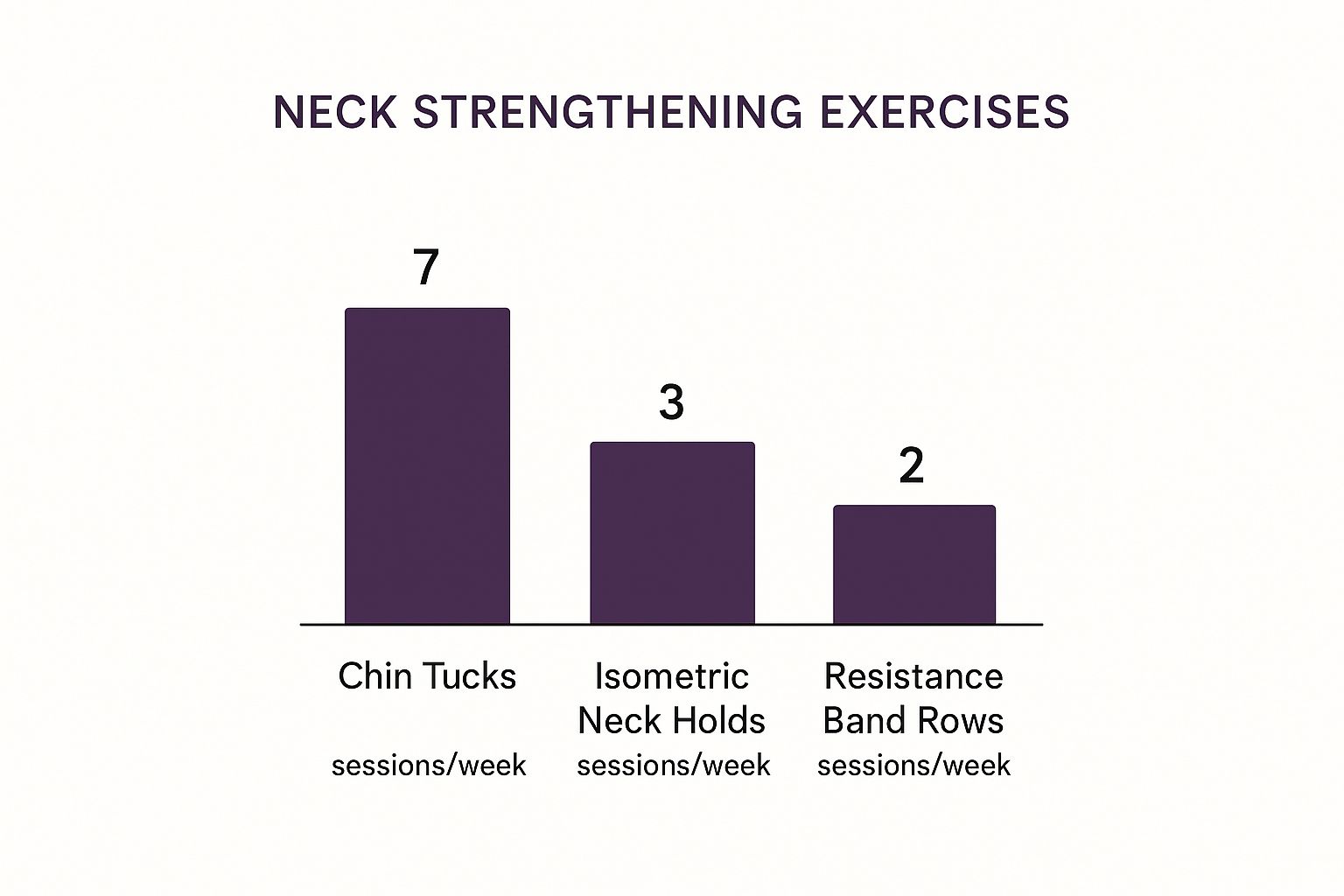
As you can see, gentle daily exercises like Chin Tucks are the bedrock of the routine. The more focused strength work can be done just a few times a week.
This balanced approach keeps those deep stabilizing muscles activated without overdoing it. Over time, your neck will be much better equipped to handle the daily grind of work and life.
Strengthening your neck is a proactive strategy. You’re moving beyond just reacting to pain and instead building a defense system that makes future flare-ups far less likely. It’s a shift from temporary fixes to a permanent solution.
By combining these targeted exercises with the posture and ergonomic tips we’ve already covered, you create a powerful, multi-faceted plan to get rid of neck pain for good.
Knowing When to Seek Professional Care
While the strategies we’ve covered are fantastic for handling everyday aches and stiffness, there are times when neck pain is more than just a nuisance. Sometimes, it’s your body’s way of signaling it’s time to bring in a professional.
Knowing how to read those signs is key. Ignoring a problem that needs professional attention can turn a small issue into a much bigger one. Professional care isn’t about just masking symptoms; it’s about finding and fixing the root cause for good.
Recognizing Red Flags
Certain symptoms suggest that something more serious is going on than a simple muscle strain. If you experience any of the following, it’s time to shift from self-care to a professional evaluation.
- Pain Radiating Down Your Arms or Legs: If the pain shoots from your neck into your shoulders, arms, or fingers, that’s a classic sign of an irritated or pinched nerve in your cervical spine.
- Numbness or Tingling: That “pins and needles” feeling or a loss of sensation in your hands or arms is a major red flag. It means nerve signals are being disrupted and should be addressed right away.
- Persistent, Severe Headaches: If you’re dealing with frequent, intense headaches that feel like they start at the base of your skull, it’s time to get it checked out.
- Pain Following an Accident or Injury: Any neck pain that appears after a car accident, a fall, or another form of trauma needs a professional look—even if it seems minor at first.
Globally, neck pain is a growing problem, and as the world’s population ages, this trend is expected to continue. You can learn more about the global burden of neck pain and why effective solutions are so crucial. When self-care isn’t cutting it, investing in professional help is a smart move for your long-term health.
To help you decide, here’s a quick comparison of what you can manage at home versus when it’s time to see a chiropractor.
Self-Care vs. Professional Help for Neck Pain
| Symptom | Recommended At-Home Action | When to Seek Chiropractic Care |
|---|---|---|
| Mild stiffness from sleeping wrong or a long day at the desk. | Gentle stretches, applying a heat pack, and being mindful of posture. | If the stiffness lasts more than a few days or doesn’t improve with self-care. |
| Dull, achy pain localized in the neck muscles. | Ice for the first 24-48 hours, followed by heat. Rest and avoid strenuous activity. | If the ache becomes sharp, constant, or significantly impacts your daily activities. |
| Tension headaches that feel like a tight band around your head. | Over-the-counter pain relievers, stress reduction techniques, and gentle neck stretches. | If headaches become frequent, severe, or are accompanied by dizziness or nausea. |
| Sharp, shooting pain that travels down your arm or leg. | Do not attempt to “stretch it out.” Limit movement that aggravates the pain. | Immediately. This is a classic sign of nerve compression that requires a professional diagnosis. |
| Numbness, tingling, or weakness in your arms or hands. | No specific at-home action is recommended. Avoid aggravating positions. | Immediately. These are serious red flags indicating potential nerve issues. |
| Any pain following a fall, car accident, or other trauma. | Do not try to self-treat. Immobilize as much as possible and seek care. | Immediately. Even if symptoms seem minor, there could be underlying damage. |
This table is a general guide, but the golden rule is simple: when in doubt, get it checked out.
The Role of a Chiropractor in Neck Pain Relief
When you do need professional help, a chiropractor is positioned to get to the bottom of most types of neck pain. The practice is built on the principle that the body works best when the spine and nervous system are properly aligned.
A chiropractor looks at the whole picture—the structure of your spine. The focus is on finding and correcting misalignments, which are called subluxations, that put pressure on nerves and create various issues.
The goal of chiropractic care is to restore your body’s natural ability to heal itself. By correcting spinal alignment, we can alleviate pressure on the nervous system, which often provides lasting relief from the source of the pain.
A visit starts with a thorough evaluation. A chiropractor will talk about your health history, your daily routines, and do a physical exam to figure out exactly what’s going on. From there, a care plan is created that often includes gentle, precise adjustments to your cervical spine.
These adjustments help bring proper motion back to the joints, take pressure off the nerves, and ease muscle tension. Many patients report a significant reduction in pain, along with better movement. Knowing how to choose a chiropractor that fits your needs is an important first step.
Taking the Next Step Towards Relief
You now have a solid toolkit for tackling neck pain, from quick-relief stretches and ergonomic fixes to long-term strengthening exercises. The real secret to a pain-free life isn’t finding one magic bullet. It’s about weaving these different strategies together into a consistent routine that supports your neck day in and day out.
Think about what triggers your personal pain. Is it your desk setup? The way you sleep? The stress that creeps into your shoulders? Once you know the cause, you can take meaningful steps to get ahead of the pain instead of just reacting to it.
Building Your Personal Plan for a Healthy Neck
The techniques in this guide are like building blocks. Your job is to assemble them into a sturdy foundation for a neck that feels great.
- Make it a daily thing: Sprinkle gentle stretches and posture checks throughout your day.
- Fix your workspace: Turn your desk from a pain point into a place of support. This is one of the biggest game-changers for office workers.
- Build resilience: A few minutes of strengthening exercises each week makes a massive difference in how your neck handles daily strain.
This combination creates lasting change, helping you fix what’s actually causing the problem.
The best strategy is always the one you actually stick with. When it comes to neck health, consistency beats intensity every time. Small, positive changes you make every day add up to significant, long-term relief.
When to Call for Professional Support
While these at-home methods work wonders for many people, it’s just as important to know when you need a professional to take a look. If your pain won’t quit, is getting worse, or if you’re feeling numbness or pain shooting down your arm, don’t wait it out.
Deciding to get hands-on treatment isn’t a failure—it’s a smart move. A chiropractor can get to the bottom of what’s going on, give you an accurate diagnosis, and create a plan specifically for you. Sometimes there are underlying issues that self-care alone can’t fix, and a professional can spot those right away. Taking that step is a powerful way to get back in control.
Don’t let neck pain run your life any longer. If you’re in the Spokane area and ready for lasting relief, our team at Audubon Park Chiropractic is here to help you find the true source of your discomfort.
Call Audubon Park Chiropractic today at (509) 327-4049 or walk in for treatment. We’re ready to help you on your journey to a pain-free life.
Ready to Feel Better?
Our Spokane chiropractors are ready to help. Walk-ins welcome — no appointment needed.

Dr. Michelle Snyder is a Spokane chiropractor with advanced training in women’s health, hormone balancing, pregnancy, and care for infants and children. She uses gentle low-force spinal adjustments alongside specialized therapies including Webster’s breech technique, allergy desensitization, cold laser therapy, EB cellular cleanse, and Methylation/genetic nutrition — offering patients a comprehensive, whole-body approach to wellness.
A Spokane resident for over 31 years, Dr. Michelle is deeply committed to her community, contributing time and resources to organizations including Meals-on-Wheels, Second Harvest, Ronald McDonald House, and the Union Gospel Mission.
📍 2909 W. Northwest Blvd, Spokane, WA 99205 | ☎ (509) 327-4049 audubonparkchiropractic.com
Further Reading: Neck
- How to fix rounded shoulders: A Practical Guide
- Chiro Treatment for Vertigo to Find Balance
- Chiropractic for Seniors & Managing Back Pain, Arthritis and Age-Related Stiffness Safely
- Gentle Chiropractic for Nervous Patients & Options that Don’t Involve Cracking
- What to Do if You Wake Up with Neck or Back Pain