

This post is part of our complete guide to Back Pain Treatment in Spokane, WA. Browse the guide for more in-depth information on treatments, exercises, and recovery strategies.
That nagging, persistent ache in your lower back can feel like an unwelcome guest who’s overstayed their welcome. But here’s the thing—you don’t have to just live with it. Learning how to relieve lower back pain naturally is all about getting to the root of the problem, one gentle, targeted step at a time. It starts with understanding why it hurts and then building a stronger, more resilient back.
Why Your Lower Back Hurts and How to Fix It
If you’re struggling with lower back pain, you’re in good company. This isn't just a personal annoyance; it's a massive global health issue that seriously impacts people's lives. Back in 2020, an estimated 619 million people across the globe were dealing with lower back pain, making it the top reason for disability for over three decades. And it's not slowing down—projections suggest that number could swell to 843 million by 2050.
The discomfort you feel is rarely from a single event. It's more often the result of small, everyday stressors piling up over time, slowly pulling your spine out of its natural alignment.
Common Triggers for Lower Back Discomfort
So many of our daily habits contribute to back strain without us even realizing it. The first step to feeling better is figuring out what those triggers are.
- Sitting for Hours: Being parked at a desk or in a car all day leads to tight hip flexors and weak glutes, a combination that yanks on your lower back and creates pain.
- Poor Posture: Slouching when you stand or sit puts a ton of uneven pressure on your spinal discs and vertebrae. Over time, that adds up.
- Lifting the Wrong Way: Using your back instead of your legs to pick up something—even if it's not that heavy—is a classic recipe for a sudden, sharp pain you won't soon forget.
On top of these habits, chronic lower back pain is often tied to underlying inflammation. If you want to dig deeper into this connection, it's worth understanding how to reduce inflammation naturally.
To help you get started, here's a quick look at the effective, natural strategies we'll cover in this guide. Think of this as your roadmap to finding both immediate and long-term relief.
Core Strategies for Natural Lower Back Pain Relief
| Strategy Type | Primary Goal | Examples You'll Learn |
|---|---|---|
| Movement & Stretching | Improve flexibility and release tension | Gentle spinal twists, cat-cow, knee-to-chest |
| Core Strengthening | Build a supportive "corset" for your spine | Bird-dog, glute bridges, planks |
| Postural Adjustments | Reduce daily strain on your back | Ergonomic setups, proper lifting techniques |
| Lifestyle & Nutrition | Decrease inflammation and support healing | Anti-inflammatory foods, hydration, better sleep |
These aren't just random exercises; they're foundational pillars for building a healthier back from the ground up.
Moving Beyond Temporary Fixes
Lasting relief isn't about popping a pill to mask the symptoms. It’s about tackling the root causes with a holistic approach that combines gentle movement, targeted exercises, and smarter daily habits. It’s all about empowering your body to heal itself. You can get more details on what’s causing your discomfort in our guide on the common causes of lower back stiffness.
The goal is to move from a reactive state of managing pain to a proactive one of building strength and resilience. This shift in mindset is crucial for long-term back health.
By focusing on these core ideas, you can take real, meaningful steps to not only ease the pain you're feeling now but also prevent it from coming back. It’s time to get back to living your life to the fullest.
Don’t wait — relief is closer than you think.
Gentle Stretches That Provide Immediate Relief
When your lower back is screaming, the last thing you probably want to do is move. But believe it or not, gentle, targeted motion is often the best medicine. It’s what your tight muscles need to finally release that built-up tension and get some healing blood flow moving again.
The trick is to listen to your body. You should never, ever push into a sharp or shooting pain. These movements aren't about being a hero at the gym; they're restorative. Think of it as a way to gently wake up your spine in the morning or as a soothing routine to decompress after a long day hunched over a desk. You're just giving your back the gentle release it’s been craving.
Foundational Stretches for Your Back
Find a comfortable spot on the floor—a yoga mat or a soft carpet is perfect. The focus here is on slow, controlled movements that you can pair with your breath.
- Cat-Cow Stretch: This one is a classic for a reason. Start on your hands and knees. As you inhale, let your belly drop and look up toward the ceiling (that's the "Cow" part). As you exhale, round your spine up, tucking your chin to your chest (the "Cat"). This simple back-and-forth is fantastic for gently waking up the entire spine.
- Pelvic Tilts: Lie on your back, bend your knees, and plant your feet flat on the floor. Now, just gently flatten your lower back against the floor by tightening your ab muscles. Hold it for a few seconds, then release. It’s a tiny movement, but it does wonders for activating your core and taking pressure off the lumbar spine.
- Knee-to-Chest Stretch: Still on your back, gently pull one knee in toward your chest, holding it for 20-30 seconds. You should feel a nice, gentle stretch in your lower back. Switch legs and repeat.
This whole process—understanding the problem, adding gentle movement, and then building supportive strength—is key to finding lasting relief.
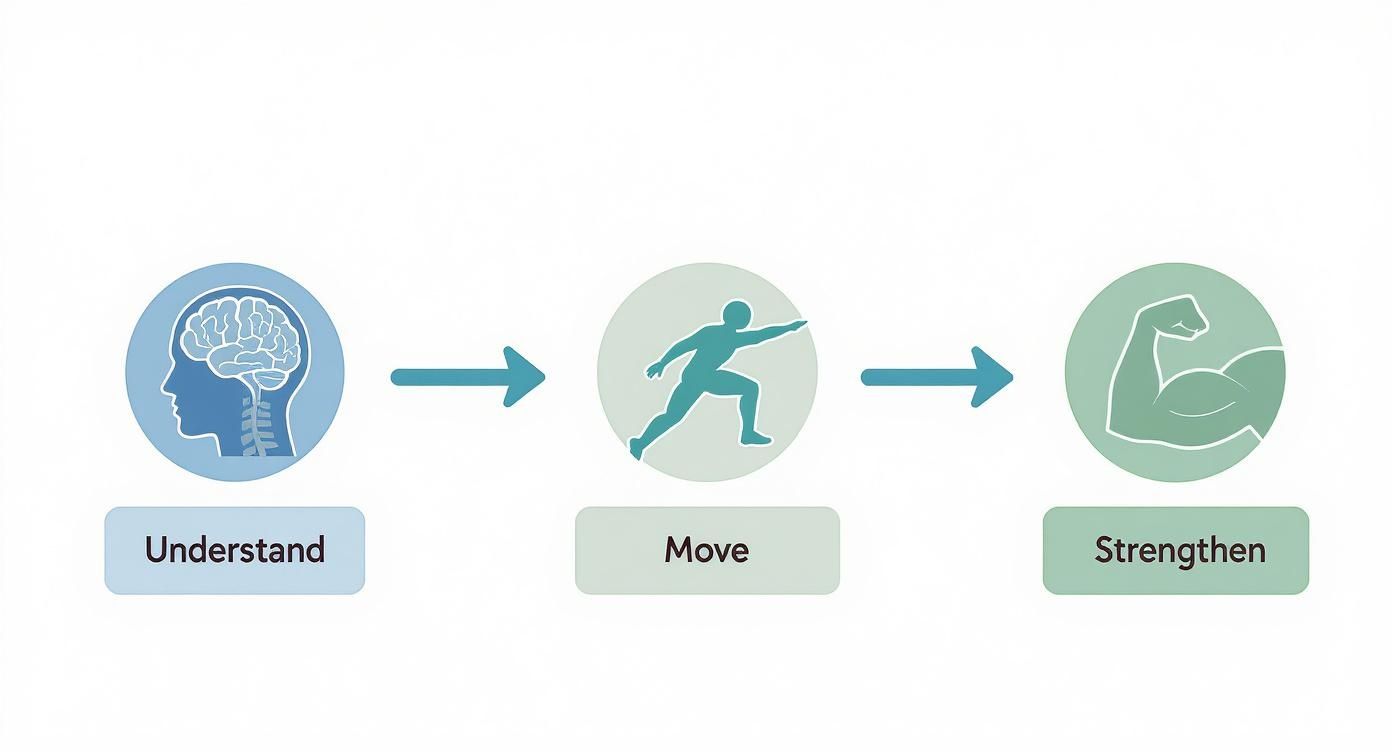
As the infographic shows, real relief isn’t a one-and-done fix. It's a journey that addresses both the immediate ache and the long-term habits that prevent it from coming back.
Integrating Movement into Your Daily Life
When it comes to back pain, consistency beats intensity every time. Just five to ten minutes of stretching each day can make a world of difference in how you feel. This is especially true for anyone who spends long hours at a desk. We put together a guide with the best stretches for office workers specifically to help counteract the damage from all that sitting.
Remember, the motto for back pain relief is "motion is lotion." Gentle movement lubricates the joints in your spine and delivers vital nutrients to the surrounding tissues, which helps reduce stiffness and pain.
If you want to combine that flexibility with a bit of strength, exploring yoga for joint health can be a game-changer for your lower back. Yoga’s focus on mindful movement and breathing is a powerful tool for managing discomfort and improving your overall spinal health.
Once you get comfortable with these foundational stretches, you can start doing them for a little longer or explore other gentle movements that feel good. The most important thing is simply to stay active without causing any extra strain.
Building Core Strength to Protect Your Spine
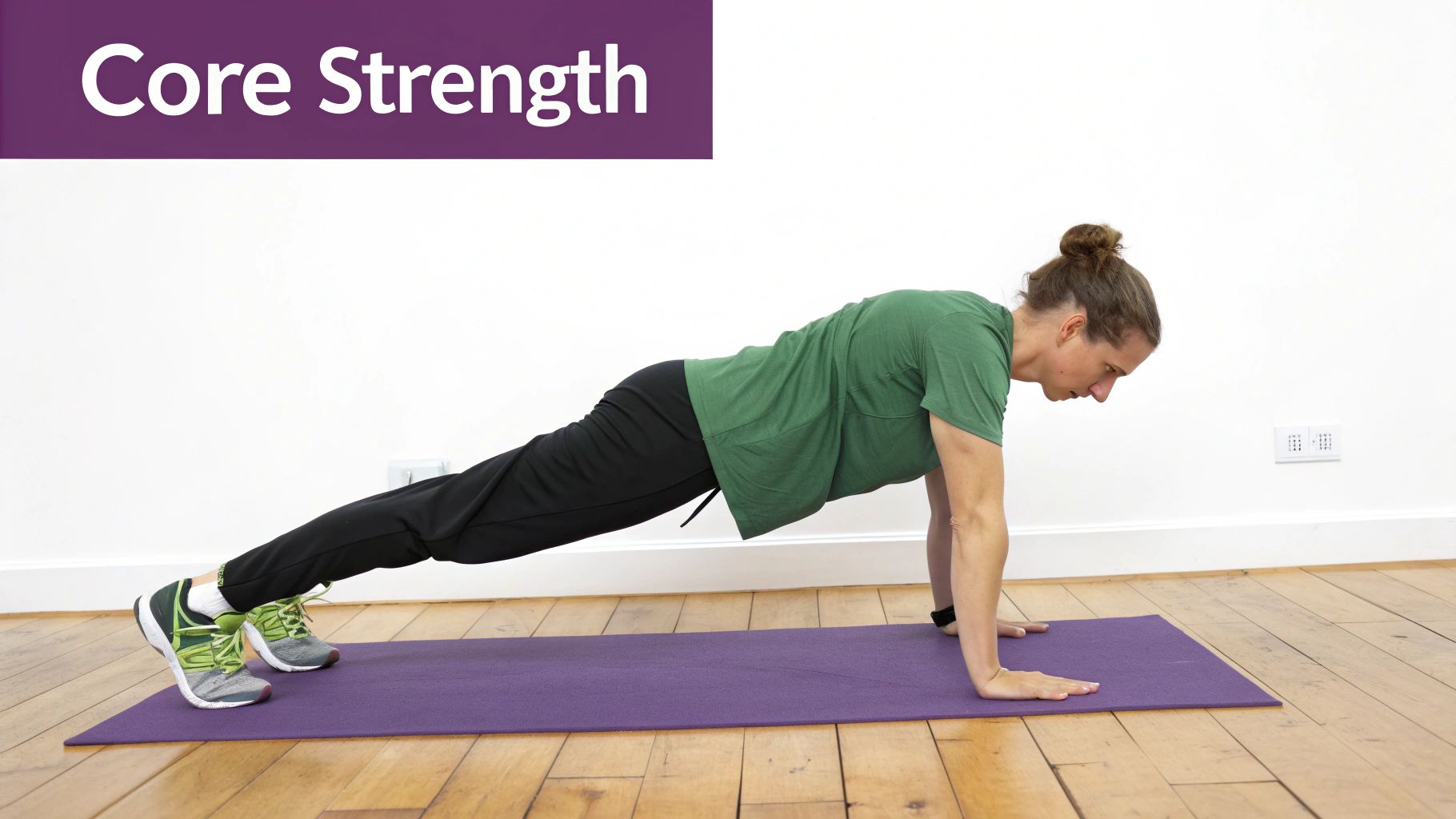
While gentle stretches feel great and offer immediate relief, building long-term resilience is the real game-changer. Think of your core muscles—your abs, obliques, and lower back—as a natural back brace. When they're strong, they take a huge amount of pressure off your spinal discs and ligaments, which is key to preventing future flare-ups.
This isn't about chasing a six-pack or doing endless crunches, which can actually put more strain on a sensitive lower back. Instead, we're focusing on low-impact, stabilizing exercises that teach all those muscles to work together as a team. Moving from temporary fixes to a solid foundation of strength is how you get lasting results.
Why Your Core Is Your Back's Best Friend
When your core is weak, the smaller, more delicate muscles around your spine are forced to pick up the slack. This leads to them getting tired, strained, and eventually causing chronic pain. On the flip side, a strong, engaged core creates a solid base that helps distribute weight and absorb shock from everyday movements—walking, lifting, even just sitting at a desk.
Low back pain is a massive issue, especially for working folks. In 2021 alone, there were a reported 452.8 million cases globally among people aged 15-64. That’s a staggering 52.66% increase since 1990. These numbers really drive home how important proactive strategies like core strengthening are for fighting the strain of modern life. You can learn more about these global health trends and how they connect to natural solutions.
Your core is the central link in a chain connecting your upper and lower body. If that link is weak, the entire structure becomes unstable, and your lower back often pays the price.
Safe and Effective Core-Building Exercises
With these exercises, it's all about quality over quantity. Proper form is so much more important than how many reps you can crank out. You want to move slowly and deliberately, really concentrating on engaging the right muscles.
Here are three excellent, back-safe exercises to get you started:
The Bird-Dog: Start on all fours, with your hands right under your shoulders and your knees under your hips. Keeping your back flat, extend one arm straight forward and the opposite leg straight back. Hold it for a few seconds, focusing on keeping your hips perfectly level. Come back to the starting position and switch sides. This move is fantastic for your balance and strengthens those deep muscles that run along your spine.
Glute Bridges: Lie on your back, knees bent, with your feet flat on the floor about hip-width apart. Squeeze your glutes and lift your hips up until your body makes a straight line from your shoulders to your knees. Hold that for a moment before you slowly lower back down. This is critical for waking up your glute muscles, which are often weak in people with back pain.
Modified Plank: Get on your hands and knees, then walk your hands forward until your body is in a straight line from your head down to your knees. Pull your belly button in toward your spine to engage your core. Try to hold this for 20-30 seconds, making sure your hips don't start to sag. It's a great way to build endurance in your abs without straining your back.
Simple Changes to Your Daily Habits and Workspace
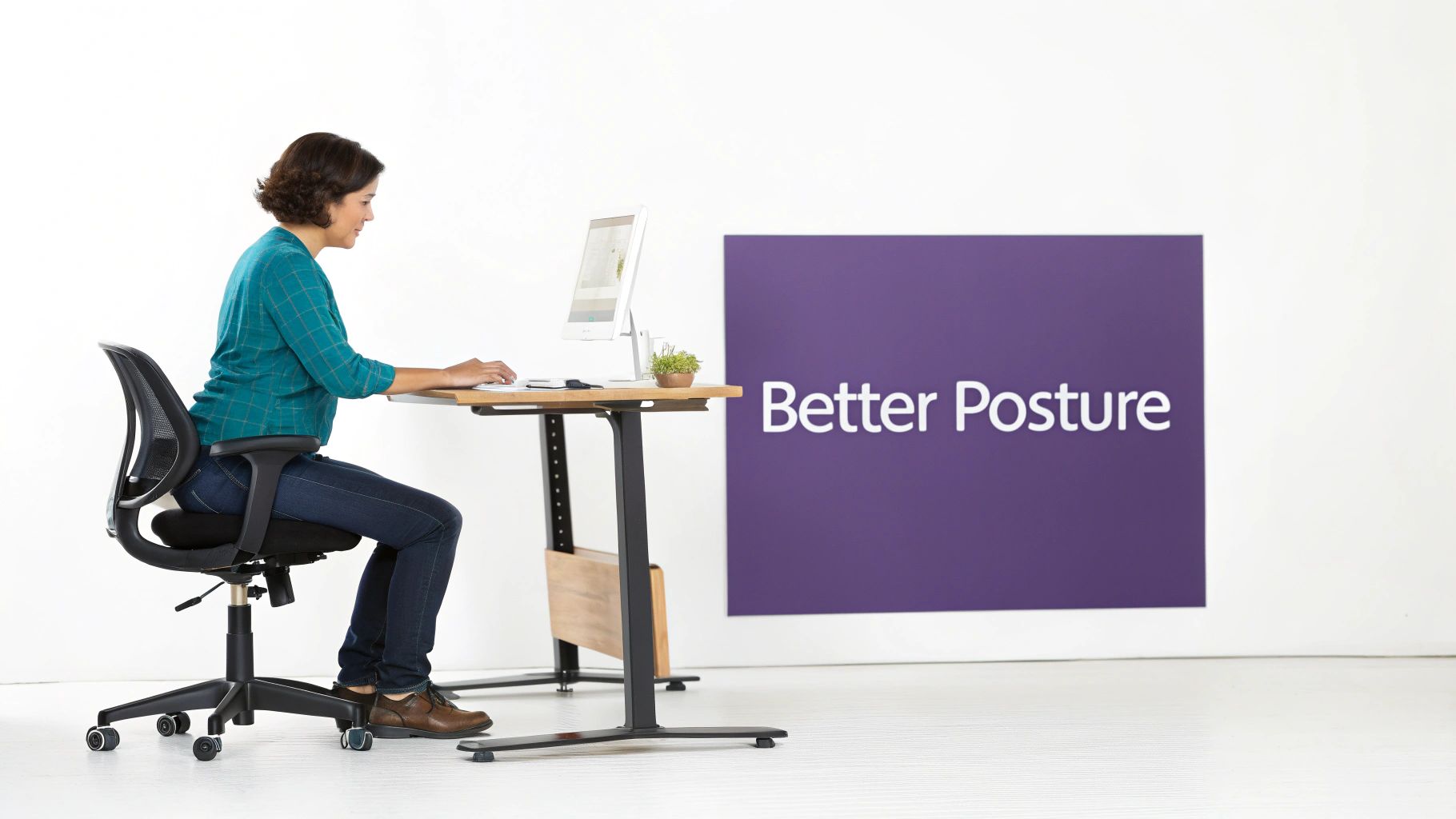
More often than not, that nagging ache in your lower back isn't the result of a single, dramatic injury. It's the slow burn from the little things you do every day. The way you sit at your desk, lift a box, or even how you sleep can either protect your spine or place it under constant, damaging stress.
The good news is that making small, conscious changes to these daily habits can make a world of difference.
Think about it: you spend hours in your workspace. If that space isn't set up to support your body's natural curves, you're fighting an uphill battle against back pain from the moment you clock in. The goal is to transform your environment from a source of strain into a powerful tool for healing.
Crafting an Ergonomic Workspace
Whether you're glued to a computer or on your feet all day, your posture is everything. An ergonomic setup isn't about fancy equipment; it's about minimizing physical effort and discomfort by keeping your body in a neutral, relaxed position.
If You Work at a Desk: First, adjust your chair so your feet are flat on the floor and your knees are at a comfortable 90-degree angle. Your monitor needs to be at eye level—this is key to stopping you from hunching forward. Position your keyboard so your elbows can rest easily at your sides.
If You Have a Standing Job: Supportive shoes are non-negotiable. Also, look into getting an anti-fatigue mat. It’s a simple addition that can dramatically reduce the strain on your back, legs, and feet over a long shift.
These simple adjustments help maintain the natural, healthy curve of your lumbar spine, taking a huge load off the muscles and discs that work so hard to support you.
Your best posture is your next posture. Even with a perfect setup, staying frozen in one position causes stiffness. Set a reminder on your phone to get up, stretch, and walk around for a few minutes every single hour.
Smarter Lifting and Bending
One of the most frequent ways people hurt their lower back is by lifting something the wrong way. And it doesn't have to be a heavy piece of furniture; many patients are sidelined by picking up a laundry basket incorrectly.
The golden rule is simple: always lift with your legs, not your back.
Keep your back straight, bend at your knees and hips, and hold the object close to your body as you power up with your legs. This technique lets your powerful leg muscles (your quads and glutes) do the work, sparing the delicate structures in your spine.
Optimizing Your Sleep Position
You spend about a third of your life in bed, so your sleep posture has a massive impact on your back health. The best positions are the ones that keep your spine in a neutral alignment, reducing stress all the way from your neck down to your hips.
Sleeping Positions for a Healthier Back
| Position | How It Helps | Pro Tip |
|---|---|---|
| On Your Back | This is often ideal because it distributes your weight evenly across the widest surface of your body. | Tuck a small pillow under your knees. This helps maintain the natural curve of your lower back and instantly relieves pressure. |
| On Your Side | This can help keep your spine elongated and straight, preventing twisting. | The trick here is to place a pillow between your knees. It stops your top leg from sliding forward and pulling your spine out of alignment. |
Try to avoid sleeping on your stomach if you can. It flattens your spine's natural curve and forces you to twist your head, which is a recipe for both back and neck pain. By making these mindful changes to your daily routines, you can take a significant step toward a pain-free life.
How Chiropractic Care Supports Natural Healing
While consistent home care—stretching, strengthening, and building better habits—is absolutely fundamental, sometimes your body just needs a professional hand to guide the healing process.
If your efforts at home aren't bringing the relief you need, chiropractic care can be an incredibly effective next step. It works in harmony with all your other natural methods to get to the root mechanical issues in your spine.
This isn't about just "cracking" your back. It's a precise and gentle approach focused on restoring proper function to your body. By addressing misalignments, a chiropractor can help your body heal itself much more efficiently.
Restoring Proper Spinal Alignment
At the very heart of chiropractic care is the spinal adjustment. This isn't a forceful process; it’s a targeted technique used to correct what are called subluxations—minor misalignments of the vertebrae.
These misalignments can irritate nerves, strain muscles, and interfere with your body's ability to communicate with itself.
Think about it this way: a slight shift in a lumbar vertebra from years of poor posture can put direct pressure on the sciatic nerve. This can lead to that sharp, radiating pain that shoots down your leg. A chiropractic adjustment gently guides that vertebra back into its proper place, taking the pressure off the nerve and providing relief. The goal is to improve your spine’s overall mechanics.
The core principle here is simple: a properly aligned spine allows the nervous system to function without interference. This is crucial for unlocking your body's natural healing capabilities.
Enhancing Your Body’s Function
Restoring alignment creates a positive cascade effect throughout your body, with several powerful benefits that directly help relieve lower back pain naturally.
- Improved Range of Motion: When joints are stuck or misaligned, your movement becomes stiff and restricted. Adjustments help restore mobility, allowing you to move more freely and with much less pain.
- Reduced Nerve Pressure: Your nerves are the communication highways of your body. When spinal misalignments pinch or irritate them, it can cause pain, numbness, and tingling. Correcting these issues relieves that pressure.
- Decreased Inflammation: Misalignments often cause inflammation in the surrounding soft tissues. By improving joint mechanics, we can help reduce this localized swelling and soreness.
This focus on restoring function is what makes chiropractic care such a powerful part of a natural healing strategy. If you're curious about the specifics of the process, you can get a clearer picture of what a chiropractic adjustment involves on our blog. It really is a cooperative effort between you and your chiropractor to get your body working at its best.
For anyone seeking lasting relief, professional care isn't just a treatment—it’s a partnership in your health journey. If you feel you've hit a plateau with your home remedies, we invite you to see how we can help.
Your Questions on Natural Back Pain Relief, Answered
When you decide to tackle lower back pain on your own, it's natural to have a few questions pop up. Getting clear, honest answers is a huge part of feeling confident in the process and sticking with your new habits. We hear these questions all the time from people just starting out.
Let's clear things up so you can get back to what matters: moving without pain, feeling stronger, and enjoying your life.
How Long Will This Take to Work?
This is usually the very first thing people ask, and the honest answer is: it depends. Some people get a bit of immediate relief after a good, gentle stretch, which is fantastic for shaking off acute stiffness.
But for pain that's been hanging around for a while, real, lasting improvement is more of a slow burn. If you're consistent with strengthening exercises and fixing your posture, you'll likely start to notice meaningful changes within several weeks to a few months. The key here is patience. Those small, daily efforts really do add up over time to create big results.
Can I Do These Exercises with a Herniated Disc?
If you've been diagnosed with something specific like a herniated disc, sciatica, or spinal stenosis, it is vital to talk to a healthcare professional before jumping into a new exercise plan. Movement is almost always good, but the wrong kind of movement can definitely make things worse.
A professional, like a chiropractor, can build a plan just for you. They’ll modify movements to make sure they're not only safe but actually effective for your specific situation. This way, you’re helping your body heal without taking any unnecessary risks.
Is It Normal to Feel Sore After These Exercises?
Yes, a little bit of muscle soreness is completely normal when you start a new strengthening routine. It's just like the feeling you'd get after any other workout—a sign that your muscles are waking up and getting stronger.
What's not normal, however, is pain. You should never feel sharp, shooting, or radiating pain during or after an exercise. If a movement causes that kind of sensation, stop right away. The golden rule is to start easy and build up the intensity slowly as you get stronger and more confident.
When Is It Time to See a Professional?
You should seek professional care if your pain is severe, isn't getting any better after a couple of weeks of trying these self-care tips, or if you notice any "red flag" symptoms. These include things like numbness, tingling, or weakness in your legs. For a proper diagnosis and a treatment plan designed specifically for you, getting professional guidance is the best move you can make.
Don't let lower back pain run your life. For a clear diagnosis and a personalized treatment plan, contact Audubon Park Chiropractic by calling (509) 327-4049, or simply walk in for a consultation and start your journey to lasting relief.
Ready to Feel Better?
Our Spokane chiropractors are ready to help. Walk-ins welcome — no appointment needed.

Dr. Michelle Snyder is a Spokane chiropractor with advanced training in women’s health, hormone balancing, pregnancy, and care for infants and children. She uses gentle low-force spinal adjustments alongside specialized therapies including Webster’s breech technique, allergy desensitization, cold laser therapy, EB cellular cleanse, and Methylation/genetic nutrition — offering patients a comprehensive, whole-body approach to wellness.
A Spokane resident for over 31 years, Dr. Michelle is deeply committed to her community, contributing time and resources to organizations including Meals-on-Wheels, Second Harvest, Ronald McDonald House, and the Union Gospel Mission.
📍 2909 W. Northwest Blvd, Spokane, WA 99205 | ☎ (509) 327-4049 audubonparkchiropractic.com
Further Reading: Back
- Back Pain, Sciatica, and Headaches: When Chiropractic Helps — And When It Doesn’t
- Chiropractic Without the Commitment: What No Long-Term Contracts Actually Means for Your Care
- What causes sciatic nerve pain: Symptoms and relief
- NW Spokane’s Neighborhood Chiropractor: Why Location, Parking, and Knowing Your Doctor Actually Matter
- Why Some People Are Afraid of the Chiropractor & And What We Do Differently