

This post is part of our complete guide to Neck Pain Treatment in Spokane, WA. Browse the guide for more in-depth information on treatments, exercises, and recovery strategies.
To get that head back where it belongs, you’ll need a three-pronged attack: targeted corrective exercises to build up weak muscles, dedicated stretching to loosen up that tight chest, and some smart ergonomic adjustments to your daily setup. This how to fix forward head posture strategy hits the problem from all angles, addressing both the ache you feel now and the root causes behind it.
What Is Forward Head Posture and Why Does It Matter?
You’ve probably heard it called ‘tech neck’ or ‘text neck.’ It’s that all-too-common posture where your head juts forward, sitting out in front of your shoulders instead of directly on top of them.
Think of it this way: if you drew a line straight down from your ear, it should pass right through the middle of your shoulder. When that line drifts forward, you’ve got forward head posture, and a whole host of biomechanical problems are just getting started.
This isn’t just about how you look in a photo. That forward drift dramatically cranks up the strain on your cervical spine. For every single inch your head moves forward, it adds about 10 pounds of effective weight for your neck to handle. Your upper back and neck muscles are forced to work overtime, day in and day out, just to keep your head up. No wonder they get so fatigued and sore.
The Real-World Causes of Misalignment
Nine times out of ten, forward head posture creeps up on us. It’s the direct result of the positions we hold our bodies in for hours every day.
The biggest culprits are no surprise:
- Prolonged Screen Time: Hunching over a laptop or staring at a monitor that’s too low is a classic. It forces your neck into that strained, forward-leaning position.
- Constant Smartphone Use: We all do it. Looking down at our phones for hours is basically training our heads to stay in that forward position.
- Poor Sitting Habits: Slouching on the sofa or driving with your head pushed toward the windshield reinforces the exact muscle imbalances we’re trying to fix.
- Sleeping Position: Believe it or not, using a stack of pillows that props your head up too high can keep your neck in that poor alignment all night long.
Recognizing the Symptoms Beyond a Stiff Neck
While a sore, stiff neck is the most obvious red flag, the fallout from forward head posture often spreads. That chronic muscle tension and spinal strain can kick off a whole range of other uncomfortable symptoms.
Many people come in complaining of persistent tension headaches that feel like they start at the base of their skull. You might also have that nagging, deep ache right between your shoulder blades as those back muscles scream for a break.
In some cases, the misalignment can even lead to tingling or numbness down the arms and into the hands if nerves get compressed. Understanding how these issues are all connected is the first step in learning how to fix forward head posture. You can take a deeper dive into how poor posture creates these problems in our guide on posture and its potential problems.
Just how common is this? Shockingly so. Studies show forward head posture affects a massive chunk of the population. Some research even suggests that up to 66% of young adults between 20 and 30 years old are dealing with it, which just goes to show how much our modern habits are shaping our bodies.
Don’t wait — relief is closer than you think.
So, How Do You Check Your Posture at Home?
Before you can fix your forward head posture, you need a good, honest look at where you’re starting from. Getting a baseline is the key to seeing just how far you’ve come a few weeks or months down the road, and honestly, it’s a huge motivator. The good news is you don’t need any fancy equipment—just a wall and your phone will do the trick.
These two simple checks will give you some real, visual feedback on your current alignment. Let’s walk through how to do them right now.
The Classic Wall Test
The wall test has been around forever for a reason: it works. It’s a super quick and effective way to feel out your natural standing posture and see the gap between where your head is and where it should be.
Here’s how you do it:
- Find a flat wall and stand with your back against it. Your feet should be about six inches away from the wall.
- Make sure your tailbone and your shoulder blades are both touching the wall. Just let your arms hang naturally by your sides.
- Now, here’s the important part: without trying to force anything, just notice where your head is. Does the back of it naturally touch the wall?
If you feel a gap of more than an inch or two between your head and the wall, that’s a pretty clear sign of forward head posture. The goal isn’t to strain your neck to close that gap, but eventually, to have the back of your head rest comfortably against the wall without you even thinking about it.
Think of this test less as a “pass/fail” and more as a diagnostic tool. That gap you feel is a tangible measurement of the problem we’re about to solve.
Your Phone’s Side Profile Analysis
The wall test gives you a physical feel for your posture, but a picture? That’s undeniable proof. Seeing your own side profile can be a real eye-opener and is the absolute best way to track your progress over time.
You might need to ask a friend for help with this, or you can just set your phone’s camera on a timer.
- Snap the Picture: Stand sideways to the camera in your normal, relaxed posture. Don’t “stand up straight” for the photo—we want to capture how you actually stand day-to-day. If you can, wear something a bit more form-fitting to get a clearer silhouette of your spine.
- Analyze Your Alignment: Open the photo and imagine (or even draw) a straight vertical line down from your earlobe.
Ideally, that line should go right through the middle of your shoulder, the center of your hip, and land just behind your ankle bone. If you have forward head posture, you’ll see that line fall well in front of your shoulder. The distance between that line and your shoulder is a visual representation of how far your head has drifted forward.
This picture is your “before.” Take a new one every few weeks as you start doing the exercises and making changes to your workspace. Seeing that imaginary line slowly shift back into place is the best proof that what you’re doing is working.
Core Exercises to Correct Forward Head Posture
Alright, this is where the real work—and the real change—begins. Understanding why you have forward head posture is one thing, but targeted exercises are what will actually pull your head and neck back into a healthy, natural alignment.
The game plan is simple: we need to wake up the weak, overstretched muscles in your neck and upper back. At the same time, we’ll loosen up the tight, overworked muscles in your chest that are constantly pulling you forward.
This isn’t about hitting the gym for hours. It’s about being precise and consistent with a few key movements. Let’s walk through three foundational exercises that directly tackle the muscle imbalances at the root of the problem. When you start weaving these into your day, you’re actively retraining your body to hold itself correctly without even thinking about it.
Just look at how a small forward shift in your head’s position dramatically increases the load on your neck. It’s no wonder so many people deal with chronic pain.
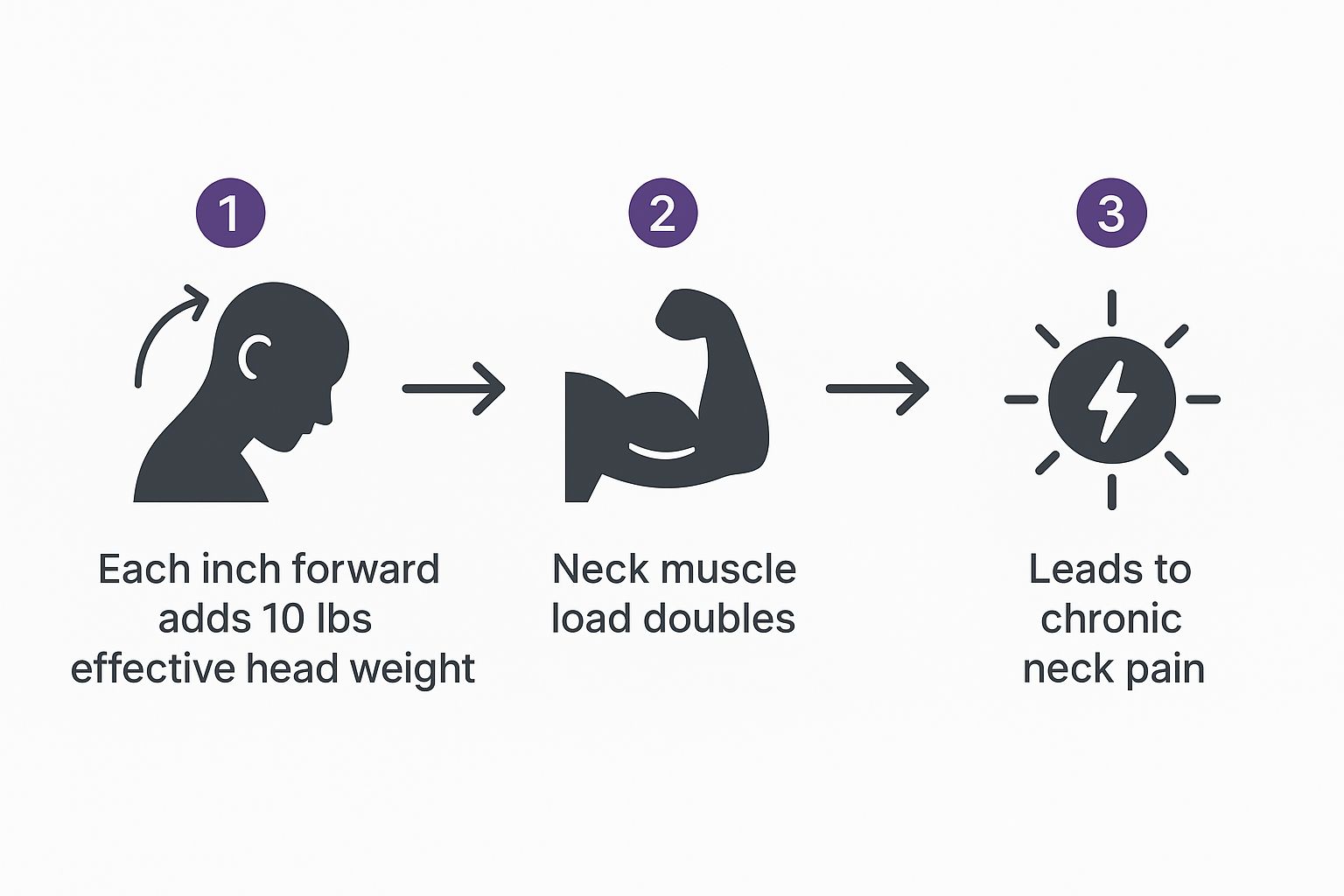
What starts as a seemingly harmless habit quickly snowballs into a major biomechanical issue, putting a ton of strain on your entire upper body.
Re-Engage Your Deep Neck Flexors With Chin Tucks
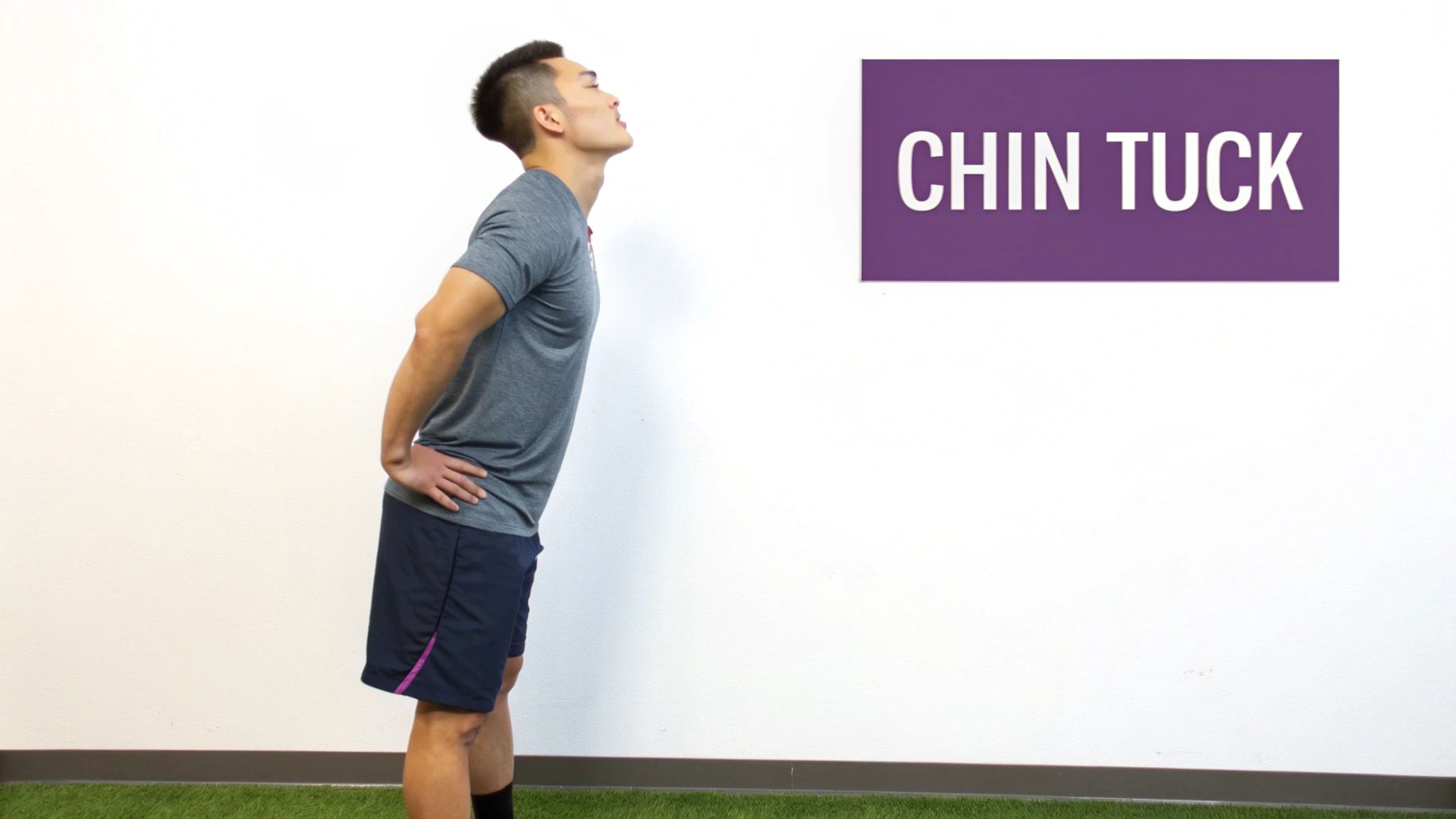
If you only do one exercise from this list, make it this one. The chin tuck is, without a doubt, the most important movement for fixing forward head posture. It zeroes in on the deep neck flexors—muscles you’ve probably never heard of, like the longus capitis and longus colli—that are supposed to stabilize the front of your neck. For almost everyone with “tech neck,” these muscles are asleep at the wheel.
Think of it like this: you’re rebuilding the foundation your head rests on. It’s a subtle movement, but it’s incredibly powerful.
How to Do It:
- Sit or stand tall and look straight ahead. Imagine a string gently pulling the top of your head toward the ceiling.
- Now, gently pull your chin straight back, like you’re trying to make a double chin. Don’t tilt your head down!
- You should feel a nice stretch at the base of your skull and feel the muscles in the front of your neck wake up.
- Hold that position for 3-5 seconds—and don’t forget to breathe.
- Relax back to the start. Aim for 10-15 reps.
A Common Mistake to Avoid: The biggest error people make is tucking their chin down to their chest. The movement needs to be purely horizontal, almost like a turtle pulling its head back into its shell. Your eyes should stay fixed on a point directly in front of you the whole time.
Try to sneak in a few sets of these throughout your day. They’re perfect for a quick break from your computer screen.
Pull Your Shoulders Back With Scapular Retractions
Forward head posture is never just a neck problem. It’s a whole-body issue. As your head creeps forward, your shoulders naturally slump and round to compensate. This weakens the crucial muscles in your upper back, like the rhomboids and middle traps.
Scapular retractions are the perfect antidote. This exercise teaches your shoulder blades to sit back and down where they belong, creating a solid base for your neck and head.
How to Do It:
- You can do this sitting or standing. Just let your arms hang relaxed at your sides.
- Without shrugging your shoulders up, squeeze your shoulder blades together. Imagine you’re trying to pinch a pencil right between them.
- Hold that squeeze for about 5 seconds. Really focus on feeling those upper back muscles engage.
- Slowly release and come back to the starting position. Try for 2-3 sets of 12-15 reps.
A strong back is the key to good posture and a healthy spine. If you’re looking for more ways to build a resilient back, you can find some of the best back strengthening exercises right here on our blog.
Mobilize Your Upper Back With Thoracic Spine Extensions
All that time spent hunched over a desk or phone doesn’t just pull your head forward; it makes your upper and mid-back (your thoracic spine) stiff and rounded. When that area gets rigid, it’s almost impossible to get your head and shoulders back into place.
Using a foam roller for thoracic spine extensions is like hitting a reset button. It helps release all that built-up tension and restores the natural curve to your upper back.
How to Do It:
- Lie on your back and place a foam roller horizontally right under your shoulder blades. Bend your knees and keep your feet flat on the floor.
- Place your hands behind your head for support, but don’t pull on your neck.
- Gently lower your head and shoulders toward the floor, letting your upper back arch over the roller. You should feel a great stretch across your chest.
- Hold it there for a couple of deep breaths, then use your abs to pull yourself back up.
- You can roll up or down an inch or two to hit different spots. Spend about 1-2 minutes on this in total.
Here is a simple routine you can follow every day to get started. Consistency is what really drives results.
Your Daily Posture Correction Routine
| Exercise | Primary Goal | Instructions Summary | Reps & Sets |
|---|---|---|---|
| Chin Tucks | Strengthen deep neck flexors | Gently pull chin straight back, hold for 3-5 seconds | 2 sets of 15 reps |
| Scapular Retractions | Strengthen upper back muscles | Squeeze shoulder blades together, hold for 5 seconds | 2 sets of 15 reps |
| Thoracic Extensions | Mobilize the upper back | Arch upper back over a foam roller, hold stretch briefly | 1-2 minutes total |
By consistently performing these three core exercises, you’re doing more than just finding temporary relief. You are fundamentally retraining your body’s muscle memory to achieve and maintain correct alignment for the long haul.
Building a Posture-Friendly Environment

Corrective exercises are a huge piece of the puzzle, but they can only get you so far. If you spend the rest of your day undoing all that good work, you’ll feel like you’re constantly fighting an uphill battle. To see real, lasting change, your environment has to support good posture, not work against it.
Think of it this way: doing 10 minutes of exercises is fantastic, but it won’t win against eight hours spent hunched over a desk. We need to make your daily surroundings work for you, turning those posture pitfalls into supportive habits.
For most of us, the biggest battleground is our workspace. A few simple ergonomic tweaks can be the difference between reinforcing that forward head slump and promoting a healthy, neutral spine all day long.
Optimizing Your Workspace for a Neutral Spine
Your desk is ground zero for posture. The entire goal is to set up your chair, monitor, and desk so your body can stay in alignment without you even thinking about it.
First, let’s look at your chair. Your feet should be flat on the floor, with your knees bent at a nice, easy 90-degree angle. If they’re dangling, grab a footrest or even a stack of old textbooks to bring the floor up to you. It’s a small change, but it stabilizes your entire foundation.
Next, your lower back needs support. A lot of office chairs have built-in lumbar support, but if yours is lacking, a small rolled-up towel or a dedicated lumbar pillow tucked into the curve of your low back does the trick. This simple cue helps prevent the slouch that starts the whole forward-head cascade.
But the real game-changer? It’s your monitor height.
The top of your computer screen should be at or just slightly below your eye level. This is non-negotiable. When your screen is too low, your head will inevitably drift down to follow it.
You should never have to tuck your chin to see what you’re working on. Use a monitor stand or another stack of books to get that screen where it needs to be. Honestly, this one adjustment is a cornerstone of fixing forward head posture in our screen-heavy world.
Beyond the Desk: Daily Habits Matter
Your posture doesn’t clock out when you leave your desk. The little habits you keep all day long either help or hurt your alignment.
Let’s talk about your phone. “Text neck” is a very real problem, and it comes from one thing: constantly looking down. The fix is simple, but it takes conscious effort: bring your phone up to eye level. Lift the phone instead of dropping your head. It feels a little weird at first, but it keeps your neck in a much happier, neutral position.
Driving is another common culprit. How often do you see people craning their necks toward the windshield? Try adjusting your seat to be a bit more upright and actually use your headrest. It’s not just for naps on road trips; it’s a guide. The back of your head should be just a couple of inches from it, giving you a physical reminder not to creep forward.
Your Sleeping Position Can Help or Hurt
You spend roughly a third of your life in bed, so your sleeping posture has a massive impact. The wrong pillow can completely sabotage the progress you made during the day.
The goal is to keep your spine—from your tailbone to your skull—in a straight, neutral line.
- For back sleepers: You’ll want a thinner pillow that just supports the natural curve of your neck. If it’s too thick, it’s pushing your head forward into that same posture you’re trying to fix.
- For side sleepers: A firmer, thicker pillow is your friend here. It needs to fill that gap between your ear and the outside of your shoulder to keep your head from drooping. Putting a pillow between your knees is another great trick to keep your hips and spine aligned.
Sleeping on your stomach is the toughest position on your neck. It forces your head to be twisted to one side for hours on end. If that’s you, try your best to train yourself to sleep on your back or side instead.
By making these simple, conscious tweaks to your environment, you build a foundation that supports your exercises. These small, consistent changes are what turn a temporary fix into a permanent, healthy posture.
When to Seek Professional Chiropractic Help
While doing consistent exercises and making smart ergonomic changes are the cornerstones of fixing forward head posture, sometimes they just aren’t enough on their own. If you’ve been diligently performing chin tucks and adjusting your workstation but still feel stuck with that nagging pain, it might be time to bring in some professional help.
Recognizing the signs that you need a deeper level of care is a huge step in recovery. Self-guided efforts can definitely hit a plateau, especially if the postural issue is long-standing and has created some serious joint restrictions or deep muscle compensation patterns.
Signs That At-Home Care Is Not Enough
So, how do you know when it’s time to make the call? Certain symptoms are clear signals that your body needs more than just stretching and strengthening to get back into alignment.
Keep an eye out for these tell-tale signs:
- Chronic Headaches: This is a big one, especially tension headaches that feel like they start at the base of your skull and creep their way up.
- Radiating Pain or Numbness: If you feel discomfort, tingling, or weakness that travels from your neck down into your shoulders, arms, or hands, this could mean a nerve is involved. That’s something you want a professional to look at.
- A Frustrating Lack of Progress: You’ve been consistent for weeks, but the neck pain isn’t getting better, and you can’t see any real improvement in your posture.
- Limited Range of Motion: Does turning your head from side to side or looking up feel incredibly stiff or painful? There could be underlying joint issues that exercises alone simply can’t fix.
These symptoms often suggest the problem goes beyond simple muscle weakness and involves the alignment and movement of the vertebrae in your cervical spine.
What to Expect From a Chiropractic Visit
The main goal of a chiropractor is to get to the root cause of your posture problem. It involves a detailed look at your spinal alignment, joint mobility, and muscle function to understand exactly why your head has drifted forward.
A chiropractic approach is multifaceted. It often involves specific spinal adjustments to gently restore proper movement to the joints in your neck and upper back that have become “stuck” or misaligned. Releasing these restrictions is often the key that unlocks real, lasting improvement.
A professional can identify specific vertebral misalignments that are holding you back. Correcting these allows the muscles to finally function properly, which makes your at-home exercises far more effective.
Beyond the adjustments, a chiropractor may use targeted therapies to address the soft tissues. These can include techniques to release deep-seated muscle knots and calm inflammation, which helps knock out the pain that makes it so hard to maintain good posture in the first place. The link between forward head posture and neck pain is well-established. In fact, a detailed review of multiple studies found that people with neck pain had a head posture angle that was, on average, 4.84 degrees more forward than those without pain. You can read the full research about the correlation between neck pain and posture to see the data for yourself.
Your Path to Lasting Posture Improvement
Fixing forward head posture is a marathon, not a sprint. It’s all about building a series of small, mindful habits that support your body every single day. The self-checks, targeted exercises, and crucial ergonomic tweaks we’ve covered are the foundational tools you’ll need to succeed.
Real progress comes from being consistent. It might not feel like much at first, but those small daily efforts—like doing a set of chin tucks on your lunch break or finally raising your monitor to eye level—really do compound over time. These simple actions retrain your muscles and reshape your posture, eventually leading to significant and lasting relief from pain and stiffness.
You have the power to move away from discomfort and toward a healthier, more aligned future. Each correct choice is a step in the right direction.
Take the Next Step
Remember, you don’t have to figure this all out alone. If you’re struggling with pain that just won’t quit, feel unsure if you’re doing the exercises correctly, or simply want some personalized guidance to speed things up, getting professional help can make a world of difference. The team here at Audubon Park Chiropractic is ready to create a plan that addresses your specific needs and helps you hit your goals.
Don’t let pain dictate your life any longer. Reclaim your comfort and well-being by taking action today.
Frequently Asked Questions About Forward Head Posture
Once you decide to tackle your posture, a few questions almost always pop up. Getting some clear answers helps set the right expectations and, more importantly, keeps you motivated for the journey ahead.
How Long Does It Take to See Improvement?
This is the big one, and the honest answer is: it really depends. How long you’ve had the posture, your age, and how consistent you are with the exercises all play a huge part.
Generally speaking, most people start to feel some real relief from the nagging pain and stiffness within 2 to 4 weeks of consistent effort. But seeing a noticeable, visual change in the mirror? That takes a bit longer, usually somewhere in the ballpark of 3 to 6 months. Your muscles need time to adapt and get stronger in their new, correct alignment.
The key isn’t speed—it’s consistency. Small, daily efforts add up over time to create significant, lasting change.
Are Posture Correctors or Special Pillows Effective?
Posture correctors can be a good tool, but you don’t want to use them as a crutch. Think of them as a temporary reminder to pull your shoulders back and sit up straight, helping you build that initial muscle memory. If you rely on one too much, though, your muscles won’t learn to do the work on their own.
A good ergonomic or cervical pillow, on the other hand, can be incredibly helpful, especially if you’re a back or side sleeper. It works by keeping your spine in a neutral position all night long, which stops you from undoing all the good work you did during the day.
Can Forward Head Posture Be Fixed Permanently?
Absolutely. With dedication, you can not only fix forward head posture but keep it that way for good. The “fix” isn’t a one-and-done thing; it’s a lifestyle shift.
By making corrective exercises a regular habit, setting up an ergonomic workspace, and just being more mindful of how you hold yourself day-to-day, you can retrain your body to hold its proper alignment naturally. The catch is, if you slide back into old habits—like slouching over your phone for hours—the posture can creep back in. Lasting success comes from making these healthy practices a permanent part of your routine.
If you are ready to address your posture and find lasting relief from pain, don’t wait. Contact Audubon Park Chiropractic on (509) 327-4049 to schedule your appointment, or simply walk in for treatment. Take the first step toward better alignment and a pain-free life today.
Ready to Feel Better?
Our Spokane chiropractors are ready to help. Walk-ins welcome — no appointment needed.

Dr. Michelle Snyder is a Spokane chiropractor with advanced training in women’s health, hormone balancing, pregnancy, and care for infants and children. She uses gentle low-force spinal adjustments alongside specialized therapies including Webster’s breech technique, allergy desensitization, cold laser therapy, EB cellular cleanse, and Methylation/genetic nutrition — offering patients a comprehensive, whole-body approach to wellness.
A Spokane resident for over 31 years, Dr. Michelle is deeply committed to her community, contributing time and resources to organizations including Meals-on-Wheels, Second Harvest, Ronald McDonald House, and the Union Gospel Mission.
📍 2909 W. Northwest Blvd, Spokane, WA 99205 | ☎ (509) 327-4049 audubonparkchiropractic.com
Further Reading: Neck
- How to fix rounded shoulders: A Practical Guide
- Chiro Treatment for Vertigo to Find Balance
- Chiropractic for Seniors & Managing Back Pain, Arthritis and Age-Related Stiffness Safely
- Gentle Chiropractic for Nervous Patients & Options that Don’t Involve Cracking
- What to Do if You Wake Up with Neck or Back Pain