

This post is part of our complete guide to Back Pain Treatment in Spokane, WA. Browse the guide for more in-depth information on treatments, exercises, and recovery strategies.
When you're in pain, the last thing you want to worry about is the cost of feeling better. So, how much does a chiropractor visit actually cost?
On average, a single session can range from $60 to $200 if you're paying out-of-pocket. With insurance, this often drops to a much more manageable co-pay, typically between $25 to $50.
However, these figures are just a starting point. The final price depends on several factors, including the specific treatments you need, your insurance coverage, and your location.
Your Quick Guide to Chiropractic Costs

Understanding what you'll pay for chiropractic care shouldn't be a puzzle. The question "how much does a chiropractor cost?" is common, but the answer has a few components.
Consider it like servicing your car. A basic oil change has a standard price, but if you need new filters, a tire rotation, or more detailed diagnostics, the final bill changes. The same principle applies here. The cost of a visit isn't a single flat fee; it's a combination of the specific care you require, what your insurance plan covers, and even your geographic location. For example, operating costs in Spokane might result in different pricing compared to a clinic in a major city like Seattle.
A Snapshot of Potential Costs
To provide a clearer picture, let's break down the numbers. Your first visit is almost always the most comprehensive and therefore the most expensive. It typically involves a deep dive into your health, including a full physical examination, a discussion of your health history, and sometimes X-rays to get a precise understanding of your condition. Subsequent adjustments are usually more straightforward and less costly.
Here’s a simple table to illustrate what this might look like:
Estimated Chiropractic Costs Per Visit
| Visit Type | Average Cost Without Insurance | Average Co-pay With Insurance |
|---|---|---|
| Initial Consultation | $100 – $250 | $25 – $50 |
| Standard Adjustment | $60 – $90 | $25 – $50 |
| Visit with X-Rays | $150 – $300 | Varies by plan |
As you can see, having health insurance can make a significant difference. It can transform what might be a substantial out-of-pocket expense into a simple, predictable co-pay.
Your health is an investment, not an expense. Understanding the cost is the first step, but the true value comes from the long-term relief and improved quality of life that proper care provides.
Ultimately, these are just estimates. The best way to determine your exact cost is to speak with a provider directly. At Audubon Park Chiropractic, we believe in complete pricing transparency and are always happy to help you understand your insurance benefits.
Don’t wait — relief is closer than you think.
What Factors Shape Your Chiropractic Bill?
So, you're wondering what a chiropractor in Spokane actually costs. The honest answer? There isn't a single, one-size-fits-all number. Think of it like ordering a custom-tailored suit. There's a base cost for the fabric and the tailor's time, but the final price depends on the cut, the material, and any special features you choose. Your chiropractic care works similarly—the cost is tailored specifically to your needs.
Let's pull back the curtain on what goes into your bill. It’s not about hidden fees; it's about understanding the value behind a personalized health plan.
Location and Experience Matter
A significant factor is simple geography. Operating a practice in a major city with high rent and other expenses is more costly than in a community like Spokane. That overhead is factored into pricing, so a chiropractor in downtown Seattle might charge more for the same adjustment we provide.
The chiropractor’s experience also plays a role. A practitioner with decades of experience or specialized certifications in areas like sports injuries or pediatric care brings a wealth of knowledge to the table. Their fee structure reflects that deep understanding and history of successful outcomes. You are paying for their refined skill and proven track record.
Your First Visit vs. Follow-Ups
Your initial appointment is almost always the most involved and, consequently, costs more than a standard visit. This isn't just a quick chat; it's a comprehensive evaluation to determine the root cause of your issue.
This initial visit usually includes:
- A Detailed Health History: We'll discuss past injuries, ongoing health conditions, and your lifestyle to get a complete picture.
- A Thorough Physical Exam: We'll assess your posture, range of motion, and nerve function to identify the source of your pain.
- X-Rays (If Needed): Sometimes, a clearer view of your spine is necessary to rule out more serious problems and understand the underlying structure.
This comprehensive first step ensures your treatment plan is built on a solid foundation. Once this initial work is done, your follow-up visits are typically shorter and less expensive, focusing on adjustments and tracking your progress.
The goal of the initial exam is to create a precise roadmap for your recovery. By investing time upfront to understand the 'why' behind your pain, subsequent treatments become more efficient and effective, ultimately saving you time and money.
The Scope of Your Treatment Plan
Finally, the cost is directly tied to the complexity of your condition. If you simply slept on your neck wrong, you might only need a few straightforward adjustments. However, if you're dealing with a chronic condition like scoliosis or recovering from a car accident, your care plan will naturally be more involved and require more time.
More complex issues might require therapies beyond a standard adjustment, each with its own cost. This is why a flat price is impractical. Your care is unique to you, and the cost reflects that.
Interestingly, this personalized approach often proves more economical in the long run. The chiropractic industry is growing, with revenues projected to reach $21.9 billion by 2025. This is because studies have shown that for many conditions, chiropractic care costs can be up to 40% lower than traditional medical routes. For low back pain, the total cost averages around $5,093 when a patient begins with a chiropractor, representing a significant saving. You can explore more data about the growing chiropractic market and its cost-effectiveness.
Knowing these factors helps you understand what you're paying for and see the value in every part of your care.
Decoding Treatments and Their Associated Costs

When you think "chiropractor," you probably picture a spinal adjustment. That’s understandable—it’s the cornerstone of what we do. But a modern treatment plan often includes much more.
Think of it like a personal trainer's toolkit. They use a variety of exercises to help you reach your goals. Similarly, we utilize a range of services to help accelerate your healing and get you back to feeling your best.
Understanding these different treatments is key to comprehending what your care might cost. Each service has a specific purpose and its own price point, so your final bill simply reflects the care you actually received.
Let's walk through some of the most common services you might see on a treatment plan.
The Foundation: Spinal Manipulation
The core of chiropractic care is spinal manipulation, also known as "the adjustment." This is the hands-on technique used to restore proper joint movement and relieve pressure on the nervous system. The cost for a standard adjustment usually forms the baseline for any visit.
You can get a deeper look into what exactly happens during this process in our guide on what is a chiropractic adjustment.
Globally, spinal manipulation accounts for about 46% of a clinic's revenue, which highlights its central role in patient recovery. The goal is always the same: to improve your body's function and alleviate your pain.
Additional Therapies to Support Healing
Sometimes, an adjustment alone isn't enough, especially when stubborn muscles and ligaments are involved. To provide your body with the extra support it needs, your chiropractor might recommend other therapeutic services.
These therapies act as a support crew for your body, helping to relax tight muscles, reduce inflammation, and kickstart the healing process.
Here are a few common examples:
- Massage Therapy: This isn't a spa massage. Therapeutic massage targets specific muscle groups to release knots, improve blood flow, and break down scar tissue. It works synergistically with your adjustments, helping your body maintain its alignment for longer.
- Electrical Muscle Stimulation (EMS): Don't let the name intimidate you. With EMS, pads are placed on your skin to send gentle electrical currents to your muscles. This causes them to contract and relax, which is effective for reducing swelling, easing muscle spasms, and blocking pain signals.
- Spinal Decompression: If you're dealing with a herniated or bulging disc, this can be a game-changer. You'll lie on a specialized table that gently stretches your spine, creating negative pressure within the disc to help it retract and relieve pressure on your nerves.
A great treatment plan is all about synergy. Just like a balanced diet and exercise work together for better health, combining adjustments with other therapies often leads to faster, more lasting results than any single treatment could on its own.
Understanding the Cost of a Full Treatment Plan
Typically, the cost for these additional services is added to the base price of your adjustment. It's important to know that these are only recommended when they are truly necessary to help you achieve your health goals more effectively.
To give you a clearer picture, here is a simple table outlining common services and their typical costs in the Spokane area.
Common Chiropractic Services and Average Costs
This table breaks down different treatments and their usual price range, helping you get a better sense of potential costs beyond a standard adjustment.
| Service Type | Description | Average Cost Range (Per Session) |
|---|---|---|
| Spinal Manipulation | The core chiropractic adjustment to restore joint mobility. | $60 – $90 |
| Massage Therapy | Targeted massage to relieve muscle tension and improve healing. | $40 – $100 |
| Electrical Muscle Stimulation | Uses electrical currents to reduce pain and muscle spasms. | $25 – $75 |
| Spinal Decompression | Gently stretches the spine to relieve pressure on discs. | $75 – $200 |
When you come to Audubon Park Chiropractic, we promise to be completely transparent. We will always explain why we're recommending a service and what it will cost. Our goal is to create a plan that fits both your health needs and your budget, so you can feel confident in your care every step of the way.
Using Your Health Insurance for Chiropractic Care
Let's be honest, understanding your health insurance policy can feel like learning a new language. But it's your best tool for managing chiropractic costs and avoiding unexpected bills.
The good news is that most insurance plans offer some level of coverage for chiropractic services. Insurers have recognized how effective chiropractic care can be for common issues like back pain, neck problems, and headaches—often preventing the need for more expensive medical procedures. However, the specifics of what's covered can vary widely between plans.
Making Sense of Insurance Lingo
To maximize your benefits, you need to be familiar with a few key terms. They may sound complex, but they simply define how much you pay versus how much your insurance company contributes.
Deductible: This is the amount you must pay out-of-pocket for your healthcare before your insurance plan begins to pay. If your plan has a $1,000 deductible, you are responsible for the first $1,000 of covered medical costs.
Co-pay: A co-pay is a fixed fee you pay for a specific service, like a doctor's visit, after you've met your deductible. It's usually a predictable amount, such as $30 per adjustment.
Co-insurance: This is your share of the bill, expressed as a percentage. For instance, with 20% co-insurance, you pay 20% of the cost, and your insurance covers the remaining 80%.
If you're ever stuck on a term, consulting a good health insurance glossary can be a lifesaver. A little research now can save a lot of confusion later.
HMO vs. PPO: What’s the Difference for You?
The type of plan you have—most commonly an HMO or a PPO—also significantly impacts how you can use your benefits.
An HMO (Health Maintenance Organization) usually requires you to use a specific network of doctors. To see a chiropractor, you will likely need a referral from your primary care physician (PPCP) first. If you go outside that network, you'll probably have to pay for the entire visit yourself.
A PPO (Preferred Provider Organization) offers more flexibility. You can see providers both in and out of the network, though you’ll pay less if you stay in-network. The best part? You generally don’t need a referral to see a specialist like a chiropractor.
A common limitation in many insurance plans is a cap on the number of covered visits per year. Some policies might cover 20 chiropractic visits annually, while others could cover more or fewer. It's crucial to confirm this number before starting treatment.
Key Questions to Ask Your Insurance Provider
The most effective way to know exactly what to expect is to call your insurance company directly. When you know the right questions to ask, you'll get clear answers that allow you to budget for your care without any guesswork.
Here’s what you need to ask:
- Is chiropractic care a covered benefit on my plan?
- Is Audubon Park Chiropractic an in-network provider?
- Do I need a referral from my primary care doctor to see a chiropractor?
- What is my co-pay or co-insurance for a chiropractic visit?
- Have I met my deductible for this year?
- Is there a limit on how many chiropractic visits I can have per year?
Getting these answers upfront removes the financial stress, so you can focus on what really matters—feeling better.
Smart Strategies to Make Chiropractic Care Affordable
Figuring out the potential costs of chiropractic care is one thing, but knowing how to fit it into your budget is what truly matters. The good news is that consistent care doesn't have to break the bank. There are many practical ways to lower your out-of-pocket expenses, making your path to wellness both effective and affordable.
We understand this. Many clinics, including ours here at Audubon Park Chiropractic, offer solutions to make care more accessible. The key is to look beyond the single-visit price and find options that reward your commitment to getting better.
Look for Packages and Wellness Plans
One of the best ways to reduce the per-visit cost is to purchase a package of treatments. It’s similar to buying in bulk at the grocery store—the upfront cost is higher, but the price per item (or per adjustment) decreases significantly.
Clinics often offer wellness packages or care plans for patients who will need multiple sessions. These plans not only make your budget predictable but also encourage you to complete your full treatment plan, which is essential for achieving the best, most lasting results.
These packages can be particularly helpful if you don't have insurance. If you're looking for more ways to manage costs, you can learn about our approach in our guide on chiropractic care without insurance.
Use Pre-Tax Health Accounts
A powerful but often overlooked tool is a pre-tax account like a Health Savings Account (HSA) or a Flexible Spending Account (FSA). These allow you to set aside money from your paycheck before taxes are deducted.
When you use these funds for your chiropractic care, you are paying with tax-free dollars. This is like getting an instant discount equal to your tax rate, which can lead to substantial savings over time. It’s a simple, smart way to make your money work harder for your health.
This decision tree can help you visualize the first steps when trying to figure out how your insurance might play into this.
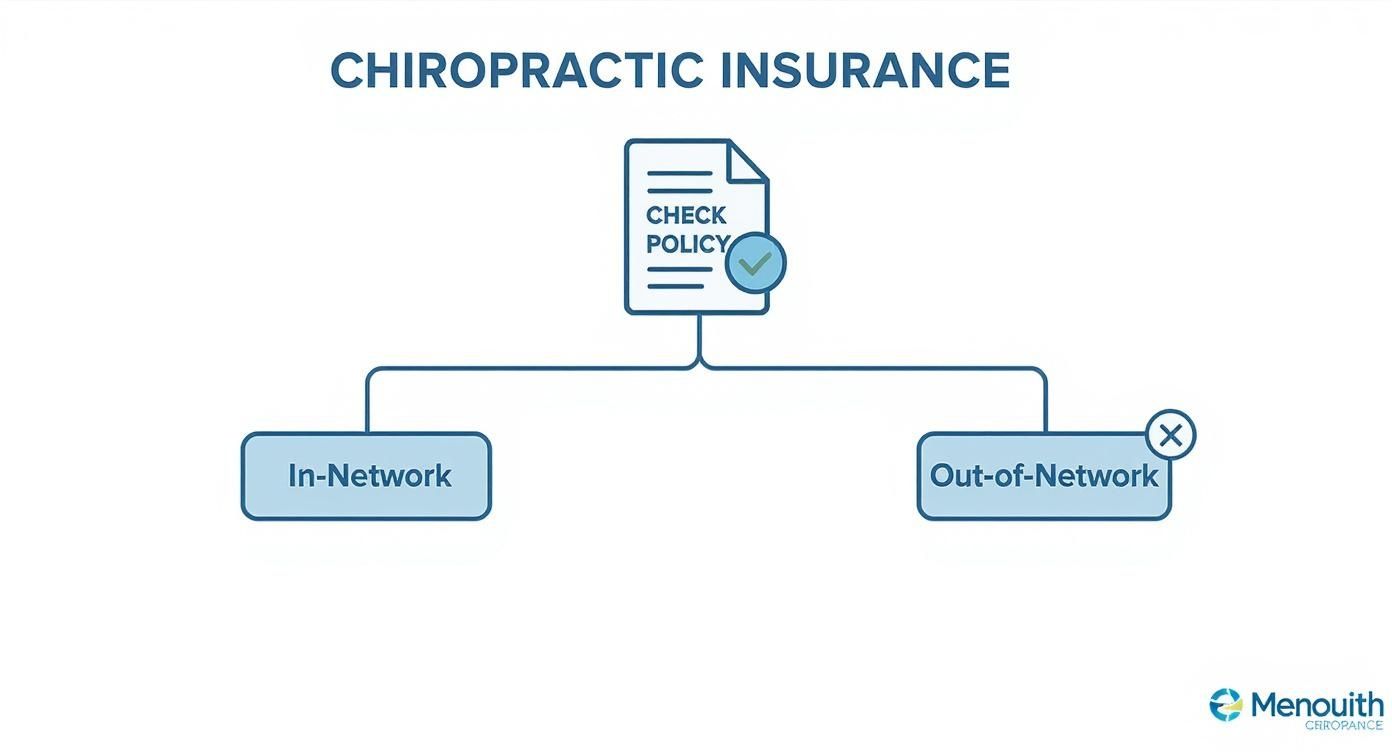
As you can see, the first step is always to check your policy. From there, you'll need to determine if a provider is in-network or out-of-network to better understand your costs.
Have an Open Conversation About Cost
Finally, never hesitate to have a direct, honest conversation with your chiropractor's office about your budget. A good clinic genuinely wants to see you get better and will almost always try to work with you to find a solution.
Your financial well-being is part of your overall well-being. A transparent conversation about costs removes stress and allows you to focus completely on your healing.
Some clinics may offer flexible payment plans that allow you to spread the cost of your care over several months, which can be much easier to manage than a single lump sum. Here at Audubon Park Chiropractic, we believe in being completely upfront. We’re always ready to discuss payment options that work for you.
By exploring these strategies—from care packages to pre-tax accounts to open communication—you can create a financial plan that truly supports your health goals. Affordable chiropractic care is absolutely within reach, and taking these steps can make all the difference.
Your Questions About Chiropractic Costs, Answered
Even after breaking down the numbers, it's normal to have more questions. Understanding "how much a chiropractor costs" is about more than a single visit's price—it’s about seeing the whole picture. To help you feel completely comfortable, we've compiled some of the most common questions we hear from people right here in Spokane.
Here are some clear, straight-to-the-point answers to help you plan your care.
Do I Need a Referral to See a Chiropractor?
Most of the time, no. Most people can schedule an appointment directly with a chiropractor without getting a referral from their primary care doctor. This direct access makes it much easier to get the care you need, when you need it.
However, some insurance plans, particularly HMOs, have rules that require a referral before they will cover a visit to any specialist. The easiest way to know for sure is to call your insurance company. That simple step can save you from a surprise bill.
How Many Visits Will I Need?
This is probably the most frequent question we receive, and the honest answer is: it depends on you. There is no one-size-fits-all timeline. The number of visits is determined by your specific issue, how your body responds to treatment, and your personal health goals.
For example, a simple problem like a stiff neck from sleeping awkwardly might only require a few sessions. But for a more complex, long-standing issue like chronic low back pain or recovery from a car accident, a more structured care plan over a longer period is likely necessary.
During your first visit, your chiropractor will outline a recommended treatment schedule. Think of it as a roadmap for your recovery—it gives you a clear idea of the timeline and helps you budget for the entire process.
Are X-rays Always Part of the Cost?
Not at all. X-rays are only recommended when they are diagnostically necessary. A chiropractor might suggest one to get a detailed look at your spine's alignment, rule out something more serious like a fracture, or assess the extent of degenerative changes.
Your chiropractor will always explain why an X-ray might be beneficial and provide the cost upfront before you make a decision. The price for imaging can range from $50 to over $200, depending on the number of views needed. They are an excellent diagnostic tool but are not part of every new patient's first visit.
Does Location Really Affect the Price of Care?
Absolutely. It makes a significant difference. The cost of living and the basic expenses of running a clinic—such as rent and staff salaries—vary dramatically from one city to another. Consequently, you can expect to pay more for the same treatment in a large metropolitan area compared to a community like Spokane.
This is why national averages for "how much does a chiropractor cost" can be misleading. It is always better to look at local pricing to get a realistic picture of what you can expect to pay for care in your area.
Don't let questions about cost stop you from getting the relief you deserve. For a clear breakdown of what to expect and a plan designed just for you, contact Audubon Park Chiropractic today. You can call us at (509) 327-4049 or simply walk in for a consultation. We are ready to help you on your path to feeling better.
Ready to Feel Better?
Our Spokane chiropractors are ready to help. Walk-ins welcome — no appointment needed.

Dr. Michelle Snyder is a Spokane chiropractor with advanced training in women’s health, hormone balancing, pregnancy, and care for infants and children. She uses gentle low-force spinal adjustments alongside specialized therapies including Webster’s breech technique, allergy desensitization, cold laser therapy, EB cellular cleanse, and Methylation/genetic nutrition — offering patients a comprehensive, whole-body approach to wellness.
A Spokane resident for over 31 years, Dr. Michelle is deeply committed to her community, contributing time and resources to organizations including Meals-on-Wheels, Second Harvest, Ronald McDonald House, and the Union Gospel Mission.
📍 2909 W. Northwest Blvd, Spokane, WA 99205 | ☎ (509) 327-4049 audubonparkchiropractic.com
Further Reading: Back
- Back Pain, Sciatica, and Headaches: When Chiropractic Helps — And When It Doesn’t
- Chiropractic Without the Commitment: What No Long-Term Contracts Actually Means for Your Care
- What causes sciatic nerve pain: Symptoms and relief
- NW Spokane’s Neighborhood Chiropractor: Why Location, Parking, and Knowing Your Doctor Actually Matter
- Why Some People Are Afraid of the Chiropractor & And What We Do Differently