

This post is part of our complete guide to Headache Treatment in Spokane, WA. Browse the guide for more in-depth information on treatments, exercises, and recovery strategies.
Chiropractic care can offer significant relief for vertigo by addressing the root cause of dizziness, particularly when the issue originates in the neck or inner ear. The approach often involves gentle adjustments to the cervical spine (the neck) or specific repositioning techniques designed to restore the body’s natural balance. These methods focus on re-establishing clear communication pathways between your body and brain, which is fundamental to resolving the disorienting sensation of spinning.
Why Am I So Dizzy? Understanding the Causes of Vertigo

If you’ve ever felt like the room is spinning wildly around you, you understand how unsettling and disruptive vertigo can be. It is more than just lightheadedness—it’s a powerful sensation that can completely throw your life off balance. The feeling is often compared to being on a carnival ride that you cannot stop.
This disorienting feeling often stems from a communication breakdown between three key systems: your inner ear, your neck, and your brain. These parts of your body work in constant collaboration to maintain your equilibrium. When one of them sends a mixed or faulty signal, your brain becomes confused, resulting in that overwhelming sensation of spinning.
The Most Common Causes of Vertigo
Two of the most frequent culprits behind vertigo are Benign Paroxysmal Positional Vertigo (BPPV) and cervicogenic dizziness. While they have different origins, both often respond well to focused chiropractic care.
To help you gain a clearer understanding, here’s a summary of some common vertigo types and their causes.
Common Vertigo Types and Their Causes
This table outlines prevalent vertigo types and their origins, which can help you start to identify what might be causing your dizziness.
| Vertigo Type | What Causes It | How It Feels |
|---|---|---|
| BPPV | Tiny calcium crystals in the inner ear become dislodged and move into the wrong canal, sending false motion signals to the brain. | Intense, but brief, spinning episodes triggered by specific head movements (like rolling over in bed or looking up). |
| Cervicogenic Dizziness | Misalignments or dysfunction in the neck vertebrae disrupt nerve signals to the brain about head position and movement. | A more constant feeling of unsteadiness or wooziness, often accompanied by neck pain, stiffness, or headache. |
| Meniere’s Disease | A buildup of fluid in the inner ear, though the exact cause is not fully understood. | Spontaneous, severe vertigo attacks that can last for hours, often with hearing loss, tinnitus (ringing in the ears), and a feeling of fullness. |
| Vestibular Neuritis | Inflammation of the vestibular nerve, usually caused by a viral infection. | Sudden, intense vertigo that can last for days, often accompanied by nausea and difficulty balancing, but typically without hearing loss. |
Understanding what’s behind your vertigo is the first crucial step. Now, let’s take a closer look at the two types most commonly addressed with chiropractic care.
- Benign Paroxysmal Positional Vertigo (BPPV): This is a long name for a straightforward problem. Inside your inner ear, you have tiny calcium crystals (called otoconia) that help you sense gravity. When these crystals are dislodged and float into the semicircular canals of your ear, they send confusing signals to your brain about head movement, triggering short but intense episodes of vertigo.
- Cervicogenic Dizziness: This type does not originate in your ear—it starts in your neck. When the vertebrae in your cervical spine are misaligned or not moving correctly, it can interfere with the nerve signals that tell your brain where your head is in space. This mismatch in information leads to a frustrating, often persistent, sense of unsteadiness. Problems with neck alignment can create a variety of issues, and you can learn more about how chiropractic care helps with neck pain here.
For BPPV, specific repositioning maneuvers are highly effective. The Epley maneuver, a technique frequently used in our office, has an effectiveness rate between 78% and 95%. In fact, a single session often leads to complete remission in up to 89% of cases.
Understanding the source of your dizziness is the first step toward finding a lasting solution. Whether the problem lies in your inner ear or your neck, identifying the cause allows for a targeted treatment plan to restore your body’s natural balance.
Once we have a clear picture of how these misalignments or dislodged crystals are creating conflicting signals, we can design a chiropractic treatment for vertigo that corrects the problem at its source.
Don’t wait — relief is closer than you think.
How Gentle Adjustments Restore Your Body’s Balance
When the world feels like it’s spinning out of control, the solution is often about restoring your body’s own natural alignment. The key to understanding how chiropractic care can help with vertigo lies in the profound connection between your neck (the cervical spine) and your brain’s balance center.
Think of the nerves in your upper neck as critical data cables. They constantly send information to your brain about where your head is in space. If the top vertebrae in your neck become even slightly misaligned, that communication gets jumbled. Your brain starts receiving scrambled signals, which leads to that confusing and disorienting sensation of dizziness.
Restoring Clear Communication
A chiropractor’s role is to help unscramble those signals by addressing the root of the problem. A common misconception is that chiropractic adjustments are forceful. In reality, we use very precise and gentle techniques to correct spinal misalignments and clear up nerve communication. By making specific adjustments to the cervical spine, we are essentially helping your body’s internal GPS recalibrate.
This infographic provides a clear visual of how a misalignment can block these important nerve signals and how a gentle adjustment can restore proper function.
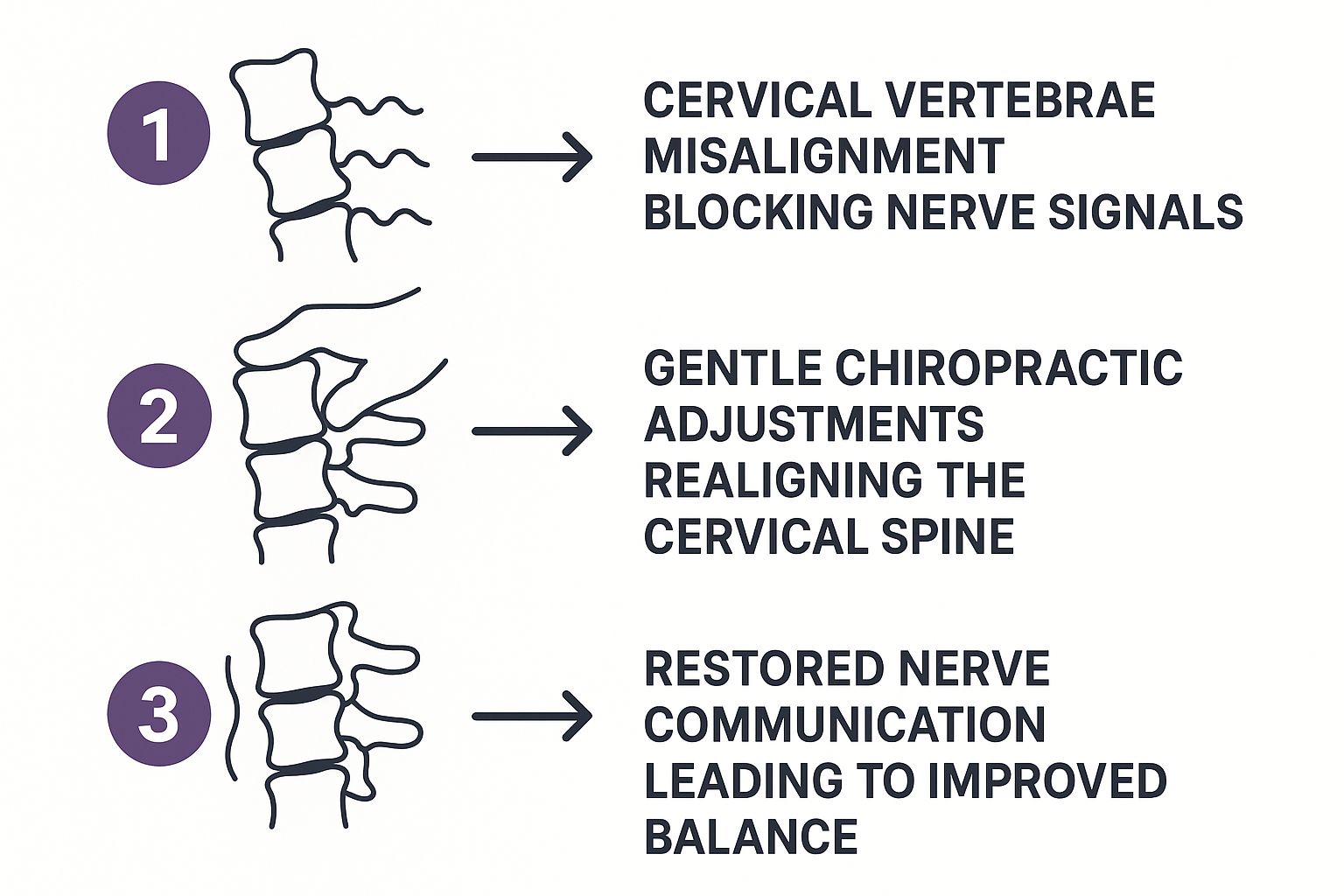
As you can see, the objective is simply to remove the structural interference. When that is achieved, your nervous system can function as it was designed to, leading to improved balance.
This approach is not about masking symptoms; it is about correcting the underlying structural issue. By realigning the vertebrae, we take pressure off the surrounding nerves. This allows your brain to once again receive accurate information about your body’s position, effectively turning off the “vertigo” signal.
The Focus on the Upper Cervical Spine
Much of the chiropractic treatment for vertigo is centered on the upper neck, and for good reason. This area plays a massive role in your sense of balance. The top two vertebrae, the atlas and axis, have a unique shape that allows for your head’s wide range of motion, but this mobility also makes them more susceptible to misalignment.
By addressing the structural issue at its source, we help your body regain its natural ability to balance itself, providing a true solution rather than just temporary relief.
Specialized upper cervical techniques have shown positive results in this area. Research indicates that specific upper cervical chiropractic care, combined with a personalized vestibular rehabilitation program, can lead to significant improvements in dizziness. One study demonstrated this positive effect over just a 30-day period. You can read more about the findings in this upper cervical chiropractic study.
This gentle, targeted approach offers several key benefits:
- Reduced Nerve Irritation: Alleviates pressure on the nerves sending scrambled balance signals to the brain.
- Improved Blood Flow: Proper alignment can support healthy blood circulation to the brain, which is essential for equilibrium.
- Restored Joint Motion: Corrects restrictions in the neck that contribute to stiffness and faulty signaling.
By focusing on these key areas, chiropractic adjustments offer a clear path to helping your body regain its natural stability and put an end to the debilitating cycle of vertigo.
What to Expect From Your Vertigo Treatment Plan
Deciding to seek help for vertigo is a significant step, and we believe you should understand the process from the moment you walk through our doors. Your journey toward regaining your balance at Audubon Park Chiropractic begins with a detailed conversation. We want to hear your story—what you are experiencing, your health history, and what seems to trigger your dizzy spells.
This initial discussion is followed by a thorough examination. We will conduct a series of physical, orthopedic, and neurological tests designed to get to the bottom of your vertigo. This is a crucial step that helps us determine if the problem is coming from your inner ear, your neck, or another source.
Your Personalized Path to Relief
Once we have pinpointed the cause, we develop a personalized treatment plan for you. We do not use cookie-cutter solutions. Instead, we view this as a partnership, ensuring your care is designed to deliver real, lasting results based on your specific needs.
Think of your plan as a roadmap to recovery. It will outline the exact techniques we’ll use and, just as importantly, why we’re using them. This approach ensures you are an active and informed participant in your own healing.
Our commitment is to build a partnership with you. Your care plan is carefully constructed to address the root cause of your vertigo, ensuring the most effective and lasting relief possible.
The Core Components of Your Treatment
Your chiropractic treatment for vertigo will likely involve a combination of highly effective techniques. Each one is chosen based on the findings of your exam to give you the best possible outcome.
To make the process clear, we’ve broken down the patient journey into a simple, step-by-step process. This way, you will always know where you are on your path to recovery and what to expect next.
Your Vertigo Treatment Journey Step-by-Step
| Phase | Objective | What to Expect |
|---|---|---|
| 1. Diagnostic | Identify the root cause of your vertigo. | A comprehensive consultation, health history review, and a physical, orthopedic, and neurological exam. |
| 2. Acute Care | Provide immediate relief and stabilize your condition. | Targeted adjustments, repositioning maneuvers, and soft tissue therapy to reduce symptoms quickly. |
| 3. Corrective Care | Address underlying structural issues for long-term stability. | A series of treatments focused on restoring proper alignment and nerve function to prevent future episodes. |
| 4. Wellness & Prevention | Maintain your progress and support overall balance. | Guidance on at-home exercises, lifestyle adjustments, and periodic check-ups to keep you feeling your best. |
You can see how the process begins by tackling the immediate symptoms and then shifts focus to correcting the underlying problem for sustainable results.
Common therapies used during these phases include:
- Specific Cervical Adjustments: Gentle, precise movements used to restore proper alignment in your neck, which is critical for addressing cervicogenic dizziness.
- Canalith Repositioning Maneuvers: For BPPV, we use proven techniques like the Epley maneuver to carefully guide inner-ear crystals back where they belong.
- Soft Tissue Therapy: This helps release muscle tension and tightness in the neck and upper back, which often contribute to dizziness.
By breaking down each step, we ensure you always understand what we’re doing and why it’s helping you get your balance—and your life—back.
Real Stories of Reclaiming Balance
While clinical results are compelling, the true story of effective chiropractic treatment for vertigo is told through the everyday moments people reclaim. These stories show what happens when you restore balance—not just in the body, but in life itself.
Consider the graphic designer in his 40s who came to see us. His job required long hours at a computer, but his cervicogenic dizziness was making that nearly impossible. The constant off-balance, nauseous feeling was putting his career at risk. Through a series of specific cervical adjustments, we corrected the misalignments in his neck, clearing the communication lines between his spine and brain. In just a few weeks, he was back at work, stable and focused.
From Fear to Freedom
Then there was the grandmother dealing with BPPV. The sudden, violent spinning spells left her terrified to bend over or even turn her head too quickly. Her biggest fear was dropping her young grandchild.
For her, the solution was a gentle repositioning maneuver performed to guide the tiny inner-ear crystals back where they belong. After only a couple of sessions, the vertigo attacks stopped completely. The look of joy and relief on her face when she told us she could finally play with her grandchild without fear—that is the real measure of success.
The goal isn’t just to stop the spinning; it’s to give you back the confidence to live your life fully, whether that means driving, working, or simply picking up your grandchild.
You’re Not Alone in Finding Relief
These are not isolated success stories; they are part of a larger pattern. Research analyzing data from the National Health Interview Survey found that people with dizziness and balance problems reported that chiropractic care genuinely helped them.
This was especially true for individuals aged 65 and older, who were over four times more likely to report that their chiropractor made a difference. You can discover more insights on chiropractic care for balance problems directly from the source.
These stories demonstrate what is possible when we address the root cause of vertigo. It’s about more than feeling steady on your feet. It’s about regaining the freedom to enjoy life without constant hesitation or fear.
At-Home Exercises to Support Your Recovery

Your journey back to stability continues outside of the clinic. To reinforce the progress we make together, we will provide you with simple, effective at-home exercises. These are a core part of your chiropractic treatment for vertigo, helping to solidify the adjustments and accelerate your recovery.
By becoming an active partner in your own wellness, you help retrain the critical connection between your brain, inner ear, and body. This reinforces proper alignment and clear nerve signals, contributing to lasting relief.
Vestibular Rehabilitation Techniques
A significant component of at-home care is vestibular rehabilitation. This can be thought of as physical therapy specifically for your balance system. These exercises are designed to help your brain adapt to and make sense of the signals that are causing the dizziness.
One of the most powerful exercises we use is gaze stabilization. Its purpose is to improve your ability to keep your eyes focused on a single spot while your head is moving.
- How to Perform Gaze Stabilization:
- Sit comfortably and hold a small object, like a pen, at arm’s length.
- Focus your eyes on the object.
- Keeping your eyes locked on the target, slowly turn your head from side to side.
- Next, gently nod your head up and down, ensuring you maintain focus on the pen.
- Aim to do this for about one minute, several times a day, or as directed.
This straightforward practice helps your brain relearn how to maintain visual clarity and a sense of stability, even when you are in motion. For more ways to improve your mobility at home, you can explore our guide on active range of motion exercises.
The Brandt-Daroff Maneuvers
For patients dealing with BPPV, the Brandt-Daroff exercises can be very beneficial. They are designed to gently dislodge and move any inner-ear crystals that may still be causing trouble.
Important: Always perform these movements in a safe space, such as on your bed or the floor. Move slowly and deliberately to avoid triggering a strong dizzy spell.
- Step-by-Step Instructions:
- Begin by sitting on the edge of your bed.
- In one smooth but quick motion, lie down on one side, turning your head to look up at a 45-degree angle. Hold this position for 30 seconds or until the vertigo subsides.
- Slowly return to the seated position and rest for 30 seconds.
- Repeat the same process on the opposite side.
- Aim for five repetitions on each side, twice a day.
By consistently incorporating these targeted exercises into your daily routine, you actively support your body’s natural healing process.
Frequently Asked Questions About Chiropractic Vertigo Treatment
It is completely understandable to have questions when considering a new approach to your health. To help you feel more confident and informed, we’ve compiled some of the most common questions we hear about chiropractic treatment for vertigo.
How many chiropractic sessions will it take to see improvement for vertigo?
The number of sessions depends on the root cause and severity of your vertigo. For a straightforward case of Benign Paroxysmal Positional Vertigo (BPPV), many people experience significant improvement after just one or two sessions involving specific repositioning maneuvers.
If your vertigo is linked to a chronic neck issue (cervicogenic dizziness), it may require a series of adjustments over several weeks to correct the underlying structural problem and achieve lasting stability. We will provide a personal care plan with an estimated timeline during your first visit.
Are neck adjustments for vertigo safe?
Yes. When performed by a qualified and experienced chiropractor, cervical adjustments are a safe and effective treatment for many causes of vertigo. We use gentle, precise techniques that are tailored to your specific condition and comfort level.
A thorough initial examination is key to ensuring both safety and effectiveness. This detailed assessment confirms that chiropractic care is the right approach for you before any treatment begins.
Can a chiropractor help with vertigo caused by inner ear problems?
Yes. For inner ear issues like BPPV, chiropractors are trained to perform specific techniques, such as the Epley maneuver. This procedure is carefully designed to guide the displaced crystals in your inner ear back to their proper position, which can often stop the spinning sensation very quickly. By also ensuring your neck is properly aligned, we help support the function of your body’s entire balance system.
What does a chiropractic adjustment for vertigo feel like?
The adjustments used for vertigo are typically very gentle and controlled, so you should not feel pain. You might hear a small “pop” sound, which is simply gas being released from a joint—similar to cracking your knuckles. Most of our patients report feeling an immediate sense of relief or increased freedom of movement right after an adjustment.
When considering chiropractic care, it’s also practical to understand how it fits with your health plan. For anyone exploring different healing options, understanding insurance coverage for alternative treatments is an important step in managing both expectations and finances.
Ready to Stop the Spinning and Regain Your Balance?
You do not have to live with the dizzying uncertainty that vertigo brings. The path back to solid ground often begins by addressing the real problem, whether it lies in your upper neck or your inner ear. If you are tired of feeling like the world is spinning out of control, it is time to take the first step toward a solution.
Targeted chiropractic treatment for vertigo can make a profound difference, helping you reclaim your stability and confidence. Choosing the right healthcare provider is a crucial part of that journey. Our guide on how to choose a chiropractor offers valuable insights to help you make an informed decision.
Returning to a stable, balanced life is absolutely possible. Taking that first step is the most important part of the journey.
Our team is ready to help you find a real, lasting solution with a care plan designed just for you.
Don’t let vertigo dictate your life any longer. To start your journey back to balance, contact Audubon Park Chiropractic for a personal assessment. Call us today at (509) 327-4049 or simply walk in for a consultation.
Ready to Feel Better?
Our Spokane chiropractors are ready to help. Walk-ins welcome — no appointment needed.

Dr. Michelle Snyder is a Spokane chiropractor with advanced training in women’s health, hormone balancing, pregnancy, and care for infants and children. She uses gentle low-force spinal adjustments alongside specialized therapies including Webster’s breech technique, allergy desensitization, cold laser therapy, EB cellular cleanse, and Methylation/genetic nutrition — offering patients a comprehensive, whole-body approach to wellness.
A Spokane resident for over 31 years, Dr. Michelle is deeply committed to her community, contributing time and resources to organizations including Meals-on-Wheels, Second Harvest, Ronald McDonald House, and the Union Gospel Mission.
📍 2909 W. Northwest Blvd, Spokane, WA 99205 | ☎ (509) 327-4049 audubonparkchiropractic.com