

This post is part of our complete guide to Back Pain Treatment in Spokane, WA. Browse the guide for more in-depth information on treatments, exercises, and recovery strategies.
Best Pillow for Back Sleepers
For back sleepers, the ideal pillow supports the natural curve of your neck, keeping your spine in a neutral, straight line from your head to your tailbone. The general recommendation is a pillow with medium loft (height) and medium firmness. This combination typically fills the space between your neck and the mattress without pushing your head too far forward or letting it drop back.
Achieving this neutral alignment is the primary goal for preventing stiffness and pain, leading to more restorative sleep.
Don’t wait — relief is closer than you think.
Why the Right Pillow Is Your Key to Better Sleep

Waking up with a stiff neck or a dull headache is a common experience, often attributed to a “bad night’s sleep.” However, the pillow is frequently the overlooked cause. For those who sleep on their backs, a pillow is more than just a cushion; it is a critical tool for maintaining proper spinal alignment for roughly a third of your day.
Imagine your spine as a straight line. A well-designed pillow for back sleepers works to preserve that line. If your pillow is too high, it forces your head forward, creating a significant curve in your neck, similar to the posture adopted when looking down at a phone. Conversely, a pillow that is too flat or soft allows the head to tilt backward, straining the neck muscles and ligaments that are trying to maintain stability.
The Consequences of Poor Pillow Support
An improperly fitted pillow doesn’t just affect your morning. Consistent misalignment night after night can contribute to several persistent issues that impact your daily life. A thoughtful pillow choice can help prevent these common problems.
Here are the potential outcomes of using the wrong pillow:
- Chronic Neck Pain: Continuous strain on the cervical spine can lead to persistent muscle tension and discomfort.
- Morning Stiffness: Holding the neck in an unnatural position overnight can cause muscles to become rigid, making it painful to turn your head upon waking.
- Tension Headaches: Misalignment in the upper cervical spine is a primary trigger for tension headaches, which often originate at the base of the skull.
- Disrupted Sleep: Physical discomfort prevents the body from achieving deep, restorative sleep stages, leading to frequent tossing and turning.
A Growing Focus on Sleep Quality
There is a growing awareness of the importance of high-quality sleep, which is reflected in the consumer market. The global sleeping pillow market is valued at approximately USD 15.5 billion and is projected to expand as more individuals seek ergonomic solutions for better health. This reflects a broader understanding that a simple tool like a pillow can significantly influence overall well-being. You can read the full research about sleeping pillow market growth on imarcgroup.com.
A good pillow acts as a supportive bridge, filling the gap between your neck and the mattress to hold your head in a neutral position. Without this support, gravity causes the head to slump, disrupting the natural curve of the spine.
Ultimately, selecting the right pillow is a direct investment in your health. By understanding the principles of loft, firmness, and materials, you can find a pillow that works in harmony with your body.
Quick Guide to Pillow Features for Back Sleepers
To simplify your search, here is a summary of key features for a back sleeper’s pillow.
| Pillow Feature | Ideal Specification for Back Sleepers | Why It Matters |
|---|---|---|
| Loft | Medium (3-5 inches) | Fills the gap between the neck and mattress without overextending the head forward. |
| Firmness | Medium to Medium-Firm | Provides sufficient support to prevent the head from sinking too low, maintaining spinal alignment. |
| Shape | Cervical or Contoured | Offers targeted support to the natural curve of the neck, reducing muscle strain. |
| Material | Memory Foam, Latex, or Buckwheat | These materials conform to the head and neck, distribute weight evenly, and maintain their shape. |
This table provides a foundational starting point. The primary objective is to find a balance of comfort and support that keeps your spine straight and promotes uninterrupted sleep.
Why Spinal Alignment Is Your Top Priority
When you lie on your back, your spine should ideally form a straight line. Maintaining this position, known as neutral spinal alignment, is the most critical factor for achieving deep, restorative sleep.
When a pillow’s height is incorrect, it disrupts this alignment by creating a kink in your neck. This places immediate stress on the muscles, ligaments, and nerves in your neck and upper back. Over time, this sustained strain is a direct cause of morning stiffness and soreness.
What Happens When Your Spine Is Out of Whack
Think of your head as a bowling ball. When your pillow forces it into an unnatural position all night, your neck muscles must work continuously to stabilize it, preventing them from resting and recovering.
This constant effort means your body cannot fully relax, leading to several common issues:
- Chronic Muscle Strain: The muscles in your neck and shoulders remain tense instead of repairing themselves, resulting in persistent soreness.
- Nerve Irritation: Misalignment can compress or irritate nerves branching from the spine, causing pain, tingling, or numbness that may radiate down the arm.
- Tension Headaches: Many morning headaches originate from stress at the base of the skull, which is a direct consequence of poor sleep posture.
A study in The Journal of Physical Therapy Science established a direct correlation between sleeping posture and neck pain. Participants who slept on their backs with proper pillow support reported significantly less discomfort compared to those with poor alignment.
Your Pillow’s Real Job
A pillow’s function is not merely comfort; it is a tool for structural support. For back sleepers, its primary role is to fill the natural space between your neck and the mattress, supporting the gentle curve of your cervical spine. The right pillow accomplishes this without pushing your head forward or allowing it to fall back.
When your spine is correctly aligned, your entire body can relax. Muscles can release tension, the discs between your vertebrae can rehydrate, and your nervous system can function without interference. This is when genuine healing and recovery occur during sleep.
Finding That Perfect Neutral Position
How can you tell if your alignment is correct? It’s straightforward. When lying on your back, your ears should be in line with your shoulders. Your chin should be level—not tucked into your chest or pointing toward the ceiling.
Achieving this position helps open your airway, removes pressure from your spine, and sets the stage for a pain-free morning. By prioritizing alignment, your pillow becomes an essential component of your overall health strategy.
Choosing the Right Pillow Loft and Firmness
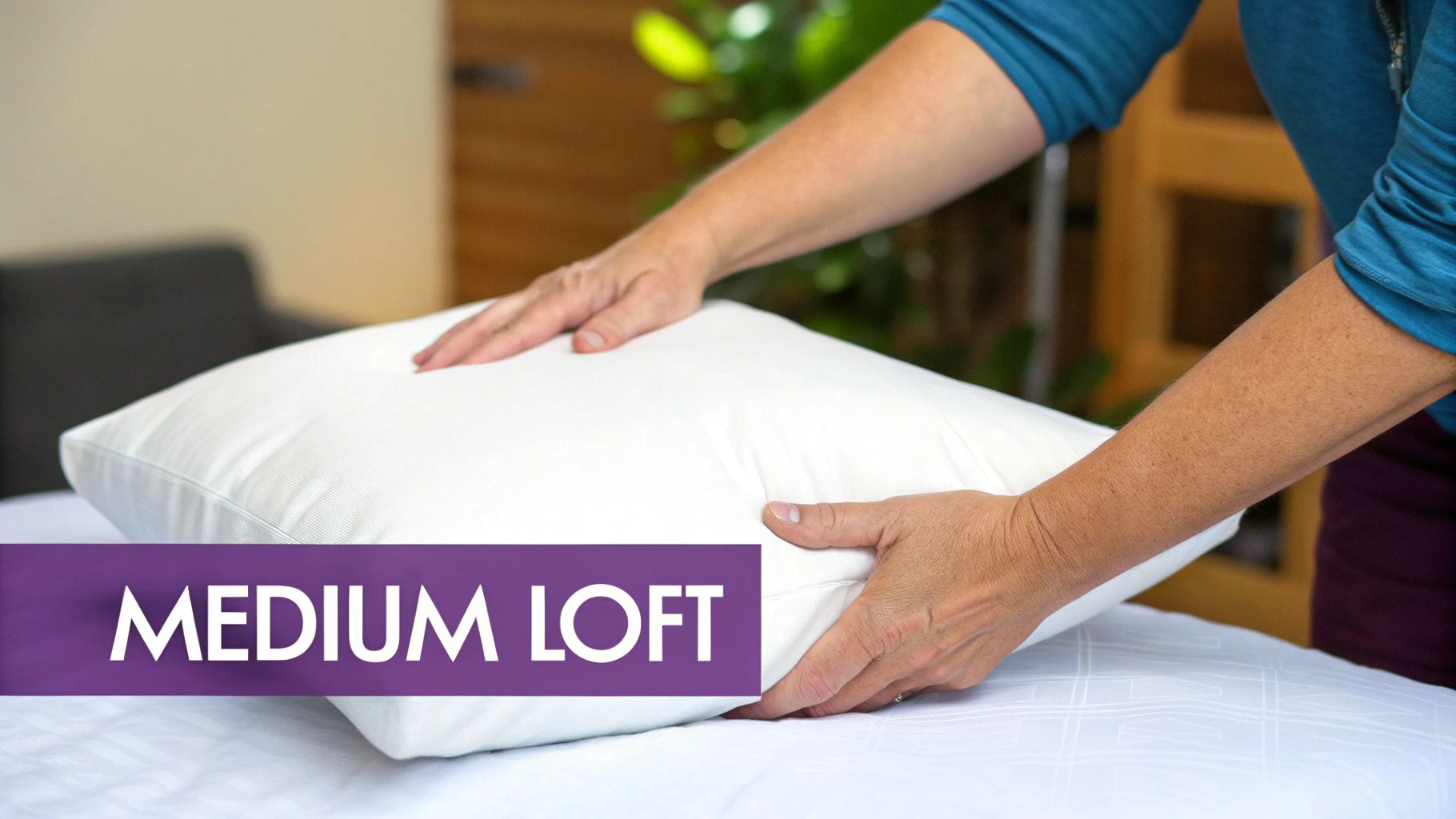
When searching for the perfect pillow, the terms loft and firmness are paramount. These concepts are simple yet crucial.
Loft refers to the pillow’s height or thickness. Firmness describes how much the pillow yields under the weight of your head. Mastering these two elements is the key to optimal sleep for back sleepers.
For most back sleepers, a medium loft pillow, typically between three to five inches high, is the recommended starting point. This height is generally sufficient to fill the space under your neck and support its natural curve.
However, individual anatomy and mattress type can influence this recommendation.
How Your Mattress Affects Pillow Choice
Your mattress and pillow function as a system to maintain a straight, neutral spine. A very soft mattress can alter the dynamics of this system.
On a soft memory foam mattress, for example, your torso sinks deeper into the bed. This reduces the distance between your head and the mattress surface. In this scenario, a standard medium-loft pillow might become too high, pushing your head forward.
On a soft mattress where your body sinks, a low-to-medium loft pillow is often a better choice to maintain neutral spinal alignment.
Conversely, a firm mattress supports your body on top of the surface, creating a larger gap beneath your neck. Here, a medium-loft pillow becomes essential to provide the necessary support and prevent your head from tilting backward.
Finding the Right Firmness Level
Equally important as loft is the pillow’s firmness. The goal is to find a balance—soft enough to be comfortable but firm enough to prevent your head from sinking through to the mattress.
This is why a medium-firm feel is consistently recommended for back sleepers.
Here’s why extreme firmness levels are less effective:
- Too Soft: A pillow that is too soft will compress completely under the weight of your head, offering no support. This allows your head to fall backward, straining the neck.
- Too Firm: A pillow that feels like a rock creates pressure points and fails to conform to the natural curve of your neck, leaving it unsupported.
A medium-firm pillow provides the ideal combination of contouring and support, adapting to your shape while maintaining proper alignment. If you are already experiencing morning aches, optimizing your pillow is a critical first step. For additional strategies, see our guide on how to sleep with neck pain.
Comparing Pillow Materials for Support and Comfort
The material inside your pillow—its fill—determines its performance characteristics, including support, temperature regulation, and durability. For back sleepers, selecting the right material is vital for maintaining consistent spinal alignment.
Consider the fill as the engine of your pillow. Each type offers a different combination of benefits and drawbacks.
Memory Foam Contouring Support
Memory foam is known for its ability to contour under pressure and heat. It molds to the unique shape of your head and neck, creating a customized cradle that distributes weight evenly. This is highly beneficial for back sleepers as it can perfectly fill the gap beneath the neck.
However, traditional memory foam can retain heat. Many modern memory foam pillows incorporate cooling technologies, such as gel infusions or perforated designs, to improve airflow and mitigate this issue.
Latex Responsive Buoyancy
Latex foam, derived from the sap of rubber trees, offers a more responsive and buoyant support compared to memory foam. It provides an uplifting feel rather than a slow sink, pushing back gently to keep your head properly elevated.
Key advantages of latex for back sleepers include:
- Instant Responsiveness: It immediately returns to its original shape when you move, ensuring consistent support.
- Cooling Properties: Its open-cell structure promotes superior airflow, making it an excellent choice for those who sleep warm.
- Durability: High-quality latex pillows are very durable and tend to retain their supportive properties longer than many other materials.
Down and Feathers Traditional Softness
Down and feather pillows provide a classic, luxurious softness. They are highly malleable, allowing you to shape them to your preference. For a back sleeper, this can be both an advantage and a disadvantage.
While you can initially bunch the fill to support your neck, it tends to compress throughout the night. This can lead to a loss of support by morning, allowing your head to sink too low and compromising your spinal alignment. These pillows also require frequent fluffing to maintain their loft.
Buckwheat Hulls Firm and Adjustable
Buckwheat hull pillows offer a unique, very firm support. They are filled with the outer casings of buckwheat seeds, which interlock to create a stable surface that does not collapse under weight.
Their primary benefit is adjustability. You can add or remove hulls to customize the loft to your exact needs, ensuring perfect alignment. Additionally, the space between the hulls allows for excellent air circulation, making them one of the coolest pillow options available.
The market shows a clear demand for pillows that solve specific ergonomic needs. For example, the U-shaped maternity pillow market is valued at USD 258 million, demonstrating that consumers are seeking specialized designs for better alignment and pressure relief. This same principle of targeted support is what back sleepers require for the neck and spine. You can discover more insights about this specialized pillow market.
The ideal material ultimately depends on your personal preferences for feel, temperature, and maintenance.
Pillow Material Comparison for Back Sleepers
This table provides a concise comparison of how different materials meet a back sleeper’s needs.
| Material | Key Benefit for Back Sleepers | Potential Drawback | Best For |
|---|---|---|---|
| Memory Foam | Precise contouring for neck support and pressure relief. | Can retain heat; may have an initial off-gassing odor. | Sleepers who need targeted support and do not overheat. |
| Latex | Responsive, buoyant support that keeps the head elevated and sleeps cool. | Can feel too bouncy for some; higher price point. | Hot sleepers and those who prefer a responsive feel. |
| Down/Feathers | Luxuriously soft and easily shaped for initial comfort. | Loses support overnight as it compresses; needs frequent fluffing. | Sleepers who prioritize softness over consistent, firm support. |
| Buckwheat Hulls | Firm, adjustable support with superior breathability. | Can be noisy when shifting; the texture is not for everyone. | Individuals who need a very firm, cool, and customizable pillow. |
Comparing these options side-by-side can help you identify which material best aligns with your primary needs, whether that is firm support, a cool sleep surface, or a plush feel.
Exploring Specialized Pillow Designs
While a standard-shaped pillow can work well, some individuals benefit from specialized designs engineered for more targeted support. If you find that traditional pillows do not fully alleviate morning stiffness or pain, these designs may offer a more effective solution.
These pillows are purpose-built to address the specific anatomical contours of the head and neck.
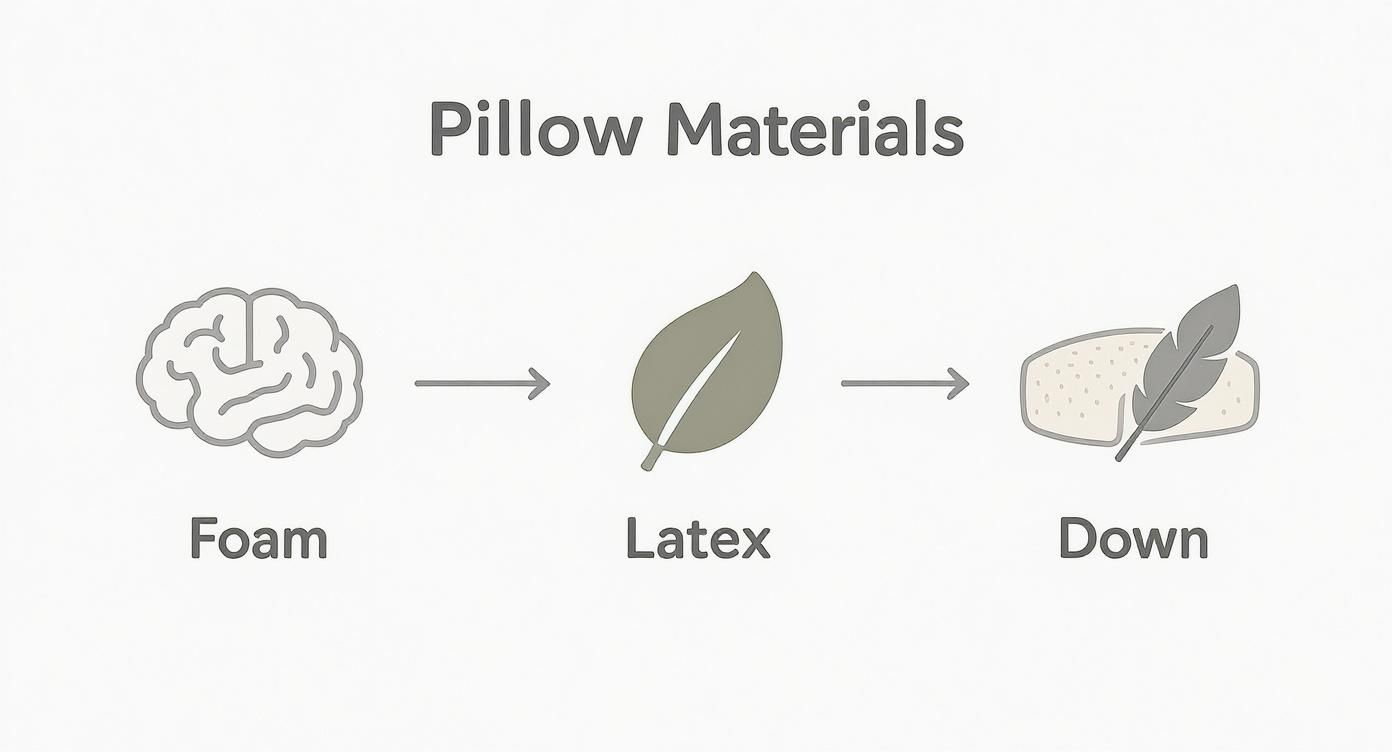
As the infographic illustrates, materials like foam, latex, and down each provide a different feel and function, which are key to the effectiveness of these specialized pillows.
Cervical and Contoured Pillows
The cervical pillow is one of the most common specialized designs, easily recognizable by its wave-like shape. This contour is highly functional: the higher curve is designed to support the natural arch of your neck, while the lower curve cradles your head.
This design provides consistent support throughout the night, preventing the neck from flattening or bending at an unnatural angle. It is an excellent option for individuals who frequently wake up with a sore or stiff neck, as it promotes proper posture during sleep. Research has shown that pillows supporting the cervical curve can significantly reduce neck pain.
Pillows with a Center Depression
Another innovative design features a shallow depression in the center of the pillow. The purpose of this crater-like feature is to cradle the head, keeping it stable and centered throughout the night. This is particularly beneficial for back sleepers who tend to roll their head from side to side.
By securing the head in a neutral position, these pillows help ensure that spinal alignment remains consistent from the neck down through the lower back. This subtle stabilization can make a significant difference in preventing muscle strain.
This design minimizes the small movements that can lead to waking up with a tweaked neck and encourages complete muscle relaxation.
The Rise of Adjustable Pillows
Adjustable pillows may be the most versatile specialized option, as they allow you to customize the pillow’s loft and firmness to your precise needs. This makes them a strong candidate for the best pillow for back sleepers who have struggled to find an off-the-shelf solution.
Adjustable pillows typically come in two forms:
- Layered Pillows: These contain multiple foam layers that can be added or removed to achieve the desired height.
- Shredded Fill Pillows: These are filled with shredded memory foam, latex, or other materials that can be removed or added to adjust both the height and density.
This level of personalization ensures you can achieve ideal alignment, regardless of your body size or mattress firmness. To further enhance your sleep environment, you may wish to learn how a body pillow can enhance your sleep.
Your Next Step Toward Pain-Free Mornings
Choosing the best pillow for back sleepers is a crucial step toward eliminating neck pain and achieving restorative sleep. By focusing on maintaining a neutral spine with a medium-loft, medium-firm pillow, you are making a significant investment in your long-term health. This simple adjustment supports your spine’s natural curve and allows your muscles to fully relax.
However, a new pillow may not be a complete solution. If you’ve upgraded your pillow and still wake up with persistent stiffness or aches, it may indicate an underlying spinal issue that a pillow alone cannot resolve.
When a Pillow Is Not Enough
It can be frustrating when a high-quality pillow does not provide the expected relief. This often occurs when the root problem is not just your sleeping position but your overall spinal alignment, which is affected by daily activities like prolonged sitting.
If you are experiencing chronic pain despite changing your pillow, it is a strong signal to address the bigger picture. Identifying and correcting the root cause of the misalignment is the key to achieving lasting relief.
While your pillow supports you at night, you can take additional steps during the day. Simple tips to relieve back and shoulder pain can provide comfort and counteract daily postural stress.
Don’t let chronic pain dictate your life. If you are ready to address the source of your discomfort with a personalized treatment plan, professional help is available.
For comprehensive care that goes beyond temporary fixes, contact Audubon Park Chiropractic. Call us today at (509) 327-4049 or walk in for a consultation. Your journey to waking up pain-free can begin now.
Ready to Feel Better?
Our Spokane chiropractors are ready to help. Walk-ins welcome — no appointment needed.

Dr. Michelle Snyder is a Spokane chiropractor with advanced training in women’s health, hormone balancing, pregnancy, and care for infants and children. She uses gentle low-force spinal adjustments alongside specialized therapies including Webster’s breech technique, allergy desensitization, cold laser therapy, EB cellular cleanse, and Methylation/genetic nutrition — offering patients a comprehensive, whole-body approach to wellness.
A Spokane resident for over 31 years, Dr. Michelle is deeply committed to her community, contributing time and resources to organizations including Meals-on-Wheels, Second Harvest, Ronald McDonald House, and the Union Gospel Mission.
📍 2909 W. Northwest Blvd, Spokane, WA 99205 | ☎ (509) 327-4049 audubonparkchiropractic.com
Further Reading: Back
- Back Pain, Sciatica, and Headaches: When Chiropractic Helps — And When It Doesn’t
- Chiropractic Without the Commitment: What No Long-Term Contracts Actually Means for Your Care
- What causes sciatic nerve pain: Symptoms and relief
- NW Spokane’s Neighborhood Chiropractor: Why Location, Parking, and Knowing Your Doctor Actually Matter
- Why Some People Are Afraid of the Chiropractor & And What We Do Differently