

This post is part of our complete guide to Back Pain Treatment in Spokane, WA. Browse the guide for more in-depth information on treatments, exercises, and recovery strategies.
It’s a feeling many people know all too well: a sudden, sharp jolt of pain in your back the moment you cough. That startling sensation is often a sign that the forceful pressure from the cough is aggravating an underlying issue in your spine or the muscles around it. A cough triggers a dramatic increase in pressure inside your abdomen and chest, which can easily strain vulnerable muscles, irritate sensitive nerves, or put stress on your spinal discs.
Unpacking the Link Between Coughing and Back Pain
When you cough, your body isn’t just making a sound—it’s performing a powerful, abrupt contraction of your abdominal and chest muscles. This isn’t just a random spasm; it’s a protective reflex. The action creates a significant spike in what’s known as intra-abdominal pressure, which is your body’s way of stabilizing the spine during the violent motion of a cough.
Think of it like an internal weightlifting belt. Your body instinctively tightens your core to keep everything rigid and safe. While this is a brilliant protective mechanism, it can also act as a sort of diagnostic test, instantly revealing any weak links in your spinal system.
How Abrupt Force Exposes Weakness
Imagine giving a water balloon a quick, hard squeeze. The pressure has to go somewhere, and it will immediately push against the weakest part of the balloon’s surface. The force from a cough radiates through your torso in a similar way, putting direct stress on your spine. If your back is healthy and supported by strong core muscles, it handles this pressure without a problem. But if there’s an underlying issue, the pain is immediate.
This sudden stress can show up in a few key areas:
- Muscles and Ligaments: A violent cough can easily overstretch the soft tissues that support your spine, leading to a classic muscle strain or ligament sprain.
- Spinal Discs: If you already have a condition like a bulging or herniated disc, the sudden pressure can cause the disc to push out even further, sometimes pressing directly on a nerve.
- Nerve Roots: The increased pressure can irritate or “pinch” the sensitive nerves as they exit your spinal column, which is what causes that sharp, often radiating, pain.
To give you a clearer picture, here’s a quick breakdown of some of the potential culprits behind that back pain when you cough.
Potential Causes of Back Pain When Coughing
| Cause | What It Is | Typical Pain Sensation |
|---|---|---|
| Muscle Strain | Overstretching or tearing of back muscles or ligaments. | A sharp, localized pain or a dull ache that worsens with movement. |
| Herniated Disc | The soft center of a spinal disc pushes through a tear in its outer layer. | Sharp, shooting pain that can travel down a leg (sciatica). |
| Spinal Stenosis | Narrowing of the spinal canal, which puts pressure on nerves. | A dull ache, cramping, or numbness in the back or legs. |
| Sciatica | Irritation or compression of the sciatic nerve. | Sharp, burning, or electric-like pain running from the lower back down one leg. |
| Vertebral Fracture | A crack or break in one of the spinal bones, often due to osteoporosis. | Sudden, severe, and localized back pain. |
This is by no means an exhaustive list, but it covers many of the common reasons we see for this specific type of pain.
Understanding this connection is the first step toward relief. The pain isn’t random; it’s a direct signal from your body that an area is being pushed beyond its limits. Sometimes this discomfort is related to issues involving both the back and chest. If you’re feeling pain in both areas, you can learn more by reading our detailed guide on the relationship between back and chest pain.
Don’t wait — relief is closer than you think.
How a Cough Puts Your Spine Under Pressure
To get why your back screams every time you cough, it helps to think of your core—your abdomen and lower back—as a pressurized canister. When you let out a cough, your abs and chest muscles contract powerfully, causing a massive, sudden spike in what’s called intra-abdominal pressure.
This isn’t a design flaw; it’s actually a smart, built-in defense mechanism. The pressure instantly makes your entire torso rigid, bracing the delicate structures in your spine against the violent jolt of the cough. The problem is, this protective squeeze is also a serious stress test. That force doesn’t just hang out in your belly; it radiates straight into your lower back, putting your vertebrae, discs, muscles, and ligaments under immediate, intense strain.
The Mechanics of Force Transfer
Here’s a simple way to look at it: a healthy spine, supported by strong core muscles, can take this jolt in stride. It’s like a car’s suspension system soaking up a pothole. The muscles fire, the spine stays stable, and the force just dissipates without a problem.
But if your back is weak, already injured, or doesn’t have that solid muscle support, it can’t handle that sudden pressure wave. Instead of being absorbed and distributed, the force zeroes in on the weakest link. This is why a cough might feel fine one day but trigger sharp, stabbing pain the next—your muscles might be tired, or an underlying issue has finally decided to make itself known.
This infographic breaks down that simple but powerful chain reaction from the cough to the pain you feel.
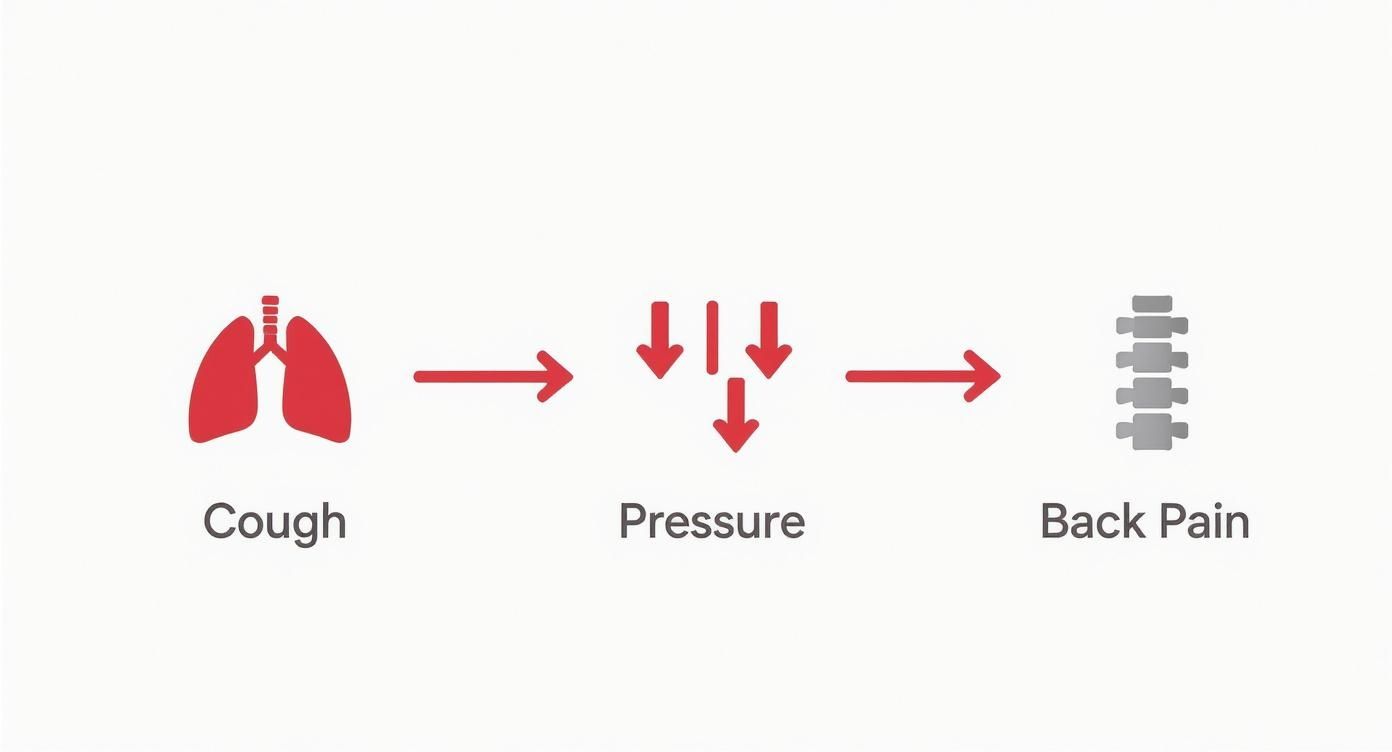
It really clarifies how a basic reflex turns into a biomechanical event that directly challenges your spine’s stability.
A Common and Widespread Issue
If this is happening to you, you are definitely not alone. Low back pain (LBP) is a massive global health problem, and something as simple as a cough is a very common trigger that exposes those underlying spinal or muscular weaknesses.
In fact, the Global Burden of Disease studies found that in 2017, around 577 million people—that’s 7.5% of the entire world’s population—were dealing with low back pain. It’s especially common in working-age adults and has been the top cause of years lived with disability worldwide since 1990. To see just how big this issue is, you can check out the full findings on the global impact of low back pain.
The key takeaway is that the pain you feel isn’t from the cough itself, but from how the force of the cough exposes an existing vulnerability in your back.
Understanding this connection is the first real step toward getting relief. Once you know why your back is reacting this way, we can start working on the root cause instead of just putting a bandage on the symptom.
Common Causes Like Muscle Strains and Sprains
More often than not, when your back hurts every time you cough, the reason is a straightforward muscle strain or ligament sprain. These are the usual suspects, and while they can be surprisingly painful, they aren’t typically a sign of something more serious.
Think of it this way: a powerful cough is like a sudden, violent jolt to your entire torso. If the muscles and ligaments supporting your spine aren’t prepared for it, that force can be too much for them to handle.
So, Is It a Strain or a Sprain?
People often use these terms interchangeably, but they actually affect different parts of your back:
- A Muscle Strain is when you overstretch or tear a muscle or the tendon connecting it to the bone. Imagine a rubber band stretched too far, too fast—that’s what happens to your muscle fibers.
- A Ligament Sprain is an injury to the tough, fibrous bands that connect your bones together. These ligaments are crucial for keeping your spinal joints stable.
At the end of the day, whether it’s a strain or a sprain, the immediate result feels pretty much the same: inflammation, stiffness, and a sharp pain that lights up with certain movements… including your next cough.
Why Some People Are More Prone to This
Certain factors can definitely make you more likely to strain your back from something as simple as a cough. Weak core muscles are a big one; they act like a natural corset for your spine, and when they’re not strong enough, the smaller muscles in your back have to pick up the slack, getting tired and vulnerable.
Poor posture is another culprit. Slouching over a desk all day puts those same back muscles under constant low-grade tension, priming them for an injury.
And, of course, a chronic cough is a major risk factor. It’s estimated that 9.6% of adults live with a chronic cough, and that repetitive, forceful stress can wear down your back muscles over time. Each cough becomes another blow, making the area weaker until even a small hack can feel agonizing. You can learn more about the global prevalence and impact of chronic cough and how it links to musculoskeletal pain.
Simple Steps for Immediate Relief
If you’re pretty sure you’re dealing with a simple strain or sprain, there are a few things you can do right away to take the edge off the pain.
A fantastic and simple trick is to brace yourself before you cough. Just place a hand firmly on your lower back or lean against a wall or countertop. This simple action provides external support and absorbs some of the shock, taking the pressure off your injured tissues.
You can also use temperature therapy to your advantage:
- Ice: For the first 48 hours, apply an ice pack (wrapped in a thin towel) for 15-20 minutes at a time. This is great for calming down inflammation and numbing the immediate, sharp pain.
- Heat: After those first two days, switching to a heating pad or a warm compress can work wonders. The warmth helps relax tight, spasming muscles and boosts blood flow to the area, which is key for healing.
When It’s More Serious: Herniated Discs and Sciatica
While a muscle strain is the most likely culprit when your back hurts when you cough, that sharp, sudden pain can sometimes be a red flag for a bigger problem, like a herniated disc. To really get what’s happening, the old jelly donut analogy is surprisingly perfect.
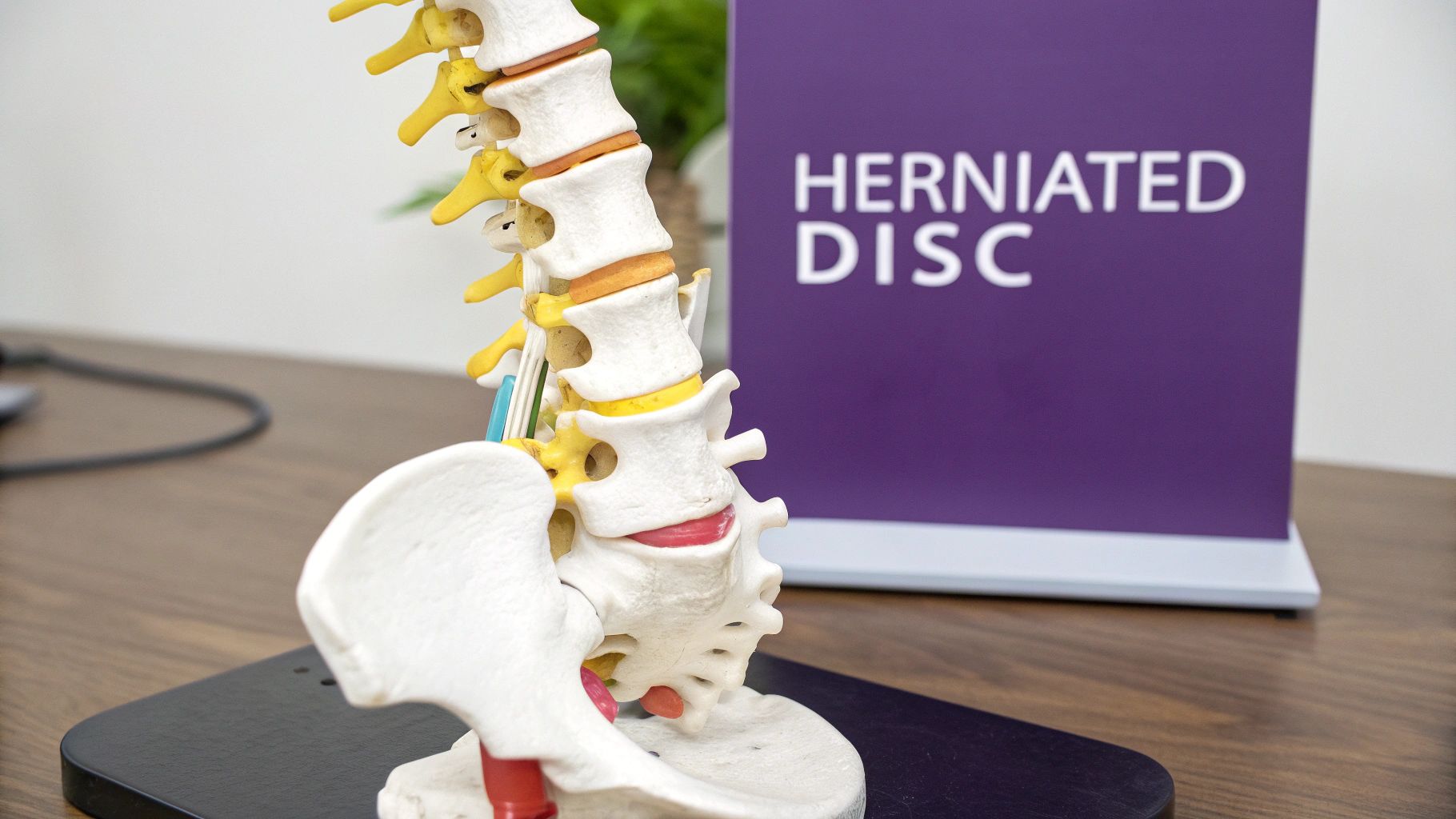
Picture your spinal disc as that donut. It has a tough, fibrous outer casing (the annulus fibrosus) and a soft, squishy, gel-like center (the nucleus pulposus). Over time, through daily life or maybe a past injury, that outer layer can get small tears and weak spots.
Then you cough. That explosive increase in internal pressure can be the last straw, forcing the jelly-like center to squeeze out through one of those weak spots. That’s a herniated disc.
From Herniated Disc to Sciatica
Now, the issue isn’t just the disc itself. The real problem is what that bulging material bumps into. Your spinal canal is prime real estate, packed with sensitive nerve roots that branch off your spinal cord. When a disc herniates, it can push right up against one of these nerves, irritating or compressing it.
If the nerve getting pinched is the sciatic nerve—the biggest nerve in your body, running all the way from your lower back down your leg—you’ve got sciatica. This is often what’s behind the most intense, unforgettable pain people experience when they cough.
The pain from nerve compression is totally different from a simple backache. It sends a very clear set of signals that this is more than just a minor muscle pull.
Learning to recognize these symptoms is the key to getting the right help, fast.
Tell-Tale Signs of Nerve Compression
If a herniated disc is pressing on a nerve root, the pain feels different. It doesn’t just stay in your back. Keep an eye out for any symptoms that seem to travel.
You might be dealing with:
- Sharp, Shooting Pain: People often describe this as an electric, burning, or stabbing sensation that zips from your low back, through your buttock, and down the back of your leg.
- Numbness or Tingling: That classic “pins and needles” feeling can pop up anywhere along the nerve’s path.
- Muscle Weakness: You might find it hard to lift your foot (a condition called foot drop) or notice a general weakness in your leg, making it feel unstable or heavy.
These symptoms are your nervous system screaming that something is wrong. Pushing through these signs can lead to worse pain and even long-term nerve issues, so it’s best not to ignore them.
Red Flag Symptoms That Require Medical Attention
Most of the time, when your back hurts from coughing, it’s just a simple muscle strain that will get better on its own. But sometimes, your body sends out serious warning signals—”red flags”—that something more is going on.
It’s incredibly important to know what these signs are. Recognizing them allows you to get the right medical help quickly and avoid potentially serious, long-term problems. Think of it as listening to your body’s built-in alarm system.
When to Seek Immediate Help
These aren’t the kind of symptoms you “wait and see” about. If you experience any of the following along with your back pain, it’s time to call a doctor or head to an urgent care clinic right away.
- Loss of Bowel or Bladder Control: This is a classic sign of severe nerve compression. It could point to a serious condition called Cauda Equina Syndrome, which is a true medical emergency.
- Numbness in the “Saddle” Area: If you notice numbness or a “pins-and-needles” feeling in your groin, inner thighs, or buttocks—basically, any area that would touch a saddle—it’s another major indicator of significant nerve pressure.
- Progressive Weakness in the Legs: Is one or both of your legs getting weaker for no reason? If it’s making it hard to stand or walk, that’s a huge red flag that something is wrong.
- Severe, Unrelenting Pain: We’re not talking about a dull ache. This is pain so intense that rest, changing positions, or over-the-counter pain relievers don’t touch it.
The impact of untreated back issues is staggering. In the United States alone, low back pain leads to around 30 million clinical visits each year. When you factor in lost productivity, the healthcare costs skyrocket past $100 billion annually. You can learn more about the profound economic effects of back pain.
The table below breaks down these critical symptoms so you can spot them easily.
Red Flag Symptoms: When to Seek Immediate Medical Help
| Symptom | Why It’s a Concern |
|---|---|
| Loss of bowel or bladder control | Points to severe spinal nerve compression, like in Cauda Equina Syndrome. |
| Numbness in the groin or “saddle” area | Indicates significant pressure on the nerves controlling the pelvis and legs. |
| Progressive weakness in one or both legs | Suggests nerve damage that is getting worse and affecting muscle function. |
| Pain that doesn’t ease with rest | Could signal a serious underlying issue like a fracture, infection, or tumor. |
| Fever, chills, or unexplained weight loss | May indicate a systemic infection or another serious medical condition. |
If you notice any of these, don’t hesitate. Getting a swift, professional evaluation is the right move.
A professional examination will always start with a detailed chat about your medical history and a thorough physical assessment. This helps get to the bottom of what’s causing your symptoms and figure out the best next steps for you.
Finding Lasting Relief for Cough-Related Back Pain
When your back hurts when you cough, the real goal isn’t just to make the pain stop for a little while. True, lasting relief comes from figuring out why it’s happening and fixing the underlying issue. It’s about restoring the natural, healthy function of your spine and all the muscles supporting it. That way, your body can handle the sudden jolt of a cough without sending pain signals.
The first step is usually looking at your spinal mechanics. We often use gentle, specific treatments to get your spinal joints moving the way they’re supposed to, especially if they’ve become stiff or slightly misaligned.
A Whole-Body Approach to Healing
Getting your spine moving correctly is a huge piece of the puzzle, but it’s not the only piece. To build a back that’s truly strong and resilient, we also have to pay attention to the muscles and ligaments that have been strained by all that coughing.
This is why effective care combines a few different techniques for the best results:
- Spinal Adjustments: These are precise, gentle movements that help restore mobility to stuck spinal joints. This takes the pressure off the surrounding nerves and tissues, which is often a major source of pain.
- Soft Tissue Therapies: Think of techniques like myofascial release. This is how we get in there and work out the deep knots and tension in those overworked back muscles, helping you feel less pain and move more freely.
- Targeted Exercises: A strong core is like your body’s built-in weight belt—it protects you from the force of a cough. We can guide you through specific exercises that build a much stronger, more stable foundation.
This kind of integrated approach doesn’t just put a band-aid on the pain you’re feeling now. It actually strengthens your body to better handle the pressure from future coughs, sneezes, and everything else life throws at you. To really speed things up, learning how to strengthen core muscles at home is a fantastic way to support your in-office care.
Our goal is to get you beyond just reacting to pain. When we improve how your spine functions and strengthen its support system, you can reduce the chances of your back hurting when you cough in the first place.

Beyond the immediate fixes, think about your sleep. Creating a supportive environment for your back while you rest is crucial for long-term comfort. It might be worth looking into finding the best mattress topper for back pain to help ease any discomfort at night.
Common Questions About Back Pain and Coughing
Why Does My Lower Back Hurt When I Cough?
Your lower back is the workhorse of your body—it supports most of your weight and takes on a ton of strain every day. When you let out a forceful cough, you’re putting a sudden, intense pressure on that entire system. This can easily overwork the muscles, but more often, it increases pressure on your spinal discs. If a disc is already bulging or weakened, that cough can be just enough to make it press on a nearby nerve, triggering that sharp, jolting pain.
Can a Cough Actually Cause a Herniated Disc?
It’s a great question. While it’s highly unlikely for a single cough to rupture a perfectly healthy disc, it can absolutely be the “final straw” for a disc that’s already compromised. Think of it like a tire with a weak spot. The sudden spike in internal pressure from a cough is often just enough to push the disc’s soft, gel-like center through a tear in its tough outer wall.
Is Upper Back Pain from Coughing a Serious Problem?
Usually, upper back pain that flares up when you cough is tied to muscle tension in your shoulders and mid-back. If you have poor posture, these muscles can become weak over time, making them prime candidates for a strain during a violent coughing fit. While this is typically less alarming than lower back issues, any persistent pain is your body’s way of telling you something is wrong, and it’s always worth getting it checked out.
It’s important to remember that while the cough triggers the pain, it’s usually exposing an existing weakness in your spine or its supporting muscles. Addressing that root cause is key to long-term relief.
Don’t let back pain from a simple cough control your life. The dedicated team at Audubon Park Chiropractic is here to uncover the root cause of your discomfort and create a personalized plan for lasting relief. We welcome you to take the first step towards feeling better. Call us today at (509) 327-4049 or simply walk in for treatment. We are ready to help.
Ready to Feel Better?
Our Spokane chiropractors are ready to help. Walk-ins welcome — no appointment needed.

Dr. Michelle Snyder is a Spokane chiropractor with advanced training in women’s health, hormone balancing, pregnancy, and care for infants and children. She uses gentle low-force spinal adjustments alongside specialized therapies including Webster’s breech technique, allergy desensitization, cold laser therapy, EB cellular cleanse, and Methylation/genetic nutrition — offering patients a comprehensive, whole-body approach to wellness.
A Spokane resident for over 31 years, Dr. Michelle is deeply committed to her community, contributing time and resources to organizations including Meals-on-Wheels, Second Harvest, Ronald McDonald House, and the Union Gospel Mission.
📍 2909 W. Northwest Blvd, Spokane, WA 99205 | ☎ (509) 327-4049 audubonparkchiropractic.com
Further Reading: Back
- Back Pain, Sciatica, and Headaches: When Chiropractic Helps — And When It Doesn’t
- Chiropractic Without the Commitment: What No Long-Term Contracts Actually Means for Your Care
- What causes sciatic nerve pain: Symptoms and relief
- NW Spokane’s Neighborhood Chiropractor: Why Location, Parking, and Knowing Your Doctor Actually Matter
- Why Some People Are Afraid of the Chiropractor & And What We Do Differently