

This post is part of our complete guide to Back Pain Treatment in Spokane, WA. Browse the guide for more in-depth information on treatments, exercises, and recovery strategies.
Experiencing pain in your back and chest simultaneously can be unsettling. It’s natural to assume the worst, but while chest pain should never be ignored, the true cause often originates from your spine, not your heart. Understanding this connection is the first step toward finding a lasting solution.
The Surprising Link Between Your Spine and Chest Pain
While the back and chest seem like separate parts of the body, they are intricately connected through your skeletal structure and nervous system. Your spine acts as a central communication hub. Nerves branch out from the spinal cord at every level, transmitting signals to all parts of your body, including the muscles, skin, and tissues of your chest wall.
A problem in the thoracic spine—the section of your spine located in your mid-back, directly behind your chest—can disrupt these nerve signals. When a spinal joint becomes misaligned, restricted, or inflamed, it can irritate the nerves that branch out from that area. This phenomenon creates what is known as “referred pain.” Your brain receives a distress signal along that nerve pathway and interprets it as originating from your chest, even though the root of the problem is in your back.
This infographic helps visualize how a mechanical issue in the spine can manifest as chest pain.
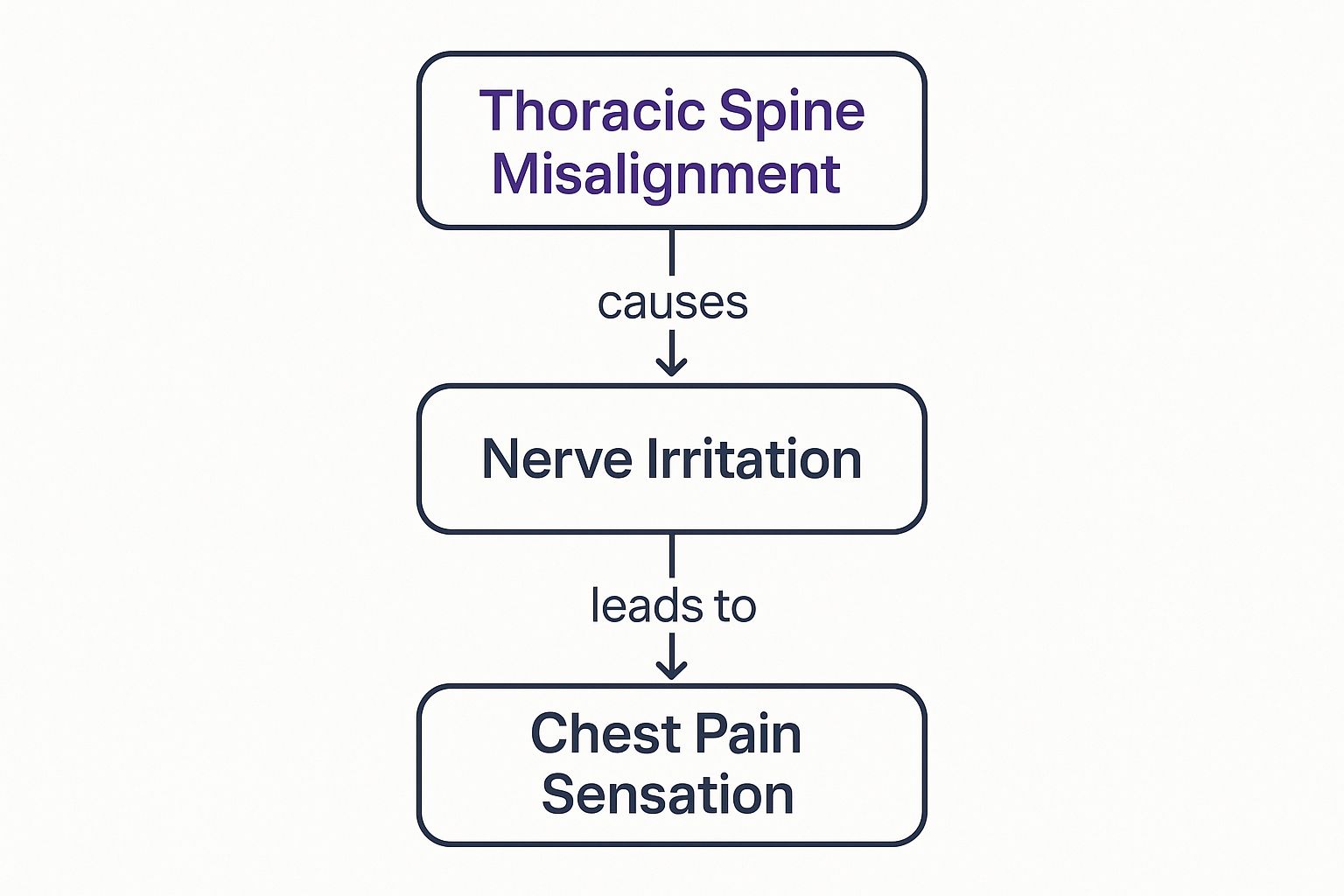
As shown, a vertebra that is out of its correct position can compress or irritate an adjacent nerve. This nerve then sends pain signals forward, which you feel in your chest area.
Why Does This Connection Matter?
Recognizing this link is crucial for effective relief. Many people endure persistent, nagging pain in their chest wall, unaware that their posture or a minor spinal issue is the underlying cause. This is particularly prevalent today, as many of us spend hours hunched over computers and mobile devices, placing continuous stress on the thoracic spine. This strain can lead to a variety of symptoms.
Common triggers for this type of combined back and chest pain include:
- Poor Posture: Slouching at a desk puts excessive pressure on your thoracic vertebrae and ribs.
- Sudden Movements: An awkward twist or improper lifting technique can easily misalign a joint.
- Repetitive Strain: Activities involving repeated upper-body motions can lead to overuse injuries.
The pain you feel is genuine, but its source can be deceptive. A problem in your back can masquerade as a chest issue, leading to unnecessary anxiety and ineffective treatment if not correctly diagnosed.
Making simple adjustments to your daily posture can significantly reduce this strain.
Once you understand that back and chest pain are often two aspects of the same issue, you can move past the worry and seek a practical solution. A proper evaluation is key to determining the precise cause and starting on the path to recovery.
Don’t wait — relief is closer than you think.
Common Musculoskeletal Causes of Chest and Back Pain

It may seem counterintuitive that a back problem could cause chest pain, but an understanding of human anatomy makes the connection clear. Several common musculoskeletal issues are known for producing sharp, stabbing, or aching sensations in the chest that can be mistaken for more severe conditions.
Understanding these frequent causes can demystify your symptoms and provide a clear direction for treatment.
One of the most common issues is costochondritis, which is inflammation of the cartilage connecting your ribs to your breastbone (sternum). This condition typically causes sharp pain that intensifies with deep breaths, coughing, or pressure on the affected area.
Thoracic Spine and Rib Misalignments
A primary source of simultaneous back and chest pain is the relationship between your thoracic spine (mid-back) and your rib cage. Each of your ribs attaches to the vertebrae in this region, forming the protective cage around your vital organs. If even a single vertebra becomes misaligned, it can directly and painfully affect the attached rib.
This misalignment can trigger a cascade of problems:
- Irritated Nerves: Nerves emerge from the spine and travel along the path between your ribs. A misaligned or “stuck” joint can easily pinch or irritate one of these intercostal nerves, sending pain signals that wrap around to the front of your chest.
- Muscle Spasms: When a joint is not functioning correctly, surrounding muscles often tighten to guard the area. This can result in deep, persistent aches in your back and a feeling of tightness or restriction in your chest.
- Restricted Breathing: If a misaligned rib causes pain with every movement, taking a full, deep breath can become uncomfortable.
Imagine a door that is slightly off its hinges. It still functions, but it creaks and puts stress on the frame with every use. A misaligned vertebra or rib joint acts similarly, stressing the entire structure and causing pain. Poor sleep support is a common contributor; if your mattress forces your spine into an unnatural position, exploring options for ultimate sleep support with hard mattress toppers could provide significant relief.
Strained Muscles and Pinched Nerves
Sometimes, the cause is a simple muscle strain. Overexertion at the gym, lifting a heavy object improperly, or a sudden, awkward movement can strain the intercostal muscles located between your ribs. The resulting pain can be surprisingly intense and is a frequent reason for concern.
Furthermore, a misaligned vertebra can lead to what is commonly called a “pinched nerve.” This occurs when a nerve root is compressed as it exits the spinal column. To learn more about this condition, you can refer to our guide on how to properly treat a pinched nerve. This compression can cause a sharp, radiating pain that travels from the back around to the chest.
Chest pain is a widespread issue, affecting approximately a quarter of the global population at some point. While it is always important to rule out serious cardiac or pulmonary conditions, a significant portion of cases seen in primary care are musculoskeletal in origin, with estimates varying from 20.6% to 46.6%.
Understanding how these structural problems can generate pain allows you to transition from a state of alarm to one of proactive problem-solving.
How Your Daily Habits Can Trigger Pain

Frequently, that persistent back and chest pain doesn’t stem from a single, major injury. Instead, it is the cumulative result of stress from our everyday routines. Many common daily activities place a subtle yet relentless strain on our thoracic spine and surrounding muscles, eventually leading to significant discomfort.
Think of your spine as a stack of blocks. When aligned correctly, the structure is remarkably strong. However, when you consistently lean it forward—as most of us do while working on a computer or looking down at a phone—you create an imbalance that puts the entire structure under strain.
The Modern Posture Problem
One of the most significant contributors to this type of pain is poor posture, sometimes referred to as “tech neck.” Spending hours a day hunched over a desk causes your head to drift forward. This posture forces the muscles in your upper back to work excessively to support your head’s weight, while the muscles across your chest become tight and shortened.
This chronic forward-slouching position creates a formula for dysfunction, often resulting in:
- Thoracic Spine Strain: The vertebrae in your mid-back are pulled out of their natural alignment, which can irritate the joints.
- Rib Cage Restriction: Tightened chest muscles can pull on your ribs, limiting their mobility and making it uncomfortable to take a deep breath.
- Nerve Irritation: Misalignment can put pressure on the nerves that exit the spine and wrap around your chest wall, causing sharp, radiating pain.
There is a clear cause-and-effect relationship. The persistent ache in your upper back and the sharp, nagging pain in your chest are often direct consequences of the posture you maintain for eight hours a day.
Beyond the Desk Job
Of course, office work is not the only culprit. Many other common activities can lead to joint and muscle strain. Consider the sudden, sharp pain that can occur after a weekend of strenuous yard work or moving furniture.
Improper lifting is a major contributor. Bending at the waist to lift a heavy object, rather than using your legs, places immense pressure on your back. Adding a twisting motion while holding that weight can easily push a rib or vertebra out of place, causing immediate back and chest pain.
Even chronic stress plays a role. When we are stressed, we unconsciously tense the muscles in our shoulders, neck, and chest, creating a cycle of stiffness and discomfort. Understanding the triggers for your pain is the first step toward finding relief.
If your pain persists, it is your body’s signal that it needs assistance to return to its natural alignment.
How Chiropractic Care Gets to the Root of the Problem
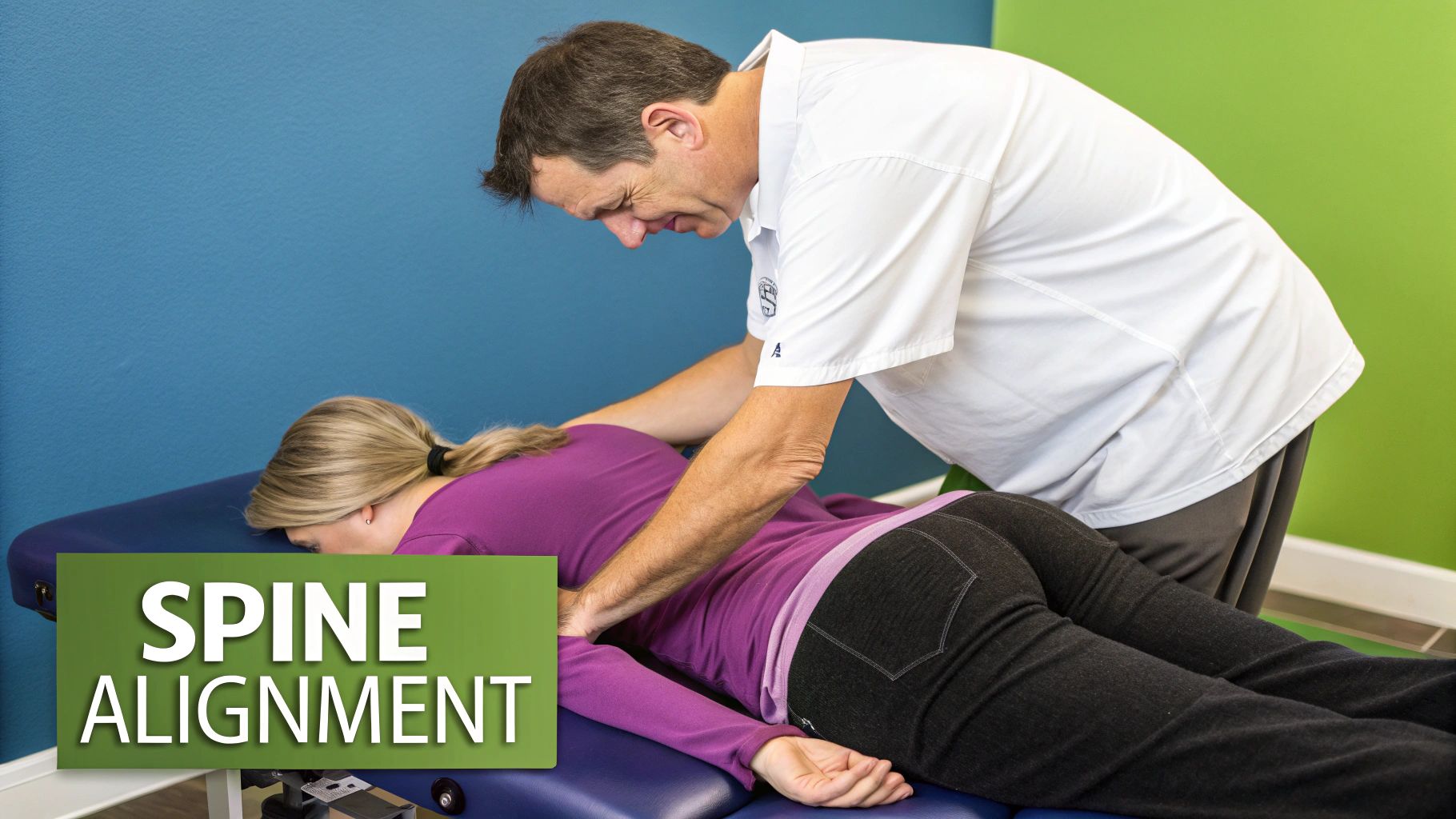
When you are dealing with persistent back and chest pain, using painkillers is like scooping water out of a boat without fixing the leak. It may offer temporary relief, but it doesn’t address the underlying issue. Chiropractic care offers a different approach by focusing on identifying and correcting the source of the problem.
The primary goal is to correct the structural issues in your spine and ribs that are generating the pain signals. This approach is not about temporary fixes; it’s about restoring your body’s natural alignment to promote proper healing and achieve lasting results.
What’s the Deal with Chiropractic Adjustments?
The core of chiropractic treatment is the spinal adjustment. This involves a precise and gentle force applied to a joint in your spine or ribs that is “stuck,” or misaligned. The purpose is to restore its proper motion, thereby relieving pressure on the surrounding nerves and muscles.
Think of it like a wheel alignment for your vehicle. If the alignment is off, the car pulls to one side, the tires wear unevenly, and the entire frame is stressed. A spinal adjustment does something similar for your body—it fine-tunes the position of your vertebrae and ribs so your entire system can function smoothly, without irritation and pain.
This process helps alleviate back and chest pain in several key ways:
- Takes Pressure Off Nerves: By correcting a misalignment, an adjustment can provide immediate relief to a compressed nerve, stopping the sharp, shooting pain that can travel from your back to your chest.
- Eases Muscle Tension: When your joints are able to move as they should, the surrounding muscles can finally relax. They no longer need to tighten up to protect the area, which eases deep, persistent aches.
- Improves Your Movement: Restoring motion to your mid-back and rib cage can make a significant difference. It can suddenly become easier and less painful to breathe deeply, twist, and bend.
A Safe and Targeted Way to Heal
Chiropractic is not a one-size-fits-all solution. Treatment begins with a thorough examination to pinpoint exactly which joints are causing the problem. This allows for the creation of a treatment plan tailored specifically to your source of pain.
This precision is why chiropractic can be so effective for this type of musculoskeletal pain—it directly addresses the mechanical problem causing the symptoms. This is a widespread issue; in 2019, nearly four in ten U.S. adults reported experiencing back pain in the previous three months, making it the most common complaint of its kind. You can read more in these back pain statistics from the National Center for Health Statistics.
By focusing on the root mechanical cause—the restricted or misaligned joint—chiropractic care aims to resolve the problem at its source. This provides a clear path to not only feeling better but also preventing the pain from returning.
If you suspect a structural issue may be the cause of your discomfort, obtaining a proper diagnosis is the most important first step.
Taking Steps to Keep the Pain from Coming Back
Eliminating your current back and chest pain is the immediate priority, but preventing its recurrence is the ultimate goal. The good news is that this doesn’t require a complete lifestyle overhaul. By making a few small, intentional changes to your daily routine, you can build a stronger, more resilient back and significantly reduce your risk of a future flare-up.
For many people, the most effective place to start is where they spend a significant portion of their day: at a desk. Creating an ergonomic workspace is one of the most powerful actions you can take to protect your thoracic spine from the constant strain of poor posture.
Setting Up Your Workspace for Success
An ergonomic workspace is designed to fit your body, rather than forcing your body to adapt to an ill-fitting environment. This simple shift can make a profound difference in preventing the muscle tension and joint irritation that lead to pain.
Here is a quick checklist to make your desk setup work for you, not against you:
- Monitor at Eye Level: Position your screen so that the top third is at or just below your eye level. This prevents you from tilting your head down, which strains your neck and upper back.
- Support Your Lower Back: A quality chair should have lumbar support to maintain the natural curve of your lower spine. If your chair lacks this, a rolled-up towel or small pillow can be an effective substitute.
- Keep Feet Flat on the Floor: Your knees should be bent at approximately a 90-degree angle, with your feet resting flat on the floor. This provides a stable base for your entire posture.
- Arms at a Right Angle: Your keyboard and mouse should be positioned so that your elbows are bent at roughly a 90-degree angle. This helps keep your shoulders relaxed and prevents them from tensing up.
How to Build a Stronger, More Flexible Spine
In addition to an ergonomic workspace, regular movement is essential. A spine that is both flexible and stable is far less likely to cause problems. Simple daily stretches can release the tightness that accumulates in your chest muscles, while targeted exercises can build the endurance your back muscles need for all-day support.
Gentle movements like the cat-cow stretch are excellent for improving spinal mobility. Exercises that involve pulling motions, such as rows, are ideal for counteracting the forward-hunching posture. For a more detailed guide, see our post on the best back strengthening exercises that you can easily perform at home.
When it comes to spinal health, consistent, gentle movement is far more beneficial than occasional, intense workouts. The objective is to build resilience over time, creating a back that can handle daily demands without strain.
Finally, never underestimate the impact of stress on your body. Chronic stress often leads to chronic muscle tension, particularly in the shoulders, neck, and chest. Simple deep-breathing exercises—such as inhaling slowly for four counts and exhaling for six—can help calm your nervous system and allow tense muscles to relax. Consistently making these small efforts is your best defense against recurring back and chest pain.
What’s Your Next Step to Lasting Relief?
As we’ve discussed, the connection between back and chest pain is frequently rooted in treatable musculoskeletal issues. Whether the cause is a misaligned spine or a simple muscle strain, the source of the pain is often mechanical. This is positive news because it means the problem can typically be resolved with the right physical care. The most critical step is to obtain an accurate diagnosis to understand what is truly happening.
Ignoring persistent pain in the hope that it will resolve on its own is rarely effective. In fact, it often allows the underlying problem to worsen. Consider low back pain, which is now the leading cause of disability worldwide, with cases increasing by 60% since 1990. A 2020 global study found that it affects approximately 619 million people, highlighting the importance of early intervention. You can read more about the global impact of low back pain in these findings.
Don’t wait for your discomfort to become a chronic condition. Taking proactive steps today is the key to preventing long-term problems and reclaiming your quality of life.
If you are tired of living with this pain, the team at Audubon Park Chiropractic is here to help. We are committed to identifying the cause of your pain and developing a personalized plan for you.
Answering Your Questions About Back and Chest Pain
We frequently receive questions about pain that occurs in both the chest and back simultaneously. It can be a confusing and concerning experience, so let’s address some of the most common questions we hear.
How Can I Tell If My Pain Is From My Back or My Heart?
This is a vital question, and while only a medical doctor can provide a definitive diagnosis, there are some characteristic signs to consider.
Pain originating from a musculoskeletal issue in your back is often sharp and localized. You might be able to pinpoint the exact spot. It also tends to worsen with specific movements like twisting, bending, or taking a deep breath. Pressing on the sore area will likely make it feel tender.
In contrast, heart-related pain is typically described differently, often as a deep, heavy pressure or a squeezing sensation. It may be accompanied by other symptoms such as shortness of breath, lightheadedness, or pain that radiates down your arm. If you have any doubt about the origin of your chest pain, treat it as a medical emergency and seek immediate help.
It is also worth noting that stress can be a significant factor. You can learn more about anxiety-related chest pain to understand how its symptoms might compare.
What Does a Chiropractic Adjustment Feel Like?
Many people are pleasantly surprised by the experience. A chiropractic adjustment for the thoracic spine (your mid-back) is a very controlled and gentle procedure.
You may hear a “pop” or “click” sound, which is completely normal. This sound is simply the release of a gas bubble from within the joint fluid, similar to cracking your knuckles. Most of our patients report feeling an immediate sense of relief and improved mobility right away.
How Many Visits Will I Need to Feel Better?
There is no single answer to this question, as every individual’s body is unique. The number of visits required depends on your specific condition.
Factors such as the severity of your pain, how long you’ve been experiencing it, and your overall health will be considered. Following your initial examination, we will develop a personalized treatment plan. Many people begin to feel a significant improvement within just a few sessions.
You don’t have to let back and chest pain dictate your life. If you are ready to get a clear diagnosis and a personalized plan for real, lasting relief, we are here to help.
Take the first step toward feeling better. Contact Audubon Park Chiropractic today by calling (509) 327-4049, or simply walk in for treatment. We are ready to help you on your path to recovery.
Ready to Feel Better?
Our Spokane chiropractors are ready to help. Walk-ins welcome — no appointment needed.

Dr. Michelle Snyder is a Spokane chiropractor with advanced training in women’s health, hormone balancing, pregnancy, and care for infants and children. She uses gentle low-force spinal adjustments alongside specialized therapies including Webster’s breech technique, allergy desensitization, cold laser therapy, EB cellular cleanse, and Methylation/genetic nutrition — offering patients a comprehensive, whole-body approach to wellness.
A Spokane resident for over 31 years, Dr. Michelle is deeply committed to her community, contributing time and resources to organizations including Meals-on-Wheels, Second Harvest, Ronald McDonald House, and the Union Gospel Mission.
📍 2909 W. Northwest Blvd, Spokane, WA 99205 | ☎ (509) 327-4049 audubonparkchiropractic.com
Further Reading: Back
- Back Pain, Sciatica, and Headaches: When Chiropractic Helps — And When It Doesn’t
- Chiropractic Without the Commitment: What No Long-Term Contracts Actually Means for Your Care
- What causes sciatic nerve pain: Symptoms and relief
- NW Spokane’s Neighborhood Chiropractor: Why Location, Parking, and Knowing Your Doctor Actually Matter
- Why Some People Are Afraid of the Chiropractor & And What We Do Differently