

This post is part of our complete guide to Auto Accident Injury Treatment in Spokane, WA. Browse the guide for more in-depth information on treatments, exercises, and recovery strategies.
The moments following a car accident can be disorienting and stressful. Amid the confusion, the actions you take can significantly influence your health outcomes and any subsequent insurance claims.
The single most important step for your auto accident injury treatment is to receive a professional medical evaluation immediately—even if you feel perfectly fine. Adrenaline is a powerful chemical that floods your system during a crash, and it is incredibly effective at masking pain from serious conditions like whiplash or internal injuries that might not manifest for hours or even days.
So here’s your guide to auto accident injury treatment and how we at Audubon Park Chiropractic can help.
Your Guide to Auto Accident Injury Treatment
Let’s look at things in order.
Don’t wait — relief is closer than you think.
Critical First Steps After a Car Accident
The minutes following a crash often feel chaotic, but taking a few key actions can protect your well-being and simplify interactions with insurance companies. It’s challenging to think clearly when your mind is racing, but a methodical approach ensures you don’t overlook anything vital.
Your first priority is always safety. Check on yourself and any passengers. If possible, move your vehicle out of the flow of traffic to prevent another collision. Once everyone is safe, begin documenting the scene. This isn’t just about paperwork; it’s about creating a clear, factual record of what occurred.
Document Everything at the Scene
Once it’s safe, start gathering information. This documentation forms the foundation for your medical care and insurance claim.
- Exchange Information: Get the other driver’s full name, phone number, insurance company, and policy number. Also, note the make, model, and license plate of their car.
- Take Detailed Photos: Your smartphone is an invaluable tool. Capture images of everything—the damage to both vehicles from multiple angles, the license plates, the wider accident scene, any skid marks on the road, and nearby traffic signs.
- Speak to Witnesses: If anyone stopped to help or saw the accident, politely ask for their name and phone number. An impartial account can be incredibly valuable.
This infographic outlines the crucial steps to take immediately after an accident, highlighting why documentation and a prompt medical check-up are so important.
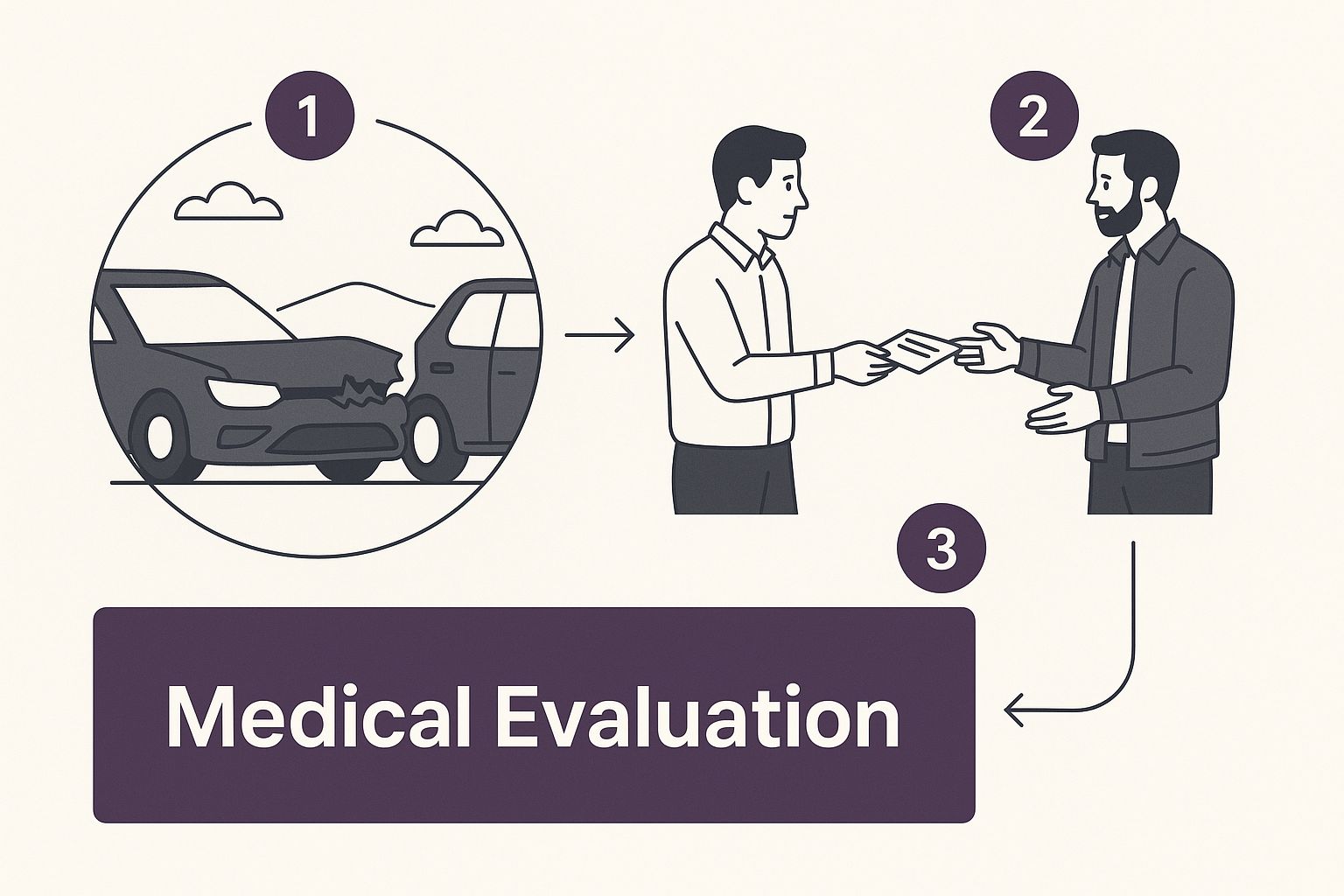
As the graphic illustrates, getting checked out by a professional is not something to delay. It is a core component of your immediate response and is directly linked to a successful recovery.
For a quick reference, here’s a checklist of what to do right away. Keeping a screenshot of this on your phone can be a helpful reminder.
Post-Accident Immediate Action Checklist
| Action Item | Why It’s Important | Pro Tip |
|---|---|---|
| Ensure Safety First | Prevents further accidents and injuries. Your health is the top priority. | Turn on your hazard lights immediately. If it’s dark, use your phone’s flashlight. |
| Call 911 | An official police report provides a neutral, third-party record of the incident. | Request a copy of the police report number before you leave the scene. |
| Take Photos | Visual evidence is difficult to dispute and helps convey the full story. | Take more photos than you think you need, including wide shots and close-ups. |
| Exchange Information | Essential for filing an insurance claim and for follow-up communication. | Use your phone to take a picture of the other driver’s license and insurance card. |
| Get Witness Info | Independent accounts strengthen your claim and provide a clearer picture of events. | Witnesses may not wait for the police, so ask for their contact information quickly. |
| Seek Medical Care | Identifies hidden injuries before they worsen and formally links them to the accident. | Tell the doctor about every symptom you’re experiencing, no matter how minor it seems. |
Following these steps provides a solid foundation for both your physical recovery and any necessary claims. It’s about protecting yourself from the very beginning.
The Non-Negotiable Police Report
No matter how minor the accident seems, always call the police. An official report is an objective record that insurance adjusters rely on to determine fault. Without one, you risk a “he said, she said” scenario, which can seriously complicate your ability to get the coverage you need for your auto accident injury treatment.
According to the World Health Organization, road traffic injuries are a leading cause of death and disability worldwide. These statistics underscore the real risks involved and why protecting yourself after a collision is so important.
A common mistake is assuming that feeling “okay” at the scene means you are uninjured. The post-accident adrenaline rush is a powerful analgesic that can easily hide significant soft tissue damage, spinal misalignments, or even a concussion.
Ultimately, being methodical in those first few hours can make all the difference. For an even more detailed walkthrough, you can consult this guide on what to do after a car accident injury.
Dealing with Insurance and Documenting Your Injury
After an accident, the last thing you want to deal with is a mountain of paperwork and confusing calls with insurance companies. It can feel overwhelming. However, with a strategic approach, you can protect yourself and ensure you receive the care you need for your auto accident injury treatment.
The moment you report the accident, a timeline begins. Everything you say and do from that point forward can impact your claim.
That First Call: What to Say and What Not to Say
When you first call your insurance company to open a claim, be concise. Stick to the essential facts: your name, the date and location of the crash, and the other driver’s information. That’s it.
Resist the natural instinct to say “I’m fine.” It’s a common polite reflex, but those two words can be used against you if pain develops later. A much safer and more accurate response is, “I am going to get checked out by a doctor to be sure.” This statement is honest and protects your future rights. Your only goal on this initial call is to get a claim number and start the process.
Talking to the Insurance Adjuster
Insurance adjusters have a specific job: to resolve claims while minimizing the cost to their company. While most are professional, it’s important to remember they do not represent your interests.
Here are a few helpful tips:
- Keep it factual. Answer their questions directly, but do not offer extra details or speculate about the crash.
- Decline a recorded statement. You are generally not required to provide one immediately, especially without seeking legal advice. You can politely decline.
- Write everything down. After every call, create a log. Note the date, time, the name of the person you spoke with, and a summary of the conversation. This record can be invaluable later.
If you encounter difficulties and the insurance company denies your claim or becomes uncooperative, understanding how to dispute an insurance claim effectively is your next critical step.
The Power of Meticulous Documentation
Your single greatest tool in this process is detailed documentation. This goes beyond medical bills. It’s about creating a complete narrative of how the accident has affected your life. This is the evidence that builds a strong claim.
The more thorough your records, the less room there is for an insurance company to contest your claim. Start a physical folder or a digital file immediately and put everything related to the accident in it.
An adjuster can question your memory of how you felt three weeks ago. It is much more difficult for them to dispute a dated journal entry describing the shooting pain you experienced while trying to lift a grocery bag.
This paper trail becomes undeniable proof of what you’ve gone through and what it has cost you—in time, money, and well-being.
Your Most Important Tool: The Pain and Symptom Journal
A daily journal is one of the most powerful actions you can take for your case. It creates a running log of your physical and emotional state, making it incredibly difficult for an insurer to claim your injuries are not serious.
Make an entry every day. It doesn’t have to be long, but it should include:
- Pain Scale: Rate your pain from 1 to 10 in different areas (e.g., neck, lower back).
- Symptom Details: Describe the sensation. Is it a sharp pain? A dull ache? Are you dizzy? Stiff?
- Daily Impact: What were you unable to do today because of the pain? Perhaps you couldn’t play with your children, complete a work project, or sleep through the night. Note it down.
This journal serves two purposes: it directly links your ongoing symptoms to the accident and provides your healthcare providers with a detailed map to guide your treatment.
The financial impact of a car accident can be significant. Road traffic crashes cost most countries around 3% of their entire gross domestic product (GDP). This is why maintaining your own detailed financial and medical records is so crucial for your recovery. You can learn more about the staggering global road traffic injury statistics and their economic consequences.
Recognizing Common Car Accident Injuries

A car crash subjects the body to immense forces, often in ways that are not immediately apparent. The sudden jolt from an impact can disrupt the musculoskeletal system, leading to a variety of injuries. Many people walk away from a collision feeling only shaken, to find that the real symptoms emerge hours, days, or even weeks later.
This delay is a common physiological response. Your system is flooded with adrenaline, a natural painkiller that masks the initial damage. Once that rush subsides, you might start to notice stiffness, a persistent ache, or sharp pains that were not there before. Identifying these signs early is key to receiving effective auto accident injury treatment before a minor issue develops into a chronic problem.
What Really Happens to Your Body in a Crash
To understand why certain injuries are so common, it’s helpful to consider the physics of a collision. When your car is struck, your body continues to move at the speed you were traveling until something—a seatbelt, an airbag, the steering wheel—abruptly stops it. This rapid acceleration and deceleration is what causes the damage.
Consider your head and neck during a rear-end collision. Your torso is pushed forward, but for a split second, your head remains stationary before being violently snapped forward and then backward. This is the classic mechanism for whiplash, one of the most frequent and misunderstood injuries seen in clinical practice.
Never judge the potential for injury by the amount of damage to your car. The forces in a low-speed collision, even at just 5-10 mph, are sufficient to cause significant soft tissue damage and misalignments in the spine.
This jarring motion can also shift vertebrae out of alignment, pinch sensitive nerves, and strain muscles throughout your back and shoulders.
The Hidden Injuries You Can’t See
While cuts, bruises, and broken bones are obvious, the most common injuries from a car accident are often invisible. These soft tissue and spinal issues can linger for years if not properly diagnosed and treated.
Based on clinical observation, these are some of the most common problems people face after a crash:
- Whiplash and Neck Strain: This involves damage to the muscles, ligaments, and tendons in your neck. Telltale signs include stiffness, headaches originating at the base of the skull, dizziness, and pain radiating into the shoulders and arms. If this sounds familiar, learning about neck pain after an accident is a logical next step.
- Herniated or Bulging Discs: The force of an impact can damage the soft, gel-like discs that cushion your vertebrae. When a disc herniates, it can press on spinal nerves, causing sharp, shooting pain known as sciatica, along with numbness or weakness in the arms or legs.
- Lower Back Pain: The lumbar spine is particularly vulnerable in a collision. Strains and sprains in the lower back muscles are very common, leading to aching, stiffness, and difficulty with movement.
- Concussions (Mild Traumatic Brain Injury): You do not have to hit your head to sustain a concussion. The same forceful snapping motion that causes whiplash can cause the brain to collide with the inside of the skull. Be vigilant for headaches, confusion, sensitivity to light, and difficulty concentrating.
Why “Waiting It Out” Is a Bad Idea
Ignoring seemingly minor aches and pains after an accident is a significant risk. What begins as simple muscle stiffness could be a sign of an underlying spinal misalignment. If left untreated, your body may try to compensate for the injury, which can lead to improper healing, chronic pain, and long-term joint problems.
For example, a slight misalignment in your neck from whiplash can trigger persistent headaches. Using pain relievers only masks the symptom without addressing the root cause. Over time, this can lead to more severe neck issues and a permanent loss of motion.
A professional evaluation is the only way to pinpoint the true source of your pain. A thorough examination can uncover hidden damage to your spine and soft tissues, allowing for the creation of a treatment plan that addresses the actual injury. This proactive approach is what separates a full recovery from a lifetime of nagging discomfort.
The Role of Chiropractic Care in Accident Recovery
When you are in a car crash, your body is subjected to forces it was never designed to handle. You might walk away feeling sore, but there is a high probability that the impact has knocked your musculoskeletal system out of alignment. This is precisely where chiropractic care becomes a cornerstone of recovery.
Instead of only managing symptoms with medication, a chiropractor works to identify and address the root cause of your discomfort. A hands-on approach is used to restore proper function to your spine and joints—which is exactly what is needed after the violent jolt of a collision.
The First Visit: A Deep Dive Into Your Injuries
Your first appointment after an accident is focused on investigation. The goal is to determine exactly how the crash affected your body.
This initial evaluation is a comprehensive effort to map out your injuries and typically involves several key steps:
- Detailed History: We will discuss the specifics of the accident. What was the direction of the impact? Where were you seated? What symptoms are you experiencing, and where? Every detail helps build a complete picture.
- A Hands-On Physical Exam: We will check your range of motion, test your reflexes and muscle strength, and assess your nerve function. We also use palpation—a trained sense of touch—to feel for spinal misalignments, muscle tension, and inflammation.
- Diagnostic Imaging: In some cases, X-rays may be recommended. This allows us to clearly see your spinal alignment and, just as importantly, rule out more serious issues like fractures.
This thorough process enables us to identify specific spinal misalignments, known as subluxations, that may be irritating nerves and causing your pain.
Restoring Proper Alignment
Once a diagnosis is established, the treatment can begin. The primary method used is the spinal adjustment. This is not about forceful cracking; it is a series of precise, gentle, and controlled movements applied to specific joints in the spine that are “stuck” or out of place.
The goal of an adjustment is simple but highly effective:
- Restore Joint Mobility: A crash can cause spinal joints to lock up, leading to stiffness and pain. Adjustments help restore their natural, fluid motion.
- Relieve Nerve Pressure: A misaligned vertebra can compress or irritate the sensitive nerves exiting the spinal cord. This can cause anything from localized pain to radiating symptoms like sciatica. An adjustment can take that pressure off.
- Reduce Inflammation: By restoring proper joint mechanics, adjustments help the body reduce localized inflammation, which is a major source of post-accident pain.
Chiropractic adjustments are highly skilled and gentle procedures, carefully tailored to your body and your specific injury. The focus is always on precision and patient comfort.
A Whole-Body Approach to Healing
A comprehensive recovery plan rarely relies on a single modality. Chiropractic adjustments are often supported by other therapies designed to work in tandem and accelerate the healing process. This integrated approach ensures we are addressing not just the joints, but also the muscles and soft tissues that support them.
These complementary therapies are a critical part of a complete auto accident injury treatment plan.
- Therapeutic Massage: This is distinct from a relaxation massage. The focus is on releasing deep muscle tension and breaking up scar tissue that often forms after a soft tissue injury like whiplash.
- Rehabilitative Exercises: As you begin to feel better, you will be guided through specific stretches and strengthening exercises. The goal is to build stability, strengthen the muscles that support your spine, and increase your resilience to future injuries.
This combination ensures we are correcting the underlying structural problem with adjustments while also healing the surrounding muscles and tissues. It is a complete strategy designed to help you return to your normal activities, not just temporarily mask the symptoms.
Going Beyond Adjustments: Therapies That Speed Up Healing
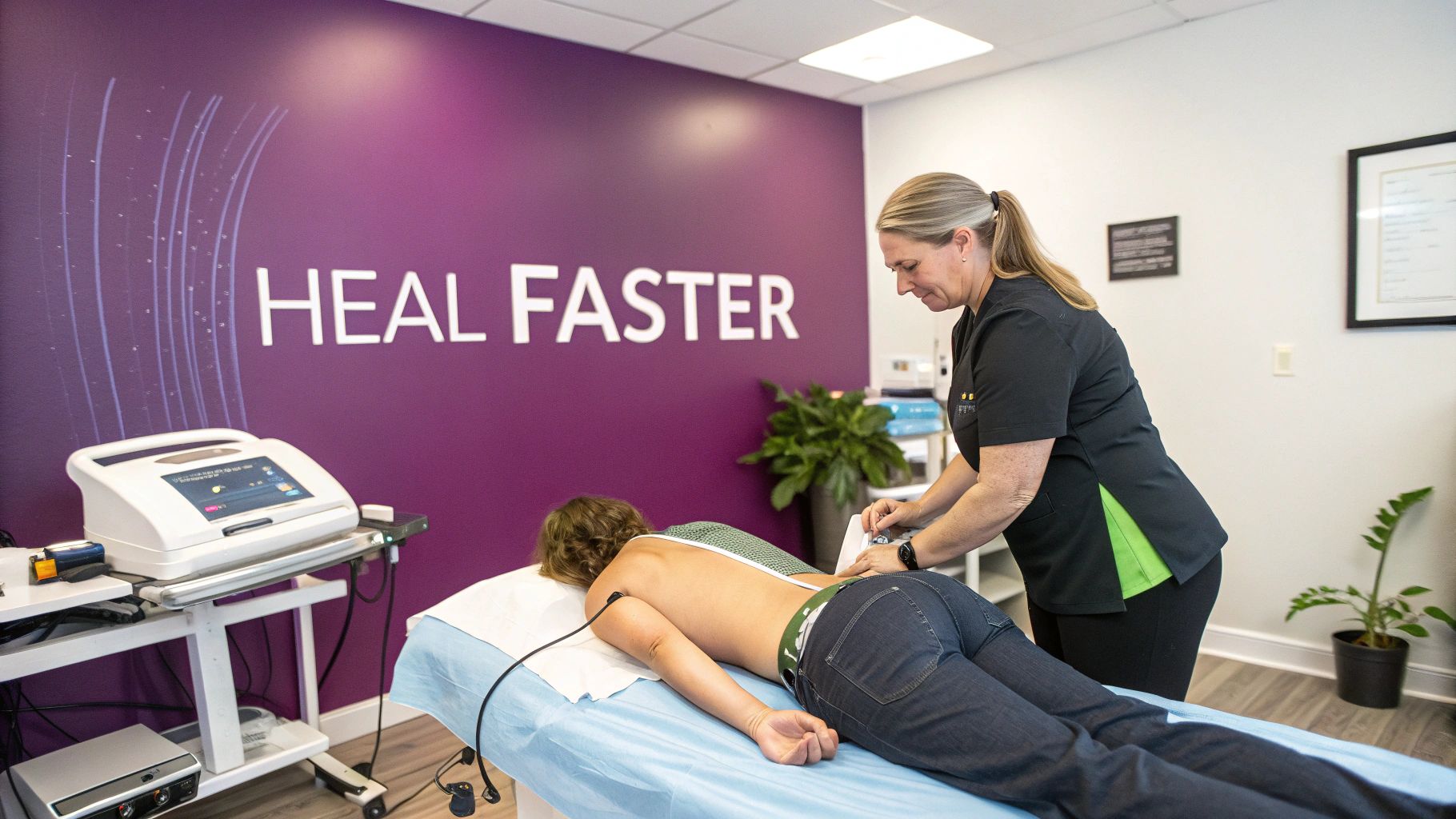
While chiropractic adjustments are foundational for correcting structural issues after a car crash, a truly comprehensive recovery plan goes deeper. Adjustments are often paired with supportive therapies designed to enhance your body’s natural healing processes.
Think of it as a combined approach. The adjustment corrects the alignment, and these therapies help the surrounding soft tissues—your muscles, ligaments, and tendons—heal more efficiently. By addressing pain and inflammation from multiple angles, we can help you get back to feeling like yourself faster.
Putting Cold Laser Therapy to Work
One of the effective tools available is Cold Laser Therapy, also known as Low-Level Laser Therapy (LLLT). This is a non-invasive, painless technology that uses specific wavelengths of light to penetrate deep into injured tissues without generating heat.
How does it work? It provides your cells with a direct energy boost. The light is absorbed by the mitochondria—the powerhouses inside your cells—which prompts them to produce more adenosine triphosphate (ATP). ATP is the essential fuel your cells need for repair and regeneration.
This boost at the cellular level translates into tangible benefits for your recovery:
- Reduces Inflammation: The therapy helps decrease the inflammatory signals that cause swelling and pain after an injury.
- Accelerates Tissue Repair: By energizing your cells, it can speed up the rebuilding of damaged muscles and ligaments.
- Alleviates Pain: It can help block pain signals from reaching the brain and encourage the release of endorphins, your body’s natural pain relievers.
Cold Laser Therapy is an excellent complement to chiropractic care, as it helps heal the soft tissues while the focus is on realigning your spine. If you are curious about the science, you can learn more about the benefits of cold laser therapy.
Fueling Your Recovery From the Inside Out
The treatment you receive in a clinic is only part of the equation. Your body works around the clock to repair itself, and the nutrients you provide it through your diet play a massive role in how well it can perform that job.
You cannot build a sturdy house with poor materials; the same logic applies to your body. It cannot effectively rebuild torn muscle fibers or strained ligaments without the right nutritional building blocks.
The powerful link between diet and pain levels is often underestimated. Chronic inflammation is a significant source of post-accident discomfort, and it is heavily influenced by the food you eat. Adopting an anti-inflammatory diet can be a game-changer for your healing.
By making a few smart nutritional choices, you can make a significant difference in your recovery timeline.
Key Nutritional Strategies to Help You Heal
- Fight Inflammation with Food: Fill your plate with foods rich in omega-3 fatty acids, like salmon and walnuts. Include plenty of colorful fruits and vegetables, which are packed with antioxidants that help calm your body’s inflammatory response.
- Prioritize Protein: Protein provides the essential amino acids needed for tissue repair. Ensure you are getting enough lean protein from sources like chicken, fish, beans, and lentils to give your body the raw materials it needs.
- Hydrate, Hydrate, Hydrate: Water is crucial for everything, from transporting nutrients to injured cells to flushing out waste products. Even mild dehydration can make muscles feel stiffer and slow your recovery.
For another way to manage discomfort at home, some people find relief by using a sauna for sore muscles and accelerated recovery, which can complement professional care.
Your recovery is a partnership between you and your healthcare team. When we combine advanced therapies in the office with smart supportive care at home, you can heal faster, more completely, and get back to your life.
Common Questions We Hear After a Car Accident
When you’re dealing with the aftermath of a car wreck, it’s normal to have many questions. Getting clear, straightforward answers is the first step toward making informed decisions for your health and securing the right auto accident injury treatment. Let’s address some of the most frequent concerns.
What If I Don’t Feel Hurt? Should I Still See a Doctor?
Yes, absolutely. The rush of adrenaline following a crash is a powerful analgesic. It can easily mask serious issues like whiplash, micro-tears in muscles, or subtle spinal misalignments for hours or even days.
Seeking a professional evaluation right away can identify these problems before they become chronic. It’s a crucial step for your long-term health.
Waiting to feel pain before seeking care is one of the biggest gambles you can take with your recovery. An early, accurate diagnosis is fundamental—it’s what can prevent a minor sprain from becoming a lifelong problem.
Will My Car Insurance Pay for Chiropractic Care?
In many cases, yes. Most auto insurance policies include Personal Injury Protection (PIP) coverage. This part of your policy is designed specifically to cover necessary medical expenses after a collision, regardless of who was at fault.
Chiropractic care is widely recognized as an essential treatment for the types of musculoskeletal injuries common in car accidents, so it is typically covered. Our office staff works with these claims daily and can help you understand your policy’s coverage.
How Long Until I Feel Normal Again?
There is no single answer to this question; every recovery journey is unique. Several factors will influence your timeline:
- The severity of the impact and your specific injuries.
- Your overall health and physical condition before the accident.
- Your adherence to the recommended treatment plan.
Some patients experience significant improvement within a few weeks. For others with more complex injuries, it might take a couple of months of consistent care. After your initial, in-depth assessment, we can provide you with a clearer expectation for your recovery.
After an accident, your health is the top priority. Don’t let questions or uncertainty prevent you from getting the help you need. The team at Audubon Park Chiropractic is ready to provide a complete evaluation and build a treatment plan to get you on the right path to healing.
It’s time to take control of your recovery. Contact Audubon Park Chiropractic today at (509) 327-4049 to schedule your appointment, or feel free to walk in for treatment. We are here to help you get back to your life.
Ready to Feel Better?
Our Spokane chiropractors are ready to help. Walk-ins welcome — no appointment needed.

Dr. Michelle Snyder is a Spokane chiropractor with advanced training in women’s health, hormone balancing, pregnancy, and care for infants and children. She uses gentle low-force spinal adjustments alongside specialized therapies including Webster’s breech technique, allergy desensitization, cold laser therapy, EB cellular cleanse, and Methylation/genetic nutrition — offering patients a comprehensive, whole-body approach to wellness.
A Spokane resident for over 31 years, Dr. Michelle is deeply committed to her community, contributing time and resources to organizations including Meals-on-Wheels, Second Harvest, Ronald McDonald House, and the Union Gospel Mission.
📍 2909 W. Northwest Blvd, Spokane, WA 99205 | ☎ (509) 327-4049 audubonparkchiropractic.com
Further Reading: Accidents
- How to Treat Whiplash at Home: A Practical Guide
- Understanding Whiplash: A Comprehensive Guide to Symptoms and Treatment
- Why You Need a Chiropractor After a Car Accident
- What to Do After a Car Accident Injury: A Step-by-Step Guide
- Neck Pain After an Accident: A Guide to Causes, Symptoms, and Effective Relief
→ Complete Guide: Auto Accident Injury Treatment in Spokane, WA